


What Does an AI Agent Actually Do?
Key Takeaway Tell an AI system, “Find five suppliers, compare price and delivery terms, check them against our procurement
Key Takeaway
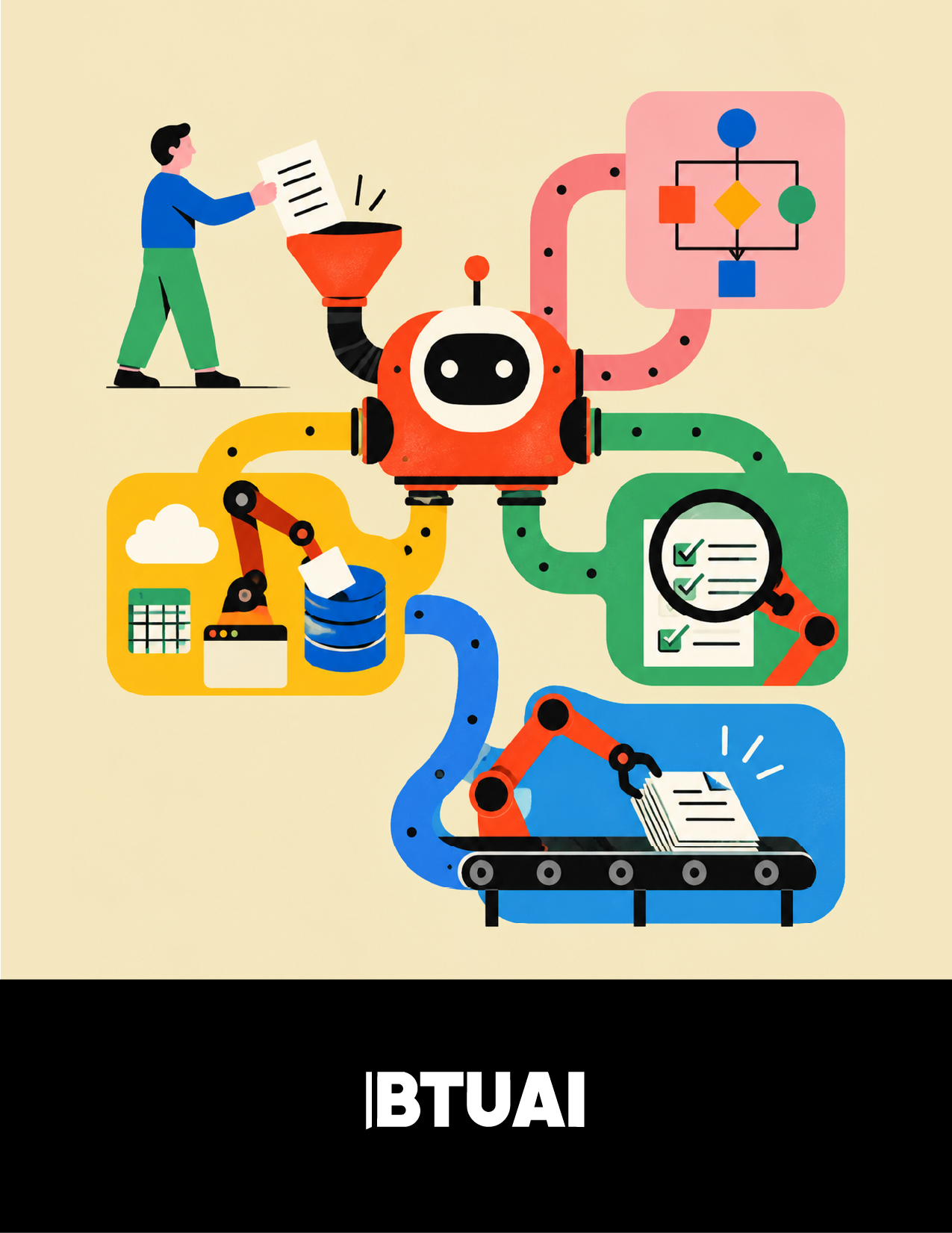
Tell an AI system, “Find five suppliers, compare price and delivery terms, check them against our procurement rules, and prepare the three best options,” and the difference between an answer and an agent becomes visible. A conventional response may explain what to do. An agent has to turn the goal into work: understand the objective, retrieve the relevant company rules, decide what information is missing, use search and business tools, compare outcomes, check constraints, prepare an action and return to a person when authority or confidence runs out.
The most useful way to understand an AI agent is therefore not as a list of features. Its defining unit is a work loop. It receives a goal, gathers context, plans, uses tools, acts, observes what happened, verifies progress and decides what should happen next. If the task is not complete, the loop continues. If risk, uncertainty or an authority boundary appears, the agent should pause, escalate or hand the work back.
This is the difference between AI that produces an output and AI that participates in a process.
The First Job Is to Interpret the Goal
Human instructions are rarely complete specifications. A manager says, “Find out why sales are slowing.” A customer says, “Choose the best option.” A finance leader says, “Check where costs are increasing.” The first task of an agent is to convert an ambiguous request into an operational objective: what outcome is required, what constraints apply, which information is needed and what counts as completion.
This is also where authority begins. An instruction to find the best supplier is not automatically permission to sign a contract or send money. A well-designed agent distinguishes the goal from its mandate. It knows what it may analyze, what it may prepare, what it may execute and what requires human approval.
The Agent Decomposes Work Into Steps
Real work is rarely a single model call. Supplier selection involves clarifying requirements, identifying candidates, gathering evidence, comparing price and terms, checking risk and preparing a decision. Research requires breaking a question into subquestions, finding sources, resolving contradictions and validating conclusions. Coding requires inspecting files, making changes, running tests and trying again when the first attempt fails.
Some tasks follow a predefined path. Others cannot. The agent may need to choose the next step after seeing what happened in the previous one. That adaptive sequencing is central to modern agent systems: tools produce environmental feedback, and the agent uses that feedback to decide what to do next.
Agents Retrieve Knowledge as They Work
A professional agent should not rely only on what the underlying model already knows. In an organization, it may need internal policy, live prices, CRM records, contracts, project status, inventory, previous decisions, sector data or current public information. One of the agent’s most important activities is retrieving the right context at the right moment.
This matters particularly in long tasks. Instead of loading everything at once, the agent can progressively fetch the documents, records or data needed for the next decision. Context becomes a managed working resource rather than a static prompt. The quality of the organization’s knowledge base therefore becomes part of agent performance. Outdated rules or unverified claims can be scaled just as efficiently as accurate knowledge.
Tools Turn Advice Into Action
A model can explain what should happen. Tools let an agent do something. A tool can search the web, read files, run code, query a CRM, inspect a calendar, retrieve data, create a document, update a task or interact with another business system.
This is why two agents powered by similarly capable models can behave very differently. One may only read information. Another may have controlled access to operational systems. The first recommends that a customer record should be updated. The second retrieves the relevant case, prepares the update and, if its mandate allows, performs a low-risk change itself.
Agent quality therefore depends on more than model intelligence. It also depends on tool design, data quality, access boundaries and the clarity of the interface between the agent and its environment.
Action Is Not the Same as Unlimited Autonomy
The most visible property of an agent is its ability to act. Responsible agent design, however, is based on bounded action. Classifying an email, retrieving public information or creating a report from an approved template can be low risk. Changing contractual terms, transferring significant funds, making consequential employment decisions or publishing a sensitive statement on behalf of a company is different.
Technical capability is not organizational authority. High-impact actions may require prior human approval, stronger verification, financial limits, a second reviewer or a complete prohibition on autonomous execution. A good agent therefore needs rules not only for when to act, but also for when not to act.
Knowing when to stop is a capability. An agent that tries to complete every task at any cost is less trustworthy than one that can recognize insufficient evidence, conflicting instructions, an exceeded mandate or a high-risk exception and explicitly return the issue to a person.
The Agent Needs to Observe the Result
Sending an action is not the same as completing a task. After changing code, tests should run. After updating a system, the resulting state should be checked. After research, key sources and contradictions should be reviewed. After delegating work to another agent, the expected result has to return.
This produces a feedback loop: action → environmental response → evaluation → next step. Anthropic’s engineering guidance describes agents in essentially this form: models using tools in a loop, obtaining ground truth from the environment and adapting based on intermediate results. Current OpenAI agent infrastructure similarly emphasizes long-running sessions, tool use, controlled environments and coordination across subagents.
BTU’s research framework adds a management question: did the final state satisfy the original objective? An agent can technically execute every intermediate step correctly and still fail to create the intended business result. Completion should therefore be evaluated against the goal, not merely against a checklist of actions.
Failure Recovery Is Part of the Job
Complex work rarely succeeds perfectly on the first attempt. Search can return weak evidence. A tool can fail. A file can have an unexpected format. Two sources can conflict. Access can disappear temporarily. A useful agent can detect the problem, change strategy and try again.
But recovery also needs limits. Repeating the same action indefinitely is not resilience. Production systems need retry limits, failure thresholds and escalation rules. When uncertainty remains material or repeated attempts increase risk, the correct next step may be human intervention rather than another autonomous iteration.
Sometimes the Agent Orchestrates Other Agents
A complex assignment may benefit from specialization. A research agent can delegate market analysis, competitor analysis and regulatory scanning. A manager agent can combine finance, sales and operations assessments. A customer-support agent can hand a technical case to a specialist agent.
Modern agent platforms increasingly support handoffs, delegation and subagent coordination directly. Yet multi-agent design is not automatically superior. Additional agents are justified when parallel work or specialization improves the result enough to outweigh the coordination cost.
Illustrative Case: What a Procurement Agent Actually Does
Consider a mid-sized Georgian company that repeatedly buys the same category of material. A manager gives the agent a goal: “Check next month’s requirement, identify shortage risk, compare approved suppliers and prepare a purchase option.”
The agent first retrieves inventory and demand or production forecasts. It then checks the approved-supplier list, recent prices, delivery times and minimum-order terms. If information is stale, it can prepare requests for updated quotations. It compares options not only on price but on delivery risk, budget and company rules. If the preferred option uses an approved supplier, fits the expected price range and remains within a low financial threshold, the agent may prepare a purchase request. If the supplier is new, the price is unusual or the amount exceeds its mandate, it stops and presents the manager with the reason, evidence and alternatives.
The agent is neither merely “searching for information” nor independently “buying.” It is managing a controlled path from objective to decision-ready action. That is what agents do.
What Professional Agents Do Across Functions
The same loop appears in different domains. A marketing agent can collect customer signals, prepare campaign options, monitor outcomes and propose changes. A sales agent can qualify leads, inspect CRM context, draft outreach and escalate high-value opportunities. A project agent can monitor dependencies, deadlines and risks and alert the right owner when a threshold is crossed. A research agent can decompose a question, retrieve evidence, reconcile conflicting sources and synthesize a conclusion. A finance agent can collect data, identify variance, model scenarios and return consequential decisions to an accountable manager.
The common capability is not a single professional skill. It is the ability to connect several steps and move work from one state to another under explicit rules.
What an Agent Should Not Become
It is tempting to call agents “digital employees.” The metaphor can be useful for explaining persistent roles, but it becomes misleading when responsibility is involved. An agent can perform parts of a role without possessing human moral accountability, professional status or unlimited legitimate authority to bind an organization.
For high-impact work, a person or authorized organizational unit should remain responsible for goals, mandates, consequential exceptions and final accountability. “The AI decided” cannot become a substitute for governance.
BTU Researchers’ Assessment
According to BTU researchers, the most useful answer to “What does an AI agent do?” is a description of its operating logic rather than a feature list. An AI agent builds a **governed loop from a goal to a verified outcome**. It interprets the task, retrieves context, plans, selects tools, acts, observes the environment, verifies progress and decides whether to continue, change course, delegate, escalate or finish.
From this perspective, agent quality should not be measured only by the quality of generated text or by the number of actions performed autonomously. More important questions are whether the agent pursued the correct objective, used current and authoritative knowledge, stayed within its mandate, observed the real result, recognized failure and knew when to stop.
BTU’s framework also separates action, decision authority and accountability. An agent may execute an action while decision rights remain partially or fully human. In consequential processes, final accountability should remain organizationally visible at the human or authorized institutional level. Without this separation, agent efficiency can turn into accountability ambiguity.
Key Findings
- The core unit of agentic work is a loop from goal to verified outcome, not a one-time answer.
- Agents interpret objectives and constraints, then decompose work into the necessary steps.
- Professional agents retrieve external and organizational knowledge rather than relying only on model memory.
- Tools allow agents to move from advice to real work in connected systems.
- Action should be bounded by mandates, risk levels and explicit limits.
- Agentic work requires environmental feedback, verification and adaptation.
- Recovery from failure is valuable, but repeated failure needs stopping and escalation rules.
- Multi-agent systems are useful when specialization or parallelism creates measurable value.
- A capable agent also knows when not to act.
- Consequential decisions require clear human or institutional accountability.
Why This Matters for Georgia
For Georgia, the practical value of agents is particularly relevant to small and medium-sized organizations that often operate with compact teams across several functions. A well-designed professional agent can connect multiple steps in research, sales, finance, project coordination, customer support or procurement. The result is not merely time savings; it can expand the functional capacity of a small team.
The prerequisite is not simply buying better AI. Georgian organizations need governed knowledge, explicit process rules, current data, defined approval boundaries and accountable owners. An agent cannot reliably resolve ambiguity that the organization itself has never resolved. The strongest local opportunity is therefore the combination of global AI capability with Georgian language and sector knowledge, professional agent design and clear human responsibility.
Conclusion
An AI agent moves work forward. It turns goals into steps, connects knowledge to tools, connects action to feedback and connects results to verification. On difficult tasks it changes strategy, delegates, recovers from failure and stops when it reaches the boundary of its mandate or evidence.
The best agent is therefore not the one that performs the most actions. It is the one that performs the right actions, in the right context, under the right authority, and verifies what actually happened. The agentic transition begins when AI is no longer only something we ask, but something we can entrust with bounded work – provided that goals, knowledge, tools, controls and human accountability are designed together.
Data and Main Sources
- BTU research and analytical work on AI Agentic Management, Agentic Operating Systems, Human-Agent Workflows, Agent Mandates, Agent Evaluation, Auditability and Human Oversight.
- OpenAI – A Practical Guide to Building AI Agents.
- OpenAI – Introducing the Agents API, September 10, 2026.
- Anthropic – Building Effective AI Agents.
- Anthropic – Demystifying Evals for AI Agents, 2026.
- NIST – AI Agent Standards Initiative and work on software/AI-agent identity and authorization, 2026.
This material is analytical and educational in nature. It does not constitute specific technology, legal, financial, investment or organization-specific professional advice.
Prepared by the academic team of Business and Technology University and the BTUAI Research Team, Tbilisi, Georgia.