
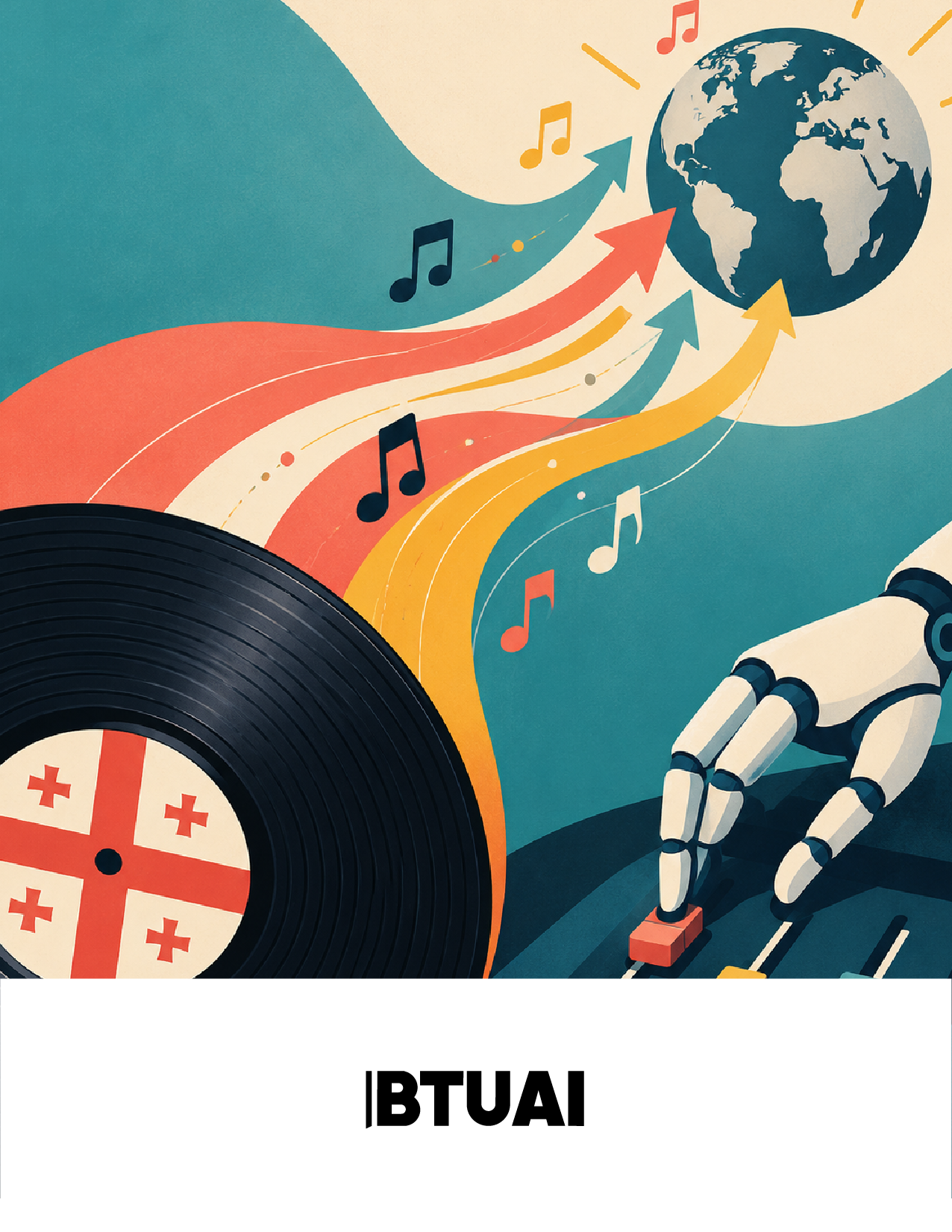
Georgia’s opportunity is not to manufacture endless low-cost songs. It is to combine rare musical heritage, contemporary creativity and rights-cleared data into products the world can license and buy.
The main point
Generative AI can already turn a short prompt into a complete-sounding track: lyrics, melody, vocals and arrangement. That lowers the cost of making music, while sharply increasing competition and raising difficult questions about training data, voice ownership and who receives the income. For Georgia, the relevant question is not whether a Georgian creator can generate a song. It is whether the country can build exportable musical assets, services and governance that create recurring international revenue.
The answer is conditionally yes. Georgia is unlikely to win by becoming a factory for disposable AI tracks. It can, however, become a small, distinctive and trusted music-technology ecosystem. Georgian polyphony, regional performance traditions, the sound of the language and a strong contemporary scene are genuine advantages only when the underlying audio is professionally recorded, richly described, legally licensed and discoverable by global buyers.
| AI-music exports begin not with a generate button, but with rights, data, trust and distribution. |
A market expanding faster than its rules
Bloomberg Businessweek’s profile of Suno captures the turning point. A consumer can request a song in ordinary language and improve the result with detailed directions about genre, lyrics and vocals. The company imagines music creation becoming as accessible as smartphone photography. The same report also documents the industry conflict over model training, imitation of artists and the risk that an unlimited supply of synthetic tracks will erode the value of human work.
The economic opportunity is real, but it is not automatically shared with creators. A CISAC and PMP Strategy study projects that the annual value of generative-AI music outputs could reach about €16 billion in 2028. Under current conditions, it estimates that 24% of music creators’ revenues could be at risk. These are scenarios, not certainties, yet they identify the central policy problem: growth in machine-generated output can coexist with declining human income.
Georgia’s scarce asset
Georgian polyphonic singing, inscribed on UNESCO’s Representative List of the Intangible Cultural Heritage of Humanity, is not one uniform sound. UNESCO describes distinct systems, including complex Svan polyphony, eastern dialogue over a bass background and western three-part forms with partial improvisation. That depth is commercially relevant precisely because it is difficult to reproduce faithfully.
AI cannot create authentic scarcity from material it has never received. It can recombine patterns, but timbre, dialect, modal knowledge, live improvisation and community context come from people and institutions. Georgia’s exportable capital is therefore not only a collection of songs. It includes clean recordings, separated vocal stems, lyrics, pronunciation, provenance, performance context and unambiguous usage rights.
What Georgia could actually export
Uploading large volumes of auto-generated tracks to streaming services is the weakest strategy. Supply is effectively unlimited, discovery becomes harder and platform safeguards against manipulation are tightening. Higher-value business-to-business niches are more credible: rights-cleared catalogues for film, games and advertising; licensed Georgian vocal and polyphonic datasets; custom AI-assisted scoring completed by human professionals; multilingual localization of Georgian catalogues; and software modules for pronunciation, source separation, harmony analysis and regional-style recognition.
In these models, the buyer is not purchasing “a song made by AI.” The buyer is purchasing reliable access to a scarce musical resource and a professional service. Potential customers include game studios, film producers, advertising agencies, music-technology firms, universities and streaming platforms.
Rights are part of the product
The costliest component of an AI-music project may be legal uncertainty. If a buyer cannot establish who owns the recording, whether a performer consented to voice modelling or whether the output is commercially usable, the asset is unsafe. A licence, provenance record and usage restrictions should travel with each file as naturally as its title and author.
International regulation is moving toward greater transparency and copyright accountability. The EU framework for general-purpose AI addresses transparency and copyright-related obligations, while music-industry organizations emphasize consent, transparency and remuneration. For Georgia, this is not merely a compliance burden. A small market can turn trust into an export advantage by building a catalogue with machine-readable permissions from the outset.
Traditional does not mean free
A traditional song may have no identifiable individual author, but a specific recording, arrangement, performance and voice can still carry separate rights. There is also an ethical question beyond copyright: who may train a commercial system on a community’s musical inheritance, and who should benefit? Responsible infrastructure must distinguish among composition, recording, performance, voice likeness and archival rights.
It must also preserve regional difference. A system that collapses Svan, Gurian and Kakhetian material into a generic “Georgian style” may spread a label while destroying knowledge. Export policy should reward documentation and diversity rather than averaging them away.
BTU’s role: build the layer others can use
According to BTU researchers, Georgia’s most credible path is not to build another universal music generator. It is to establish trusted Georgian music infrastructure on which creators, startups and international partners can build products.
BTU could convene universities, archives, ensembles, artists, rightsholders and technology companies around a consent-based Georgian music knowledge bank. Its contents could include professional multitrack recordings, vocal stems, lyrics and translations, phonetic annotation, genre, region, performance context, authorship and machine-readable licences. Contributors should be able to set permissions, withdraw future uses where contracts allow and receive an auditable share of revenue.
A second layer is evaluation. A system should not be described as understanding Georgian music merely because it pronounces Georgian words. Benchmarks are needed for natural pronunciation, musical accuracy across vocal parts, regional-style recognition, correct source attribution and avoidance of unauthorized voice imitation. This also connects to BTU’s broader work on teaching Georgian to AI: text, phonetics and singing are parts of one language-and-sound challenge.
A third layer is commercialization. A creator lab could pair musicians with engineers to produce export pilots. A rights registry and standard licensing templates could reduce transaction costs. The objective should be a first customer-a sync licence, a game soundtrack, a tourism campaign, a dataset agreement or a specialized software component-rather than a platform in search of demand.
A practical sequence
Georgia should begin with an inventory of catalogues, ownership, digitization and quality gaps. It should then create a small but fully rights-cleared pilot, perhaps combining multitrack performances from several regions with complete metadata. Finally, it should test two or three concrete international use cases before investing in a broad platform.
Success should not be measured by the number of songs generated. Better indicators are the size of the licensed catalogue, international contracts, repeat use of assets, export revenue, the share paid to creators and communities, model quality in Georgian, and the speed of response to rights incidents.
The realistic answer
Georgia can become an exporter of AI music if it refuses to treat its cultural difference as cheap training material. Technology will make production inexpensive everywhere. Advantage will move to those with trusted rights, cultural depth, professional curation and global sales capacity.
The most valuable Georgian product may not be a hit single. It may be a licensed sound library, a Georgian pronunciation layer, a polyphony-analysis tool, a curated sync catalogue or a marketplace connecting creators with global buyers. If Georgia builds that infrastructure now, AI can do more than consume Georgian music: it can generate income for its makers and introduce the culture to the world under its own name.
Prepared by the academic team of Business and Technology University and the BTUAI Research Team, Tbilisi, Georgia.