
Key Takeaway
People are feeding AI assistants data about sleep, heart rate, exercise, diet, mood and workplace stress in exchange for personalised guidance. Georgia is fertile ground for this trend: in 2025, 52.1% of recent internet users searched online for health-related information. Yet more data does not automatically produce a better health decision. The key question is whether users can distinguish a wellness tool from a medical system, control secondary data use and recognise when personalised language creates false confidence.
Personalisation Begins With Combining Data
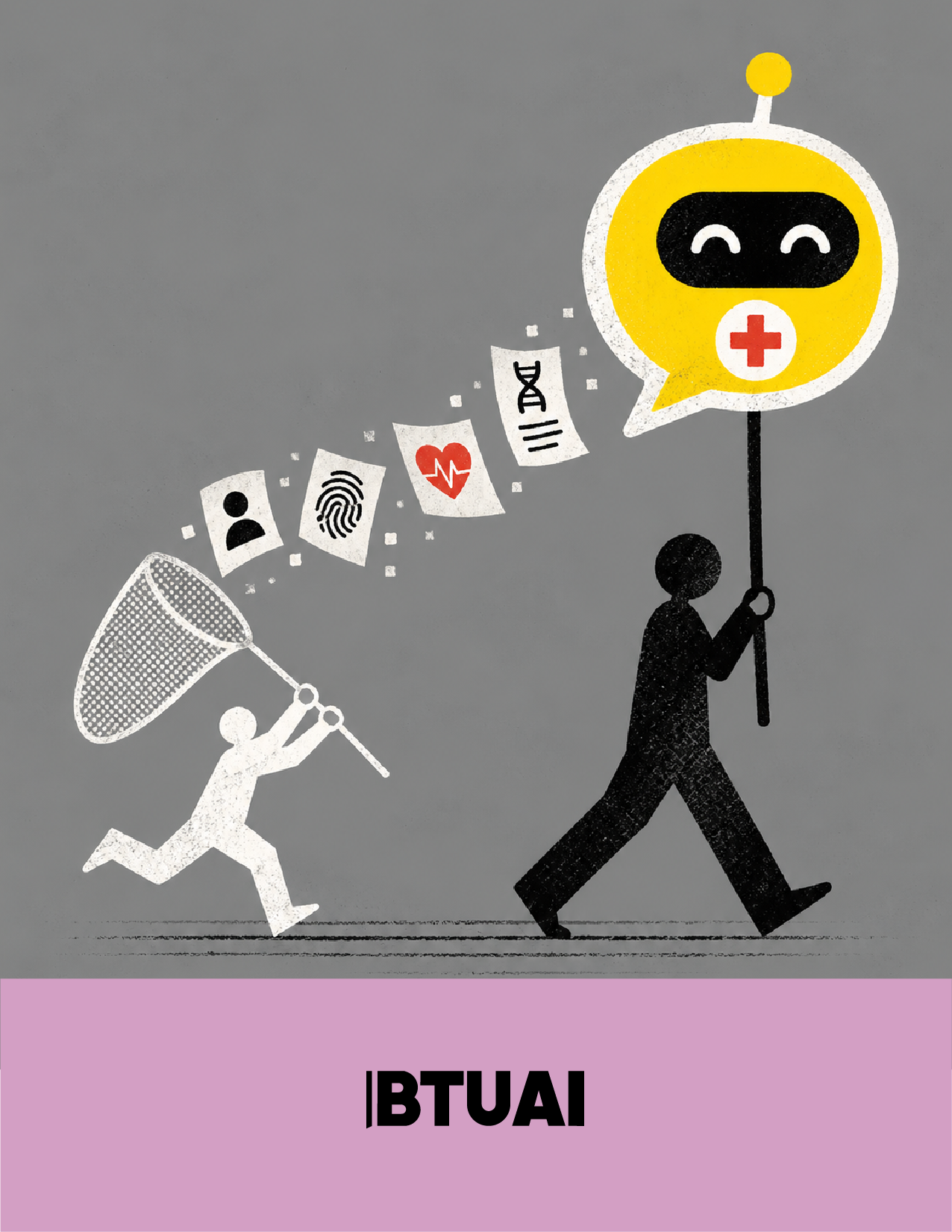
The Wall Street Journal described users linking wearable, calendar and lifestyle data to chatbots to create personal coaches. The benefit is intuitive. A watch may show poor sleep, a calendar a demanding day, and an exercise app weaker performance. Combined analysis can reveal a recurring relationship and help a person ask better questions.
Combination also creates the main privacy risk. A single measurement may be harmless, but sleep, location, heart rate, meetings and mood can jointly reveal a detailed profile of health, emotional state and working life.
Georgia already has substantial digital demand. Geostat found that 52.1% of people aged 15 and older who had recently used the internet searched for health-related information in 2025. This does not mean they shared biometric data with AI. It shows that the internet has become a normal place to seek health answers. Generative AI turns that habit from search results into a dialogue trained on the user’s own context.
Three Products That Can Look the Same
A wellness assistant summarises sleep, food and exercise. A decision-support tool organises symptoms and prepares questions for a clinician. A medical product moves closer to risk assessment, diagnosis or treatment. These functions carry different responsibilities even when they share the same conversational interface.
Friendly tone and personal detail create authority. But accuracy depends on sensor quality, model limitations and whether the system knows the user’s full medical history. A smartwatch signal, a self-reported feeling and a laboratory result are not equivalent evidence.
This distinction matters in Georgia because an online answer may substitute for timely professional care, particularly where geography, time or cost limit access. WHO’s 2025 account of Georgia’s telemedicine development stresses legal frameworks, clinical guidance, funding and monitoring. A consumer-assembled chatbot may sit outside those protections.
Consent Is More Than Clicking a Button
Georgia’s personal-data law classifies health, biometric and genetic information as special-category data and covers automated processing. In practice, users often copy data into an international platform and accept long, generic terms.
Formal consent does not answer the questions that matter most. Is the conversation stored? Is it used to improve a service or train a model? Can third parties gain access? What happens after account deletion? Can health data be linked to another profile? The most useful choice is not simply accept or reject; it is deciding which data are necessary for a defined purpose.
Data minimisation does not reject personalisation. Analysing sleep may require sleep time and workload, but not a full work inbox, precise location history or relatives’ information. More sources can create richer context, yet they also increase the consequences of leakage, misinterpretation and secondary use.
A Useful Link and a Dangerous Conclusion
Imagine a worker in Tbilisi who shares sleep and heart-rate data, meeting schedules and daily mood notes. The system notices that meeting-heavy days precede poor sleep and suggests testing a lighter evening routine. That is a useful hypothesis.
If the same system claims that several readings indicate a high risk of a specific illness, the situation changes. Sensor error, caffeine, infection, medication or an incomplete history may be missing. The first response is a behavioural experiment; the second carries medical meaning. Users need to know where that boundary lies.
Workplace use adds another risk. A wellness application may support employees, but if it reports stress or health profiles to an employer, voluntariness becomes doubtful. Productivity technology can quietly become surveillance technology.
How Trust Is Built
A trustworthy health AI first names its role: summariser, educational assistant or clinically validated product. Second, it shows provenance-what comes from a wearable, from self-report and from general knowledge. Third, it reveals uncertainty when data are incomplete or contradictory.
Fourth, users need control over individual data sources, deletion and export. Fifth, high-risk symptoms require escalation. The system should help organise information for a professional rather than perform as a doctor.
These are business-model choices, not only compliance tasks. More data may improve short-term personalisation, but one serious failure can destroy trust. The cost of error is higher for health information than for an ordinary recommendation.
Why Not All Personalisation Has Equal Value
Personalisation quality is not measured by the number of fields collected. A smaller, carefully selected dataset may support a better decision than a large and noisy profile. Mood labels can change meaning from one day to another. Wearable time series can break when a device is removed or replaced. Volume cannot compensate for inconsistency.
This has a specific Georgian dimension. A Georgian-speaking user may describe a symptom or emotional state through a local expression that an international model interprets poorly. Medicine brand names may also differ from those common in the model’s main training environment. Language quality is therefore not only a convenience in health contexts; it is part of safety. Ambiguous terminology requires clarification rather than a confident inference.
Data portability matters too. When several years of health history are trapped in one application, personalisation becomes dependency. Users need to move an understandable record to another service or a clinician. The record represents a person’s health history, not merely fuel for a platform’s product.
Finally, responsibility can disappear across the chain. A device maker may be responsible for the sensor, an app for calculations, an AI platform for interpretation, and a user for self-reported input. A trustworthy product identifies these roles before an error occurs and makes clear where each responsibility ends.
For the same reason, engagement time is a poor standalone measure of health-AI quality. Frequent use may indicate value, but it can also reflect anxious and repetitive checking. More meaningful outcomes include whether the user understood the information, reduced uncertainty, retained control over the record and reached qualified care when escalation was appropriate. A system that keeps a worried person chatting is not necessarily serving that person well.
Independent evaluation is therefore essential. Product claims should separate user satisfaction from demonstrated health outcomes, and testing should include people with different ages, digital skills, languages and access conditions. A model that performs well for an experienced urban wearable user may fail for someone entering incomplete measurements through a shared device or a slow connection.
BTU Researchers’ Assessment
According to BTU researchers, the competitive advantage of health AI will not be the number of answers it can generate, but its ability to manage the boundaries of data and advice. The most trustworthy system is not the one that “knows everything” about a user. It is the one that explains why each data source is needed, makes uncertainty visible and distinguishes wellness guidance from medical decision-making.
Georgia’s opportunity is to use existing interest in digital health safely. If personalisation becomes synonymous with maximum data collection, consumers gain convenience at the cost of control. Value is created when AI helps a person ask a better question, organise a reliable record and seek timely professional care-not when it imitates medical authority using incomplete data.
Key Findings
- In 2025, 52.1% of Georgia’s recent internet users searched for health information online, indicating strong demand for digital health answers.
- Combining health data can reveal useful patterns but also creates a more sensitive personal profile.
- Wellness assistants, decision-support tools and medical products require different safeguards even when their interfaces look alike.
- Georgian law treats health, biometric and genetic information as special-category data.
- Data minimisation tests whether each source is genuinely needed; it does not eliminate personalisation.
- Workplace health-data use raises surveillance and constrained-consent risks.
- Long-term trust depends on role clarity, provenance, uncertainty, user control and timely escalation to professionals.
Why This Matters for Georgia
Digital health can reduce some access barriers, especially outside major cities. But a personal chatbot is not the same as organised, governed telemedicine. Confusing the two can delay diagnosis, increase anxiety or expose sensitive information. Georgia benefits from innovation when people can see the product’s actual role and retain meaningful control over their data.
Conclusion
AI can turn fragmented health data into an understandable story. That is valuable. Personalised language, however, does not improve the quality of evidence, and a friendly chatbot does not automatically become a medical instrument.
The stronger path is purposeful sharing: only the data needed for a defined task, a clear boundary between advice and diagnosis, and control that remains with the person. Health AI will ultimately be judged not only by how often it answers correctly, but by how accurately it knows when it should not answer as a doctor.
Data and Main Sources
- The Wall Street Journal, “The Datamaxxers Feeding Their Every Health Move to AI”, 12 August 2026, user-supplied print edition.
- Geostat, ICT Usage in Households 2025: https://www.geostat.ge/media/72941/Indicators-of-Using-Information-and-Communication-Technologies-%28ICT%29-in-Households.pdf
- Law of Georgia on Personal Data Protection: https://www.matsne.gov.ge/en/document/view/5827307?publication=1
- WHO, Turning telemedicine into a core health-care service in Georgia: https://www.who.int/georgia/news/item/01-10-2025-turning-telemedicine-into-a-core-health-care-service-in-georgia
This material is analytical and educational. It does not constitute medical advice, diagnosis or treatment instructions. Consult an appropriate professional regarding a specific concern.
Prepared by the academic team of Business and Technology University and the BTUAI Research Team, Tbilisi, Georgia.