
Introduction
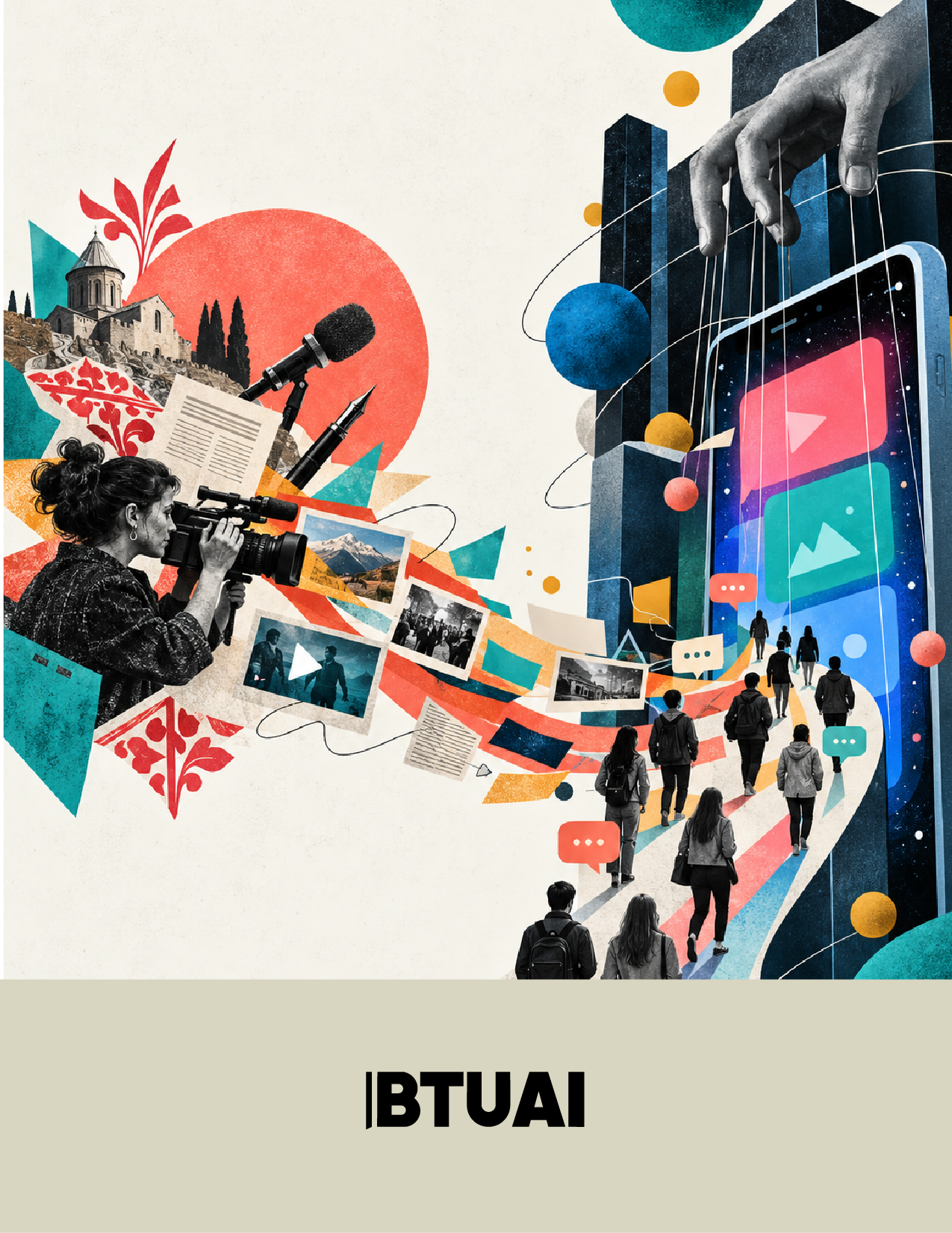
Georgian media produces a continuous stream of news, interviews, analysis, documentaries, entertainment and decades of archival material. Yet much of that content reaches viewers through YouTube, Facebook, Instagram, TikTok and other international platforms. On the surface, this looks like efficient distribution: the platforms provide reach, infrastructure and discovery. Economically, however, a harder question emerges: who owns the relationship with the user?
When a Georgian programme is watched on YouTube, the publisher may see views and basic engagement, but the platform retains the fuller picture: what else the user watches, when interest fades, what offers generate payment and which content should be recommended next. The platform controls the recommendation system, much of the advertising machinery, subscription terms and the direct link to the audience. Georgian media creates the product, while the user’s digital address often remains inside somebody else’s system.
From streaming wars to platform wars
The trend described by The New York Times suggests that global streaming competition is no longer only about producing the best film or series. Amazon, YouTube, Roku and other players want to become the gateway through which users enter every other service. Competitors that once defended closed catalogues are increasingly interested in controlling search, subscription and viewing through their own interface. The gateway sees the user, shapes the experience and captures the most valuable data.
This matters even more in a small market such as Georgia. Building a separate paid platform is expensive for each publisher, while consumers are unlikely to maintain numerous Georgian subscriptions. The strategic choice is therefore not limited to remaining entirely dependent on global platforms or constructing many costly stand-alone services. A third option is a shared digital bundle in which publishers retain their brands and editorial independence while using common infrastructure for payment, search, recommendation and delivery.
The price of visibility
Global platforms offer extraordinary scale. A Georgian company does not have to recreate video delivery networks, mobile applications, authentication, advertising systems or recommendation engines. In return, however, it accepts rules it cannot set. A modest algorithm change can sharply reduce organic reach; a monetisation change can cut revenue; an account restriction can interrupt access to the audience.
The cost is not only financial. Engagement-driven algorithms often reward immediate emotion, conflict and prolonged viewing. Public-interest journalism that is complex and less spectacular can lose the competition for attention. Editorial choices then respond not only to journalistic priorities but also to the engagement metrics of the distribution platform. A publisher may remain formally independent while the shape of its product gradually adapts to the system that controls discovery.
Lost data, lost business
Audience data is more than a tool for targeting advertisements. It reveals willingness to pay, the authors who create loyalty, the moments when users return and the points at which they leave. When that knowledge remains primarily with the platform, Georgian publishers struggle to improve their products and plan durable revenue.
A direct relationship means registered users, voluntarily declared interests, email access, payment history and explicit consent for personalisation. It allows revenue to extend beyond advertising into membership, thematic bundles, paid archives, professional newsletters, events, audio products and research services. One million accidental platform views may be less valuable than several thousand people with whom a publisher has a direct, consent-based relationship.
The archive as frozen capital
Georgian media archives preserve the country’s recent history: political and economic change, corporate development, cultural memory, interviews, regional life and the diversity of everyday language. Much of this material exists online but remains fragmented, poorly described, difficult to search or trapped in obsolete formats. Being online is not the same as being a usable digital product.
Economic activation begins with rights clearance, deduplication, reliable metadata, text recognition, audiovisual transcription and unified search. The same resource can then serve journalists, researchers, schools, documentary producers, the diaspora and AI systems. A well-managed archive is no longer merely a repository of the past; it becomes production infrastructure for new content, licensing and research services.
A new risk in the age of AI
Dependence on social and video platforms is now being joined by dependence on AI intermediaries. Users increasingly ask an AI assistant instead of visiting a website. If Georgian material is not structured, attributable and technically accessible, it may disappear from the answer. The deeper problem arises when an AI system absorbs knowledge created by Georgian publishers while the user no longer sees the source and the publisher receives neither traffic, revenue nor audience intelligence.
According to BTU researchers, structuring Georgian media archives is simultaneously a media business issue and a national digital-capital priority. Reliable sources about the Georgian language, companies, culture and public life are essential if AI systems are not to describe the country through accidental or secondary sources. A new media infrastructure should therefore support licensed AI access, mandatory attribution, usage reporting and transparent revenue-sharing rules.
What a Georgian media bundle could look like
A common bundle does not require a common newsroom or a single owner. A more realistic design is a shared technology layer: one account and one payment through which a user accesses several independent publications, video channels, podcasts and archives. Revenue could be allocated through an agreed formula combining user choice, consumption and the provision of high-value public-interest content.
The system could include free and paid tiers. The free layer would preserve mass access; the paid tier could offer an advertising-free experience, full archives, specialist analysis, audio, early video access and several media brands under one account. A diaspora package could organise culture, news and language content. A professional tier could serve companies, while schools and universities could license verified historical and public-affairs material.
The main challenge would not be application design but governance: who owns the content, who collects consent, how consumption is measured, how revenue is shared and how a user leaves the system. Data protection, competition and editorial independence require explicit safeguards. The common platform should not define acceptable political or commercial positions; its role should be technical delivery, transparent discovery and fair settlement.
Start with a pilot
The most practical first step is not a large national platform built all at once. A small group of different publishers could pool a limited archive or launch a single thematic bundle, introduce common authentication and test what users will actually pay for. The pilot should measure registration conversion, return frequency, revenue per user, cancellation and movement between participating publishers-not merely views.
Each publisher should also strengthen its own direct channels: website, application, email, membership programme and structured metadata. Abandoning global platforms would be unrealistic; they remain powerful channels for discovery and distribution. The goal is to reduce dependence. Social networks should help audiences discover content, while the publisher’s own environment should become the place where trust, registration, payment and a long-term relationship are built.
Conclusion
The central problem of Georgian media is not a shortage of content. It is the separation of content creation, audience discovery, data accumulation and revenue capture. Journalistic work remains in Georgia, while the most valuable layer of the relationship often migrates to an international platform.
If Georgian publishers remain only suppliers, every new article and video will strengthen somebody else’s network effect. If they build shared infrastructure for subscriptions, archives and direct audience relationships, the same content can become a sustainable business asset and national digital capital. The future will not necessarily belong to whoever publishes the most. It will belong to those who retain the connection between the content and the people who value it.
Prepared by the academic team of Business and Technology University and the BTUAI Research Team, Tbilisi, Georgia.