

Main
BTU’s analysis distinguishes a deliberate decision to keep a subscription from the convenience of automatic renewal and a delay caused by difficulty cancelling. Georgian businesses need this distinction because another payment does not, by itself, demonstrate satisfaction with the value received.
Key Takeaways
- BTU’s assessment is that evaluating recurring services in Georgia requires understanding payment, use and customer choice together; this is an analytical finding, not a measured share of consumer behaviour.
- Georgia had 1,212,000 fixed broadband subscribers in 2025, according to the Communications Commission; this establishes sector scale, not the total number of digital subscription customers.
- BTU proposes presenting continuation, a smaller plan and cancellation as clear choices; their effects on loyalty and revenue require separate testing.
A payment in a company’s accounts can conceal very different stories. One customer needs the service every day. Another appreciates automatic renewal. A third stopped using the product but did not understand the cancellation date. A fourth tried to leave but could not finish. The receipt looks similar in each case. What it means for the business’s future can be very different.
Here, subscription means a service for which the customer pays repeatedly: internet access, software, paid content or membership, for example. These products have different contracts and sector rules. Their shared economic question is whether the customer still receives something valuable or an existing payment arrangement simply continues. Counting cancelled accounts cannot answer that question alone.
BTU’s analysis of its research materials on subscriptions and digital services connects several decisions: using a service, accepting its price, understanding renewal, changing a plan and ending a relationship. The materials use behavioural models to explore possible responses and formulate business questions. This article draws on that analytical structure rather than publishing a quantitative distribution of consumer reactions.
The same payment can mean different things
Automatic renewal is not inherently a problem. Uninterrupted internet, access to work files and continuity of a wanted service have value. Requiring a manual payment every time can itself create unnecessary work. The relevant question is therefore whether customers can see what they will pay, when payment happens and which choices remain available.
The distinction becomes clearer when use changes. Software may no longer be needed after a project ends. A content subscription may be valuable during one period and less relevant later. A household may still need internet but not an additional package. Needing the core service is different from needing every element of a bundle.
BTU’s assessment is that businesses should distinguish revenue received, service use and informed choice. Revenue is a financial fact. Use describes an aspect of the relationship, but its frequency means different things for different products. Informed choice addresses whether continuation reflects what the customer wants. Combining these ideas risks treating a postponed cancellation as product success.
Low use is not automatically dissatisfaction either. A customer may pay for access when needed, a backup capability or use by another household member. Login frequency alone can therefore be a poor measure of value. A stronger interpretation considers the product’s purpose, the customer’s explanation and the service actually provided.
Why this matters in Georgia
Recurring services are not a narrow technology niche in Georgia. In its presentation of the 2025 activity report, the Communications Commission reported 1,212,000 fixed broadband subscribers and 803,000 broadcasting transit subscribers. These are subscriptions to different services. Adding them would not produce a count of unique people. The figures establish sector scale without describing the entire market for paid apps, fitness memberships or other recurring products.
Managing repeat charges concerns household budgets as well as providers’ stable income. A customer may want to keep an essential service while removing an optional addition. If ending everything is the only understandable choice, the product structure may fail to reflect those different needs. Whether this mismatch exists must be checked against the particular offer.
Georgia’s consumer protection law requires clear pre-contract information on contract duration and, where relevant, termination conditions. Its provisions on unfair standard terms also address automatic extension of a fixed-term agreement without consumer consent. The legal assessment of a particular contract or regulated sector remains separate. The general business implication is that renewal terms form part of the service, rather than being a technical detail of billing.
Customers must also be able to distinguish a price described per month from a commitment that is actually billed annually. Those arrangements have different cash-flow consequences even when the advertised monthly equivalent is accurate. Clear presentation should identify the payment frequency, commitment period and renewal terms together. This is a proposed clarity test, not a claim that any particular Georgian provider has failed it.
Why a discount cannot solve every departure
BTU’s research materials distinguish affordability, insufficient use and trust or service problems as possible reasons for cancellation. These are not interchangeable explanations. A smaller plan may help someone facing a budget constraint. A temporary discount does not create a need for a product that is no longer useful. Additional features do not answer a question about an unexplained charge.
The value of a retention offer therefore depends on its fit with the customer’s reason, not merely its size. A temporary discount should make the subsequent price understandable. A smaller package should explain what remains and what is removed. A pause should specify when service and charging resume. An alternative expands choice only if the customer can evaluate it.
This does not mean customers must justify leaving as a condition of cancellation. Feedback can be useful to a company, but voluntary research participation and exercising a contractual right are different activities. The business’s wish to learn cannot replace the customer’s expressed decision. Accepting or declining an offer should remain understandable.
What the business should distinguish
| Observed situation | What it can establish | What it cannot establish alone |
|---|---|---|
| Customer knowingly continues | An expressed choice to continue | Future satisfaction or permanent loyalty |
| Automatic payment succeeds | A charge was processed | Current use or understanding of renewal |
| Cancellation is started but unfinished | An incomplete process | A changed mind or satisfaction |
| Customer chooses a smaller plan | Acceptance of a different offer | That price was the only original concern |
Source: BTU analytical comparison; not a measured distribution.
BTU’s contribution is to separate several meanings behind an apparently single result. Continued revenue is real for financial reporting. Product assessment needs an explanation of what sustains the relationship. An abandoned cancellation attempt might reflect a changed mind, a technical obstacle or a lack of time. Failure to reach the final screen is not evidence of satisfaction.
Clear cancellation also produces clearer information
A company may legitimately aim to retain customers. Artificially complicating departure, however, can also obscure why an account remains active. The company sees continuity while the customer is already trying to leave. Forecasts become too optimistic if that record is interpreted as a deliberate renewal. This is a problem of interpretation, not an accusation about all providers.
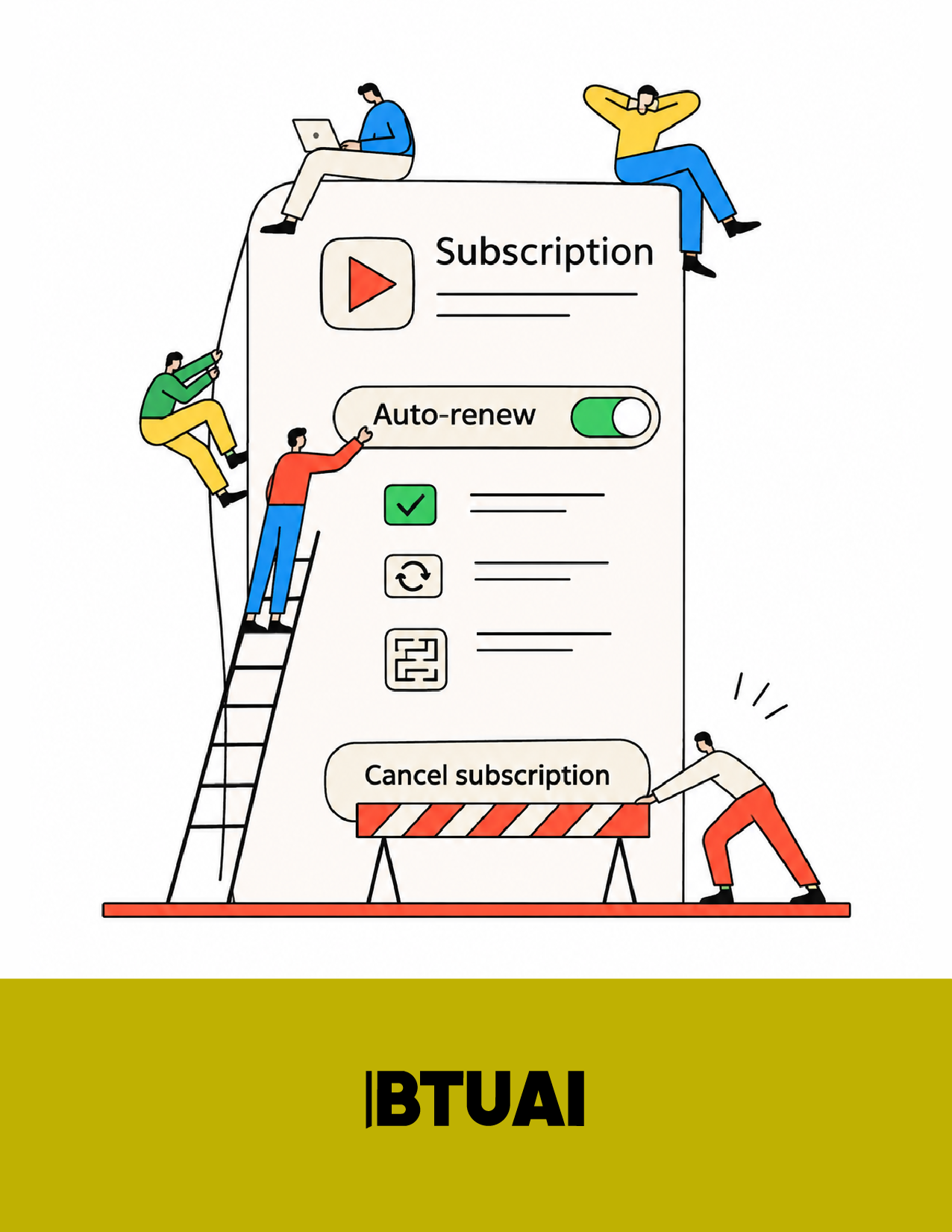
BTU proposes connecting the renewal date, next price, service end date and consequences of the decision in one understandable path. Customers should know whether cancellation stops only the next payment or ends current access immediately. Where contracts contain fixed commitments or special conditions, these should be visible in advance. Plain language does not remove a contractual obligation, but it clarifies the choice.
Ending a paid service must also be distinguished from deleting an account. A customer may wish to stop paying while keeping existing data where product terms permit. Alternatively, data deletion may be a separate intention. Combining these actions ambiguously creates additional risk. Product design should explain the consequences of each.
A business can examine whether its own descriptions agree across the pricing page, renewal notice, account settings and support response. Conflicting explanations make it difficult to interpret a customer’s decision even when each team believes its own wording is clear. This comparison is a practical recommendation, not a proven revenue intervention. Its purpose is to establish what was offered and what the customer could reasonably understand.
The economic outcome is not predetermined. A clearer process could initially produce more completed cancellations because decisions previously interrupted can now be executed. Calling that an automatic rise or fall in trust would be misleading. Subsequent evaluation should consider revenue, support requests, returning customers and their reasons over a relevant period, alongside other changes to the product and price.
The conclusion is straightforward: staying is informative when the business understands what staying means. Deliberately continuing, appreciating automatic payment and failing to complete cancellation are different relationships. BTU’s analysis asks Georgian businesses to preserve understandable value and choice, not just a payment record. Their possible effects on loyalty should be tested rather than announced in advance.
Questions and answers
Is automatic renewal bad practice?
No. It can support continuity; clear conditions, appropriate consent and understandable choice matter.
Does low use prove a subscription is worthless?
No. Product purpose and customer need differ, and login frequency alone is insufficient.
Does easy cancellation necessarily increase returns?
That is a hypothesis to test. This article does not measure a causal effect or its size.
What do subscriber counts represent?
Subscriptions to particular services, not unique customers of every digital subscription product.