

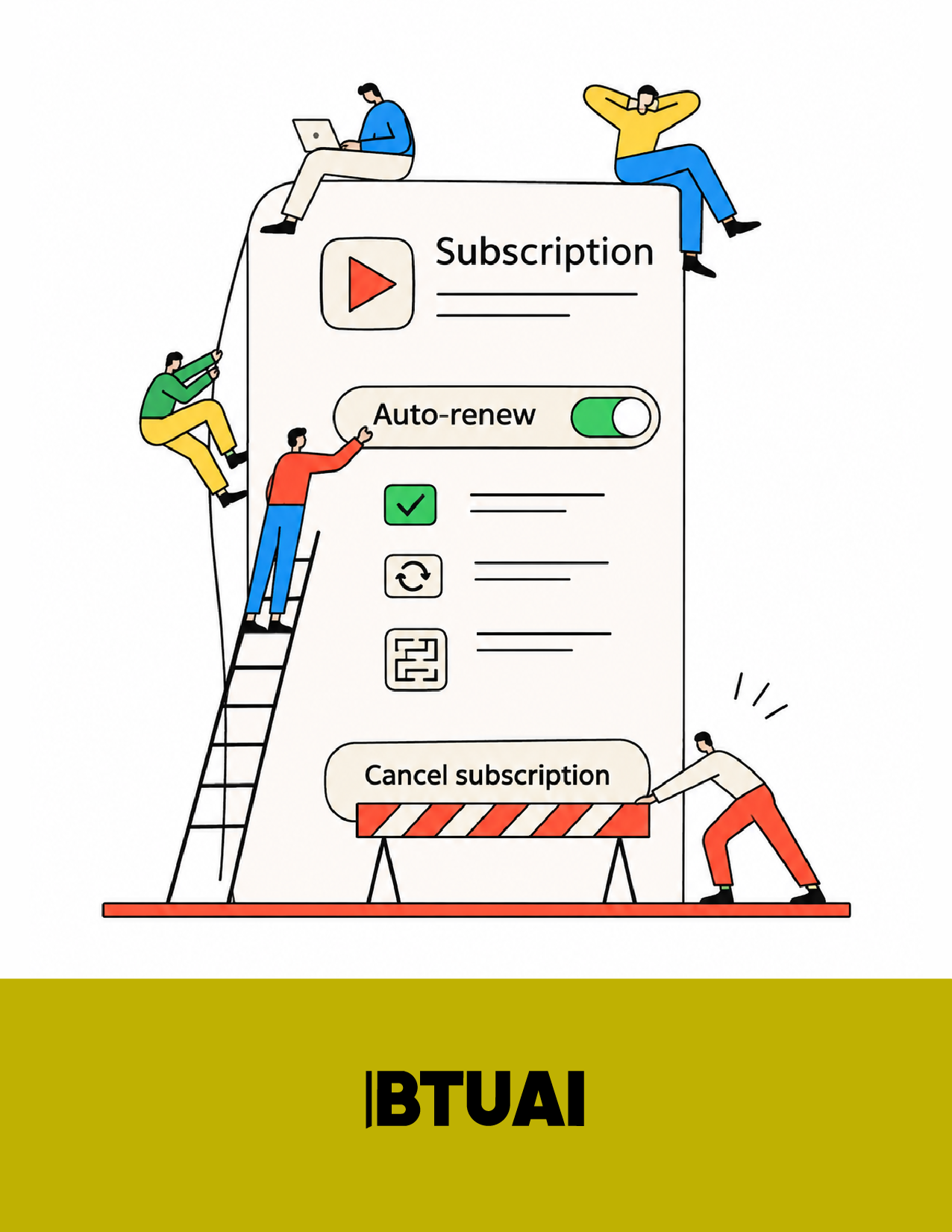
What should remain human in the AI era
Main BTU researchers’ assessment is that people should retain the ability to choose goals, judge outcomes and challenge or
Main
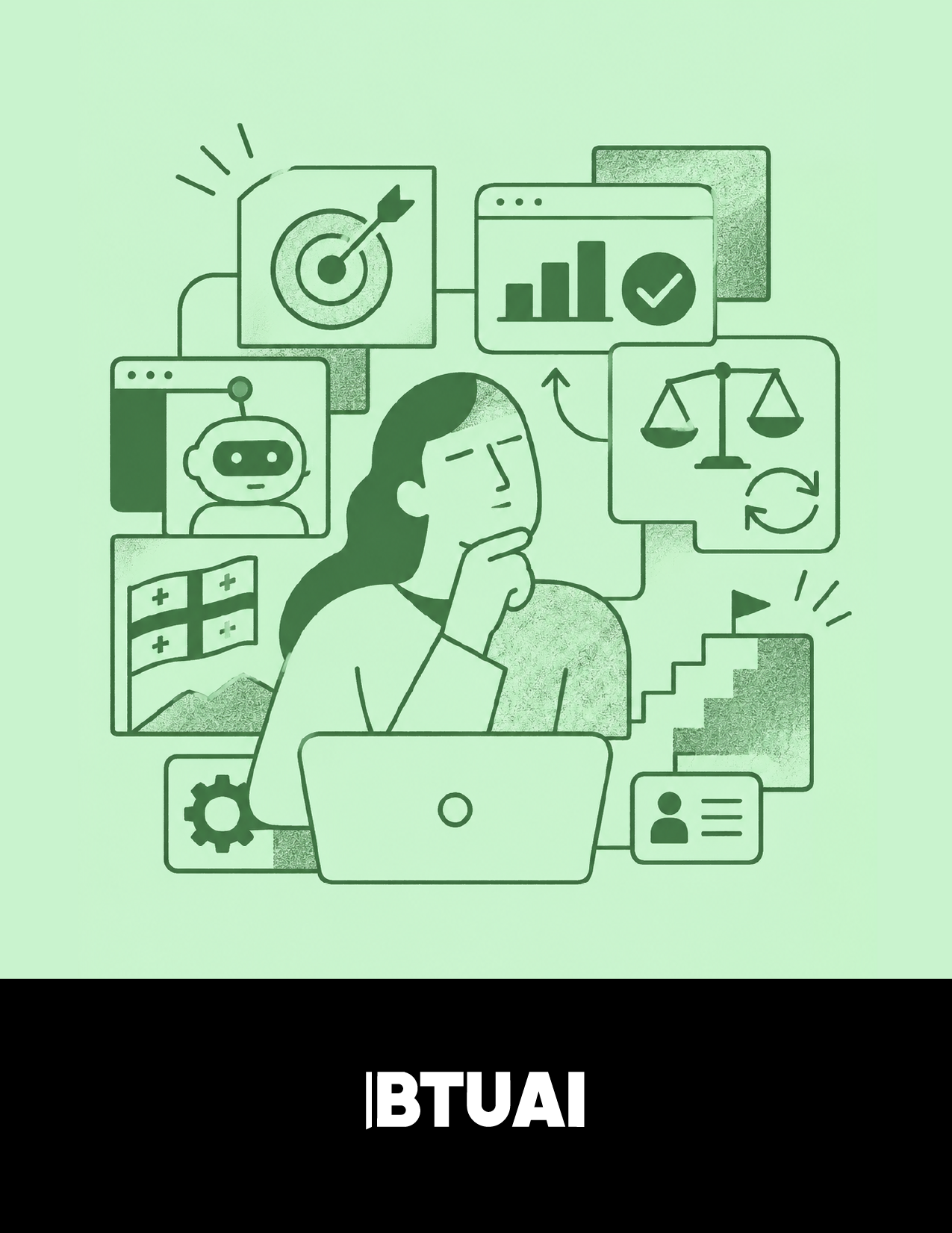
BTU researchers’ assessment is that people should retain the ability to choose goals, judge outcomes and challenge or change decisions in the AI era. For Georgia, the principal benefit will be greater independent agency if automation strengthens professional development and meaningful responsibility.
Key Takeaways
- Human involvement in AI-supported work should be judged by actual influence: whether a person can change the goal, identify an unreliable answer and stop the process.
- Geostat’s June 2026 figures show internet access in 93.5% of Georgian households; this measures connectivity, not AI adoption or the ability to assess decisions.
- BTU’s analytical assessment is that sustainable benefits in Georgian organizations require preserving employee learning, customer contestability and the responsible person’s ability to act.
AI can leave people more time for what they consider important. A small-business owner can compare markets, a student can obtain another explanation of a difficult subject, and a citizen can understand a service’s conditions more easily. The value extends beyond the number of documents a system produces. The deeper question is what a person can do after receiving assistance: choose more deliberately, understand the result and act independently.
That question becomes more important as AI moves from offering answers to helping complete sequences of actions. An agent is a system that plans and carries out steps toward a defined task using appropriate tools. The earlier distinction between what an agent can do and what it is authorized to do establishes an essential boundary. This article asks a further question: which human capabilities should survive even when delegation follows the rules?
The answer is meaningful choice, judgment and learning. Pressing the final approval button is insufficient. If an employee lacks the time, knowledge or freedom to disagree, formal approval cannot carry the responsibility assigned to it. A person may remain visible in the workflow while having little influence over it. That difference is one measure of implementation quality.
People give goals their meaning
An agent may receive an apparently clear objective: answer customers quickly, select an inexpensive offer or prepare the best learning plan. Yet “quickly,” “inexpensive” and “best” conceal competing interests. A cheap service may be difficult to cancel. A fast reply may leave a complaint unresolved. A high grade may say little about accumulated understanding. Selecting a goal includes deciding how those competing interests should be weighed.
People therefore need the ability to change the definition of success. Counting only replies encourages an organization to produce more replies. A citizen seeking correction of an error needs something different. BTU’s assessment is that human-oriented productivity begins here: expanding the capacity to complete useful work, rather than simply increasing activity. This is an evaluative principle, not a measured effect in Georgia.
Retaining choice does not mean rejecting assistance. AI can uncover a conflict, compare routes and explain consequences. Users need not independently discover every alternative. They should, however, understand which choices have already been made for them and which possibilities were never considered. Otherwise help can become an invisible constraint: the user appears to choose, but only inside a predefined frame.
Judgment is a working capability
The International Labour Organization’s 2026 review of empirical evidence finds that generative AI’s productivity effects differ across tasks and working environments. In complex work, the ability to evaluate an answer’s reliability matters. This international evidence does not predict a specific Georgian outcome. Its practical significance is that faster work and better decisions are different measures. [1]
Judgment involves checking a source, noticing missing context and recognizing when a convincing explanation rests on a faulty premise. It requires more than intuition: subject knowledge, relevant information and time are necessary. An organization that retains an employee’s checking duties while removing those conditions transfers risk without providing the ability to manage it.
Consider an illustrative Georgian service company where an agent drafts responses to complaints. If an employee checks only grammar, an exceptional circumstance in the customer’s account may go unnoticed. Meaningful judgment requires comparing facts, the company’s commitments and the customer’s request. AI can make that work easier, but the desired result is better understanding, not merely faster approval. This example describes a mechanism rather than an observed company case.
Humans are not automatically more accurate judges. People also have biases, fatigue and incomplete information. Good design therefore does not treat human participation as a guarantee against error. It provides a checkable basis, feedback and a route to reconsider the result. NIST’s AI Risk Management Framework addresses defined roles, responsibilities and oversight. It is a voluntary framework, not an automatically binding legal rule for Georgia. [2]
Learning must survive automation
Professional judgment also develops through work. A junior employee compares documents, spots an inconsistency, asks a question and gradually learns which circumstances matter. AI can accelerate that process through explanation, alternative solutions and feedback. But if the beginner’s task is only to accept a finished answer, there may be fewer opportunities to understand its foundations.
That creates an important organizational choice for Georgia. Universities and employers should distinguish the quality of a final output from the capability a person acquires. An elegant AI-assisted report does not by itself show that its author can defend the conclusion, assess conflicting evidence or correct a mistake. Education should include those activities as well as producing better text.
This is not an argument for denying young people useful tools. Assistance may let them tackle harder questions earlier. The difference lies in learning design. Students should explain their choices, compare sources and engage with a counterargument. Employees should receive feedback explaining why a correction mattered. In that setting, automation supports the acquisition of experience instead of merely substituting for it.
Organizations have their own long-term interest in preserving that process. An experienced employee checks the work today; a successor must be capable of doing so tomorrow. If beginners have no room to exercise independent judgment, expertise may become concentrated in a shrinking group. This is a possible mechanism, not a measured trend in Georgia’s labour market. Treating learning as part of quality maintenance can help address it.
Customers need a voice
Georgia has a broad practical foundation for digital services. Geostat’s official table records household internet access of 93.5% in June 2026. Connectivity creates the potential to reach much of society. The figure does not measure AI adoption or citizens’ ability to assess complex decisions. Moving directly from access to effective independent choice would therefore be unjustified. [3]
Georgian-language explanations, understandable service conditions and a functioning support channel are practical conditions for that transition. A technically accurate explanation that a citizen cannot understand weakens meaningful choice. This matters particularly when a service is denied, a record is wrong or an automated response fails to accommodate an individual circumstance. Customers should be able to supply new information and request reconsideration.
A polite conversation alone cannot meet that need. A person may receive friendly replies without gaining a route to resolution. Identifying the responsible party and enabling correction matter. BTU’s assessment is that an understandable, functioning remedy offers a stronger foundation for organizational trust than consistently confident language. This is a governance conclusion, not the result of a new customer-attitudes survey.
Private context should also remain under human control. Useful help does not require collecting every piece of information in one place. BTU’s current professional-agent production materials distinguish general professional preparation from later private personalization in the user’s environment. The practical point is straightforward: professional assistance need not require transferring a person’s entire private working life. This is a design requirement; compliance by a particular system requires separate verification. [4]
Responsibility must be actionable
Responsibility should be linked to influence over outcomes. When managers say that an employee remains ultimately responsible, that employee needs a genuine way to flag uncertainty, request information and stop a mistaken action. Responsibility cannot consist solely of a sentence in a job description. It requires working time, knowledge and organizational support.
Nor must every routine action receive manual approval. Automating easily corrected work with limited consequences can preserve human attention for more important cases. The central choice is where human participation adds value and where it becomes a formality. That choice should be revisited when the system, its operating environment or the user’s needs change.
Ultimately, what should remain human is not a permanent list of manual tasks but influence over the direction of personal and professional life. Choosing goals, assessing conclusions, continuing to learn and challenging errors are connected parts of that influence. Georgia succeeds when automation helps people do more while also enabling them to understand better and act independently.
Questions and answers
Must a person approve every AI action? No. Human attention is particularly valuable in consequential, uncertain or difficult-to-correct cases. Oversight of routine work should be proportionate to risk.
Why is a final approval button insufficient? Approval is meaningful when a person understands the choice, has time to check it and can choose differently.
How can AI strengthen learning? Through explanations, feedback and comparisons, provided the learner also evaluates the argument and defends an independent conclusion.