




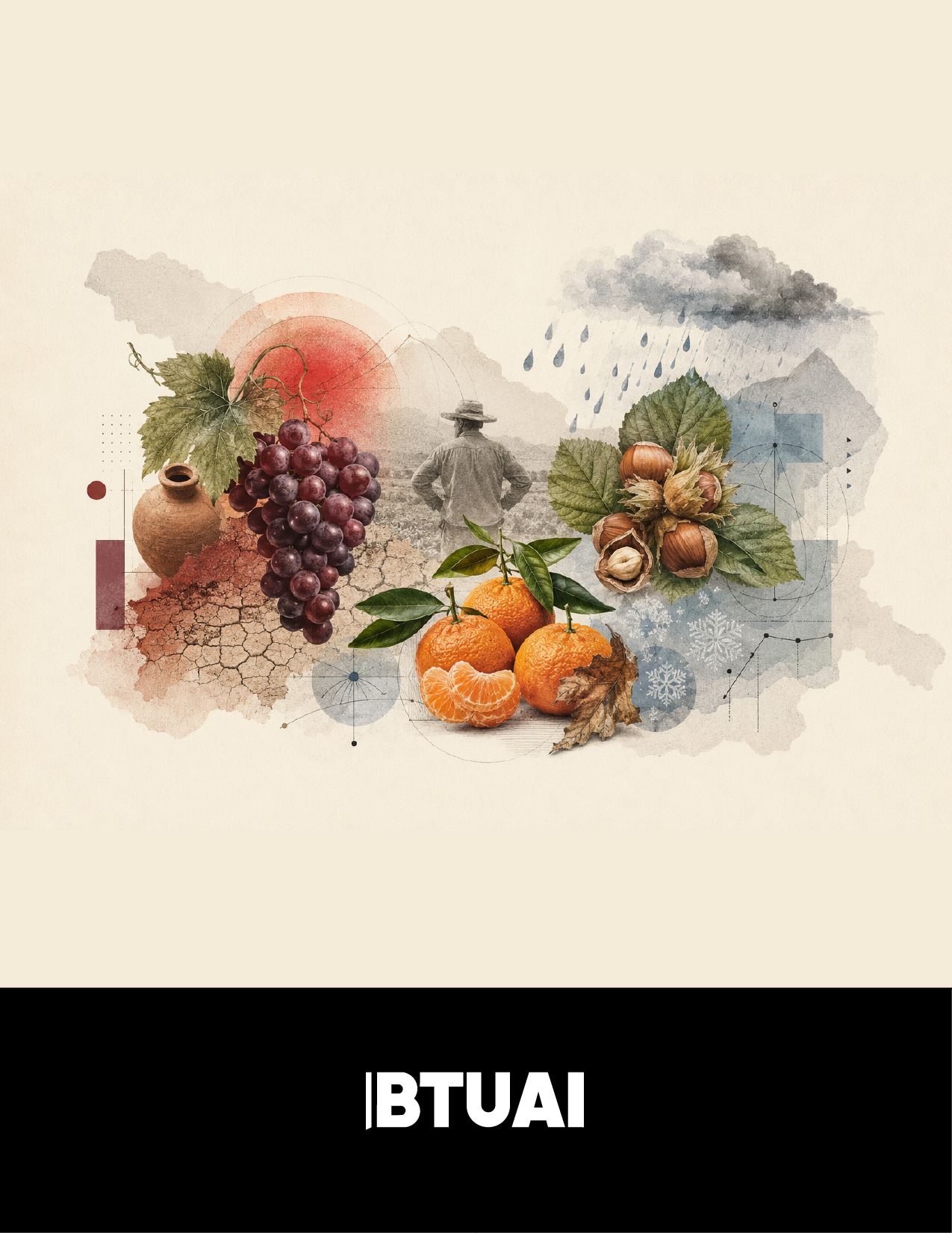
Climate change threatens Georgian agriculture through more than lower output: it can alter quality, harvest timing, disease pressure and the economics of entire regions. Applied mechanically to 2025 production, a 10% shock would equal about 34,900 tonnes of grapes, 4,930 tonnes of hazelnuts, 5,380 tonnes of citrus and 20,670 tonnes of potatoes. No single product leads on every measure, but wine carries Georgia’s broadest systemic exposure because export earnings, national branding and Kakheti’s regional economy are concentrated in the same value chain. Hazelnuts may be just as consequential when the metric is smallholder income.
A climate risk is not the same as a predicted loss
A poor harvest in one year cannot be attributed to climate change alone. Acreage, varieties, plant disease, irrigation, technology, labour and prices all matter. The scenarios below are therefore not forecasts. They translate vulnerability into physical scale using Georgia’s verified 2025 production data.
| Product | 2025 output | Unit | 10% shock | 20% shock |
| Grapes | 348.9 | ths. tons | 34.89 | 69.78 |
| Hazelnuts | 49.3 | ths. tons | 4.93 | 9.86 |
| Citrus | 53.8 | ths. tons | 5.38 | 10.76 |
| Potatoes | 206.7 | ths. tons | 20.67 | 41.34 |
| Wheat | 138.5 | ths. tons | 13.85 | 27.7 |
| Milk | 556.2 | mn litres | 55.62 | 111.24 |
Note: shock values are BTUAI mechanical calculations based on official output data. They exclude price, quality, inventories, imports and adaptation responses.
Wine carries the broadest systemic exposure
Georgia produced 348,900 tonnes of grapes in 2025. Of this, 296,100 tonnes – approximately 84.9% – came from Kakheti. Heat can accelerate ripening and change acidity; drought can reduce berry size; excess moisture can raise fungal pressure. Because the same region supports vineyards, wineries, seasonal jobs, logistics and exports, one large event can travel through the entire value chain. A national 10% volume shock would equal 34,900 tonnes, although the financial effect would depend heavily on the varieties and quality segments affected.
Hazelnuts expose smallholder income
Hazelnut output reached 49,300 tonnes in 2025, with production strongly concentrated in western Georgia. The crop is exposed not only to heat but also to humidity, pests and disease. Its social importance is unusually high because many small farms depend on the annual cash harvest. A 10% shock equals roughly 4,930 tonnes, but its household impact could be much larger than the tonnage suggests.
Citrus, potatoes, wheat and dairy reveal different risks
Around 77% of Georgia’s 2025 citrus crop came from Adjara, making mandarins and other citrus products highly exposed to a regional extreme event. Potatoes and wheat matter less for national branding but more for food prices and import dependence. A 10% output shock equals 20,670 tonnes of potatoes and 13,850 tonnes of wheat. Dairy is affected indirectly: heat lowers animal productivity, while drought degrades pasture and raises feed costs. Family holdings produced 93.6% of Georgia’s milk in 2025, so the risk quickly reaches rural household income.
A comparative risk map
| Product | Primary climate channel | Main economic consequence | Assessment |
| Wine/grapes | Heat, drought, hail, disease | Exports, brand and Kakheti concentration | Highest systemic exposure |
| Hazelnuts | Humidity, pests, disease, heat | Smallholder cash income and exports | Very high social exposure |
| Citrus | Heat, frost, excess rain | Adjara and Guria regional income | High concentration exposure |
| Potatoes | Drought, water scarcity, hail | Domestic supply and prices | Food-security exposure |
| Wheat | Drought, heat, rainfall shifts | Import dependence | Strategic exposure |
| Milk and cheese | Heat, pasture and feed stress | Family-farm income | Diffuse but broad exposure |
BTU Researchers’ Assessment
“Most threatened” should not be reduced to the largest possible tonnage loss. Wine ranks first when the metric combines national brand, exports and regional concentration. Hazelnuts become equally prominent when the metric is smallholder livelihoods. Wheat, potatoes and dairy move to the centre when the concern is food affordability and dependence on imports.
What Georgia should do next
Adaptation requires more than irrigation construction. Georgia needs field-level weather data, early warning for pests and disease, transparent water accounting, locally tested varieties, better-designed agricultural insurance, shared infrastructure for small farms and selective geographic diversification. Vineyards can test higher-altitude sites and data-driven harvest timing; hazelnut farms need humidity and pest monitoring; dairy farms need shade, water and feed reserves.
Key Findings
- A 10% mechanical shock to 2025 production equals 34,900 tonnes of grapes, 20,670 tonnes of potatoes and 13,850 tonnes of wheat.
- Wine carries the broadest systemic exposure because climate affects output, quality, exports, Georgia’s brand and Kakheti’s economy simultaneously.
- Hazelnuts have especially high social exposure through smallholder cash income.
- Citrus production is geographically concentrated, leaving Adjara vulnerable to a single extreme event.
- Wheat, potatoes and dairy transmit climate risk into food prices and import dependence.
- A single year’s output change is not evidence of climate causation; integrated long-term weather, yield and quality data are required.
- Adaptation succeeds only when it reaches the farm as a practical decision about varieties, water, insurance and early warning.
Why This Matters for Georgia
In Georgia, agricultural products are not interchangeable commodities. Wine is part of the country’s international identity, hazelnuts support western Georgia’s cash economy, mandarins underpin Adjara’s seasonal activity, and potatoes, wheat and cheese sit in the daily food basket. Delayed adaptation therefore threatens export earnings, regional employment, food security and cultural heritage at the same time.
Conclusion
The realistic danger is not that a famous Georgian product disappears overnight. It is that production becomes less stable, more expensive, less consistent in quality and less profitable for small farms. An inert policy reimburses losses after every bad season. A resilient policy converts climate data into production decisions. Wine should be the first testing ground, but the system must protect hazelnuts, citrus, potatoes, wheat and dairy as well.
Data and Main Sources
- National Statistics Office of Georgia – Agriculture of Georgia 2025.
- Georgia’s Fourth National Communication to the UNFCCC.
- World Bank – Reducing the Vulnerability of Georgia’s Agricultural Systems to Climate Change.
- The Guardian, 28 August 2026 – international case on drought, heat and traditional cheese production.
Methodological note: 10% and 20% shock values are mechanical calculations applied to 2025 production. They are not forecasts of output, price or financial loss, and annual changes are not attributed solely to climate change.
Prepared by the academic team of Business and Technology University and the BTUAI Research Team, Tbilisi, Georgia.