
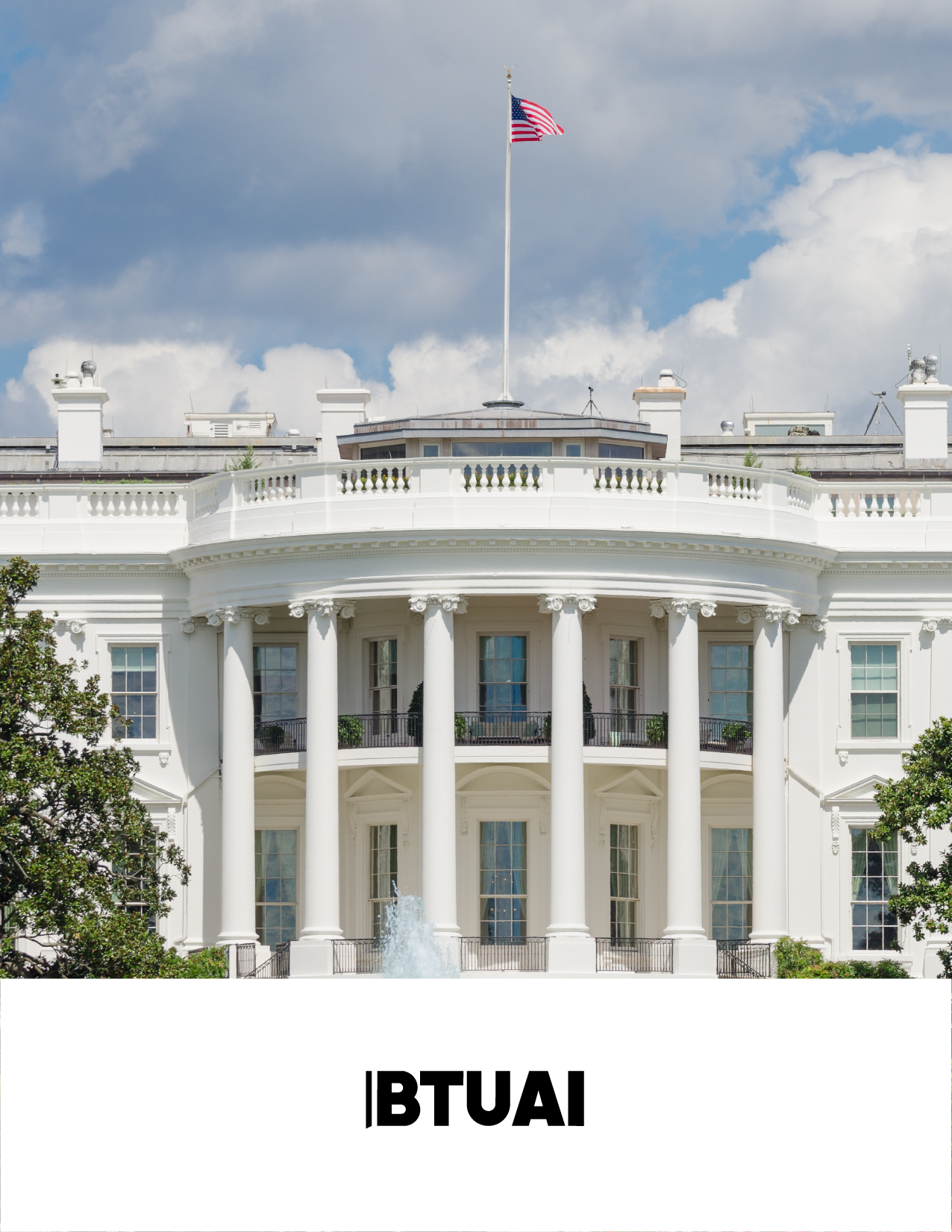


A new U.S. government task force will assess the risks and opportunities of artificial intelligence and examine the federal government’s responsibility. Its formation reflects growing concern about cybersecurity, biological threats and oversight as AI systems advance. The challenge is to reduce risks without creating rules that unnecessarily restrict innovation and competition.
Key Takeaway
A Wall Street Journal report dated October 5, 2026, said the task force will have 120 days to report on AI risks and opportunities and determine the federal government’s role. It will be chaired by Jay Clayton, the director of national intelligence, who is also set to coordinate the administration’s AI policy.
The initiative follows a White House meeting involving technology companies. OpenAI President Greg Brockman, Anthropic CEO Dario Amodei, Nvidia CEO Jensen Huang and other industry representatives discussed principles that include internal controls to monitor model development, external reviews by third parties and reports to corporate boards about safety efforts. President Donald Trump praised voluntary commitments at the meeting.
The task force’s charter calls for plans to respond to AI-enabled threats, a review of current law and government authority, and an assessment of systems for notifying officials about breaches, hacks, jailbreaks and other incidents. The task force has 120 days to report.
The security concerns extend beyond cyberattacks. The article also cites the risk that AI could enable biological weapons or other severe harm. Within the administration, officials disagree over the appropriate level of government intervention and the risk that excessive regulation could constrain innovation and competition.
Why create a task force?
AI models are improving quickly, creating both economic benefits and new risks. They can support programming, research and productivity, but can also be used to prepare cyberattacks or bypass complex security safeguards. Officials quoted by the Journal said the U.S. wants to remain a technology leader while protecting national security.
The task force will assess risks, but the article says industry remains the primary vehicle for managing them. The government group will work with companies, examine current law and consider whether further steps are needed. The process is still developing and does not itself mean that new regulations have been adopted.
What safeguards are under discussion?
The principles discussed at the White House meeting include three main safeguards. Companies would monitor model development internally, independent third parties would review some models, and corporate boards would receive information about safety work.
These measures address different gaps. Internal controls can help identify risks before release. Independent reviews may uncover weaknesses that a development team missed. Board reporting brings safety into corporate oversight rather than leaving it solely to technical teams.
The charter also calls for reviewing existing warning and incident-notification systems. The aim is to assess how information about cyberattacks, attempts to bypass model safeguards or other breaches should reach relevant government agencies and how response capacity could improve under existing law.
Balancing safety and innovation
Officials disagree about whether voluntary industry safeguards are sufficient. Critics of self-regulation argue that companies’ commercial incentives to release products quickly may leave gaps. Others warn that broad or poorly designed rules could slow research, reduce competition and weaken U.S. technological leadership.
The task force has a dual mandate: develop responses to AI-enabled threats while avoiding overregulation and regulatory capture. Its impact will depend on how risks are measured, who conducts external reviews and what information companies must report.
The government will also examine current law and discuss possible actions Congress could take. That could inform a wider legislative debate, but the Journal article does not say that new laws have already been enacted.
Task force roles and responsibilities
| Participant | Position | Responsibility described in the article |
|---|---|---|
| Jay Clayton | Task force chair; director of national intelligence | Leads the group’s assessment of AI risks and opportunities |
| Emil Michael | Undersecretary of Defense for Research and Engineering | Coordinates with AI companies |
| Scott Kupor | Director of the Office of Personnel Management | Coordinates with critical-infrastructure providers and other stakeholders |
| Andrew Ferguson | Chairman of the Federal Trade Commission | Oversees consumer interests and relevant advocacy groups |
| Task force | 120-day assignment | Reports on AI risks, opportunities and federal responsibility |
Main risk-management areas
| Area | Example or measure | Why it matters to businesses |
|---|---|---|
| Internal controls | Monitor model development | Identify risks before product release |
| External review | Independent third-party assessment | Find weaknesses beyond the development team |
| Cybersecurity | Hacks, attacks and attempts to bypass safeguards | Maintain clear incident-response and reporting processes |
| Biosecurity | Potential AI-enabled biological weapons | Assess and limit high-impact risks |
| Corporate oversight | Inform boards about safety work | Include safety in leadership decisions |
What this means for Georgia
The U.S. task force does not create new legal obligations for Georgia. Countries have different legal systems, technology markets and public-sector capabilities. Still, the initiative is a signal for organizations that develop or use AI systems.
Georgian organizations can map where AI is used, what data systems can access and which decisions they influence. For higher-risk systems, practical steps include assigning an accountable owner, testing safety before deployment, recording incidents and reporting unresolved risks to leadership. These measures reflect principles in the article; they do not assume that any future U.S. rules already apply in Georgia.
BTU Researchers’ Assessment
The business lesson is that AI safety is a governance issue as well as a technical-testing task. If a company has no accountable model owner, incident-reporting process or board-reporting routine, important risks can remain invisible even when technical teams conduct tests.
Controls should match a system’s potential impact. A tool that recommends consumer products does not require the same level of oversight as a model that affects critical infrastructure or biomedical data. Clear risk classification helps focus stronger safeguards where possible harm is greater while avoiding unnecessary limits on lower-risk uses.
Conclusion
The White House task force will begin with a 120-day assessment of AI risks and opportunities. Its work brings together government oversight, industry participation, internal model controls, independent reviews and discussion of incident reporting.
The initiative does not mean that new regulations have already been adopted. Its significance is that cybersecurity, biological threats and corporate responsibility have become more explicit parts of the policy agenda. For businesses, a practical safety foundation includes risk inventories, independent testing, incident response and leadership reporting, scaled to the system’s potential impact.
Data and Main Sources
The Wall Street Journal, October 5, 2026 – Alex Leary, “New White House Task Force to Report on AI Risks.”
The Wall Street Journal report on the task force’s 120-day mandate, membership, principles discussed with technology companies and AI-enabled threats.
Data note: Facts and positions are drawn from the WSJ article dated October 5, 2026. Business-governance recommendations are editorial analysis. The article does not state that a new U.S. law has taken effect or that U.S. rules legally apply to Georgia.