


Why Not Every Task Needs an AI Agent
Key Takeaway As AI agents become more capable, organizations face an understandable temptation: if a system can plan, use
Key Takeaway
As AI agents become more capable, organizations face an understandable temptation: if a system can plan, use tools and act, why not make every process agentic? Because autonomy is not value by itself. The right architecture is the one that produces the desired outcome with the best combination of reliability, cost, speed and control.
Many tasks are better served by simpler systems. Deterministic automation is often superior when the rule is known. An AI assistant may be sufficient when people need analysis, drafting or ideas. A structured workflow can coordinate multiple steps when the path is predictable. Agents add the most value when the path cannot be fully specified in advance and the system needs to interpret context, choose tools and manage a changing sequence of actions.
The strategic question is therefore not “Can we build an agent?” It is “Does this task actually need one?”
Agentic Does Not Automatically Mean More Mature
Technology adoption is often imagined as a ladder: manual work, automation, AI assistance, then agents at the top. Real organizations do not work that way. Different tasks require different architectures.
If a payroll calculation follows stable formulas and rules, adding model-driven discretion can reduce rather than increase quality. Where the correct behavior should be identical every time, determinism is an advantage.
Other tasks are fundamentally different. A complex customer dispute, an open-ended research problem or a technical investigation may involve enough ambiguity and exceptions that hard-coding every path becomes impractical. Maturity is therefore not maximum autonomy. It is appropriate autonomy.
Simple Rules Should Stay Simple
Thousands of business operations have a known answer: update a status when a condition is met, send a reminder at a deadline, reject a form when a required field is missing. Conventional software can often execute these processes faster, more cheaply and more predictably than an AI agent.
An agent introduces additional infrastructure: a model, context management, tool interfaces, monitoring, evaluation, fallback and often greater compute. If the decision itself does not require interpretation, that complexity may have little economic justification.
A Fixed Workflow Can Be Better Than a Free-Form Agent
Not every multi-step process is an agent problem. A workflow may contain ten steps, several LLM calls and multiple tools while still benefiting from a predefined sequence.
When the order of operations is known, branching rules are stable and exceptions are limited, structured workflows improve predictability, testability and auditability. Anthropic explicitly distinguishes workflows, where models and tools follow predefined code paths, from agents, where models dynamically direct their own process and tool use.
That distinction prevents organizations from adding dynamic autonomy where a stable workflow already performs well.
If the Need Is Better Thinking, an Assistant May Be Enough
Many professional tasks do not need to be executed on a person’s behalf. Leaders may need strategic alternatives, lawyers may need help interpreting a document, academics may need help structuring a course and marketers may need creative options.
In these settings, the value of AI is cognitive amplification. The person remains responsible for moving the work forward. That is often desirable when the goal is ambiguous, the decision is value-laden, context changes rapidly or human accountability is central.
Agents Make Sense When the Path Cannot Be Fully Hard-Coded
OpenAI’s practical guidance identifies strong agent use cases where deterministic and rule-based approaches encounter friction: complex decision-making, difficult-to-maintain rules and heavy reliance on unstructured data. These are situations where model-driven reasoning and dynamic tool use can solve a real architectural problem.
Customer service is a good example. One case may be informational, another a refund, another a contractual exception and another a mixture of technical and financial issues. Maintaining thousands of brittle rules can become less practical than allowing a governed agent to decide which information, tool or escalation path is required.
Open-ended research presents a similar pattern. The number of sources, contradictions and follow-up questions may be impossible to know before the work begins. Flexibility becomes part of the value proposition.
Agentic Systems Have a Price
Each additional agentic step adds more than capability. It adds latency, compute cost and operational complexity. Multi-step execution also creates opportunities for errors to compound: an early mistake can shape later reasoning and eventually reach an external system.
Anthropic explicitly notes that agentic systems often trade latency and cost for better task performance and that autonomous agents create potential for compounding errors. This is why guardrails, evaluation, checkpoints, rollback and human oversight become increasingly important as autonomy expands.
“Can it do this?” and “Is this worth doing agentically?” are different questions.
Unnecessary Agency Makes Governance More Expensive
The moment software can act, organizations need stronger rules around permissions, data access, ownership, approval, audit trails, incident management and stopping rights.
If a simpler assistant or workflow can accomplish the same result, much of that governance burden can be avoided. Control is not an external cost added after the architecture is chosen; it is part of the architecture’s economics.
Four Levels of Automation and Autonomy
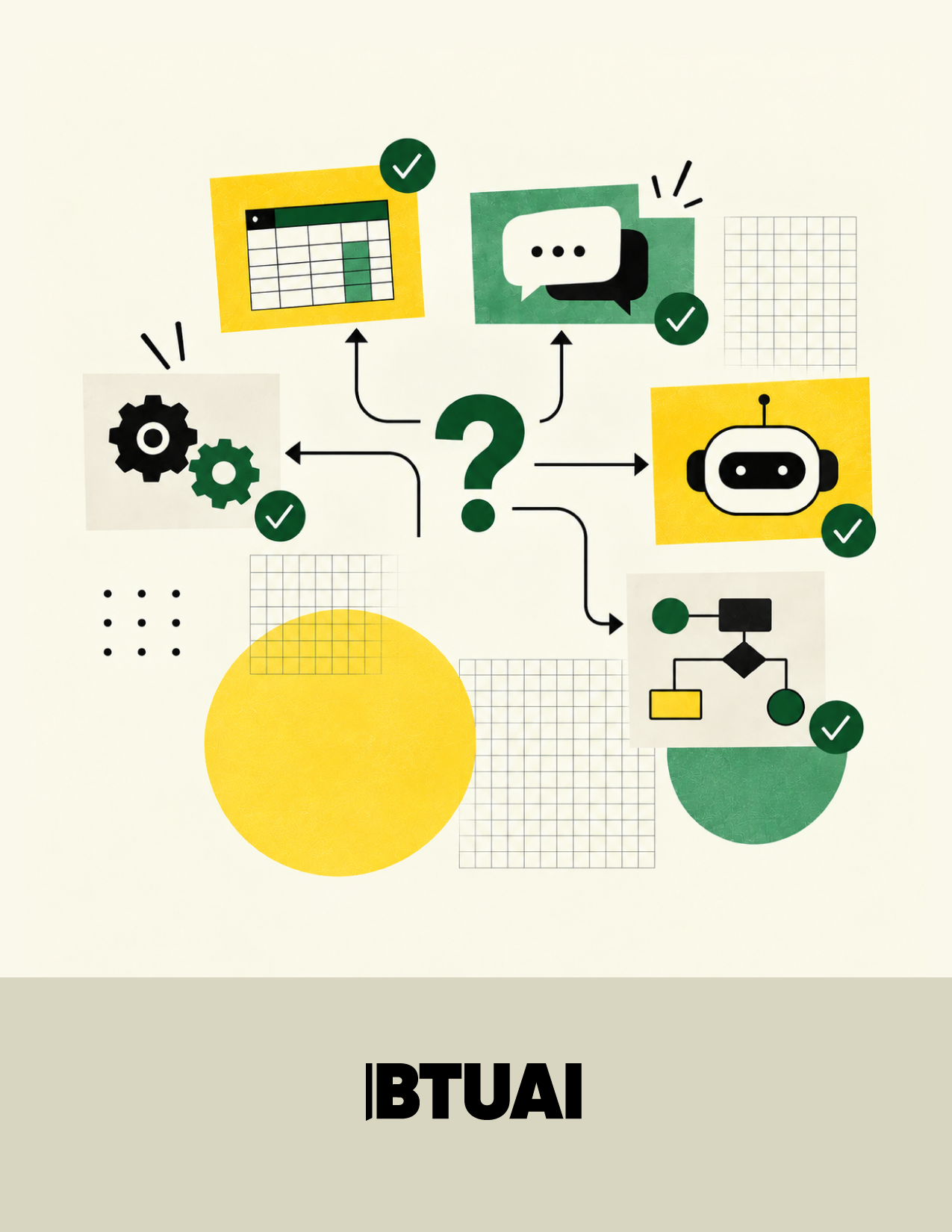
A useful way to design systems is to see four different levels. First, deterministic software or automation, where the correct next step is known. Second, AI assistance, where people need cognitive support. Third, structured AI workflows, where several steps or models are required but the path is mostly predefined. Fourth, AI agents, where the objective is clear but the route is variable and the system must decide how to proceed.
These levels are not competitors. A mature operating model uses all of them.
BTU’s Principle of Minimum Sufficient Autonomy
BTU researchers propose a practical analytical rule: use the minimum level of autonomy that can reliably satisfy the task. We can describe this as the principle of minimum sufficient autonomy.
If deterministic software is enough, do not add AI simply because it is available. If a single strong LLM call or assistant solves the problem, do not create an agent loop. If a fixed workflow is reliable, dynamic autonomy may be unnecessary. An agent becomes justified when simpler architectures cannot adequately handle context, exceptions, unstructured information or a changing route to completion.
This is a BTU analytical principle rather than an established international standard. Its purpose is to combine performance, governance, risk and cost into one practical design choice.
A Georgian Mini-Case
Consider a small Georgian online retailer. Four processes look very different. Daily sales totals can be moved into a report through deterministic automation. Product descriptions and campaign ideas can be developed with an AI assistant. Standard order handling – checking stock, creating a delivery task and sending a routine message – can run through a structured workflow.
Then a customer reports that an order is late, wants to change the address, remove one product and receive a partial refund. The correct next step now depends on order history, courier status, refund policy and financial authority. This exception-rich case is a much stronger candidate for an AI agent.
All four processes use digital intelligence or automation. Only one truly benefits from flexible agentic execution.
BTU Researchers’ Assessment
According to BTU researchers, one of the most important management risks of the agentic era may be over-agentification: organizations choosing autonomous architecture because it is technically possible rather than because the work requires it.
AI maturity should therefore not be measured by the number of agents deployed. A better measure is architectural fit – whether each task is matched to the right combination of deterministic software, automation, assistance, structured workflow or agency.
For smaller organizations, including many Georgian firms, this distinction can be economically decisive. A portfolio of strong assistants, simple automations and a small number of well-designed professional agents may create more value than dozens of unnecessary autonomous systems.
Key Findings
- An AI agent is not automatically the better solution; autonomy matters only when it improves the task outcome.
- Deterministic software is often superior for stable, rule-based processes.
- A multi-step process does not automatically require an agent; predictable paths often belong in structured workflows.
- AI assistants are often sufficient when the main need is analysis, drafting or cognitive support.
- Agents are strongest in contextual, exception-heavy, unstructured and open-ended workflows.
- Agentic systems add latency, compute cost, monitoring burden and compounding-error risk.
- Autonomous action also increases governance costs through permissions, logging, evaluation, escalation and human override.
- BTU’s minimum-sufficient-autonomy principle recommends the simplest architecture that can reliably achieve the goal.
- AI maturity should be measured by architecture-task fit, not by agent count.
Why This Matters for Georgia
For Georgian firms, especially smaller ones, every additional technology layer has a real operational cost. The strategic advantage is therefore not maximal automation, but architectural precision: knowing which work should remain rule-based, where an assistant is enough and where an agent unlocks capabilities that simpler systems cannot provide.
This approach prevents overinvestment in governance-heavy systems while allowing firms to concentrate resources on the places where professional agents genuinely expand organizational capacity.
A pragmatic combination may be more competitive than an all-agent strategy: simple automation where rules are stable, AI assistants for human productivity, and professional agents for complex, variable workflows.
Conclusion
Not every task needs an AI agent for the same reason not every problem needs the most complex technology available. Good system design begins with the work, not the tool.
If the route to the outcome is known, use a predictable system. If people need help thinking, use an assistant. If multiple known steps need coordination, build a workflow. Use an agent when context, exceptions and a changing path make adaptive execution genuinely valuable.
Professionalism in the agentic era will not mean delegating everything. It will mean knowing exactly what should – and should not – be delegated.
Data and Main Sources
- BTU research and analytical work on AI Agentic Management, Human-Agent Workflows, Agent Mandates, Agent Evaluation, Agentic Operating Systems and AI Governance.
- OpenAI – A Practical Guide to Building AI Agents.
- Anthropic – Building Effective Agents.
- European Commission – EU AI Act risk-based governance and human-oversight principles.
This material is analytical and educational in nature. It does not constitute specific technology, legal, financial, investment or organization-specific professional advice.
Prepared by the academic team of Business and Technology University and the BTUAI Research Team, Tbilisi, Georgia.
The full analytical version is available at BTUAI.ge: [article URL]