



Main
BTU researchers calculate that petroleum and petroleum oils accounted for 94% of the year-on-year increase in Georgia’s merchandise imports from Türkiye in January-September 2026; excluding that group, import value rose just 0.4%. Türkiye’s latest interest-rate cut therefore gives Georgian buyers a reason to reassess supply terms, not a basis for assuming an automatic fall in retail prices.
Key Takeaways
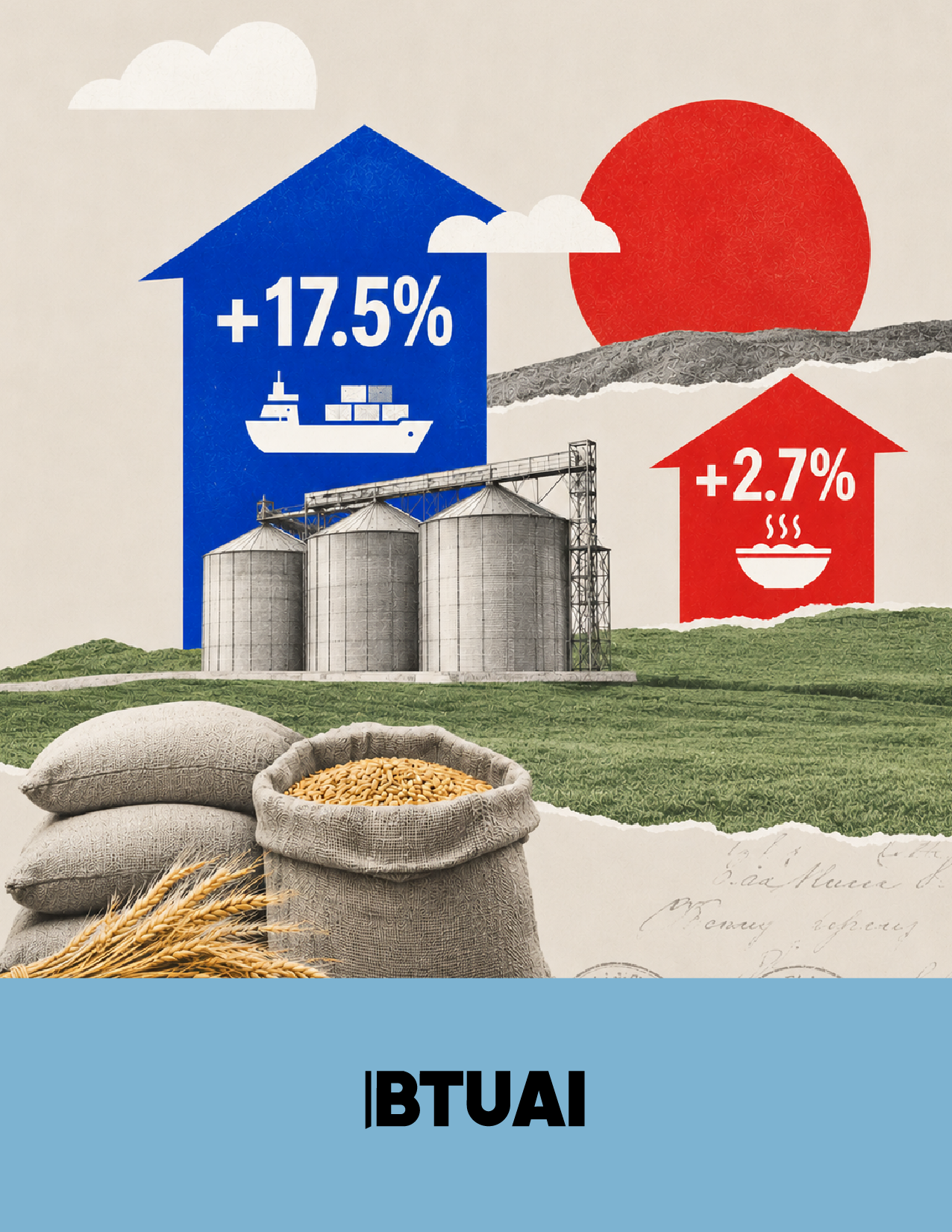
- Using Geostat’s preliminary figures, BTU calculates that petroleum and petroleum oils contributed USD 143.4 million of the USD 152.1 million annual increase in Georgian imports from Türkiye in January-September 2026: approximately 94% of the increase.
- Türkiye supplied 15.2% of Georgia’s merchandise imports in January-September 2026. On October 22, its central bank reduced the policy rate from 37% to 36% while retaining a tight monetary stance.
- BTU researchers assess that any benefit for Georgian importers depends on new supplier quotations, invoice currencies and energy costs. A policy-rate decision is not a discount already received.
Cheaper money in Türkiye is not a remote financial story for Georgia. Türkiye is the country’s largest merchandise supplier, and changes in its firms’ costs, credit conditions and pricing can reach many Georgian purchasing decisions. Yet the same monetary announcement can affect different products very differently. To understand its significance, it helps to examine what Georgia buys from Türkiye and what has been driving the value of those purchases.
On October 22, the Central Bank of the Republic of Türkiye lowered its one-week repo auction rate by one percentage point. This rate influences short-term funding conditions in the banking system; it is not the interest rate paid on every Turkish manufacturer’s loan. The trade comparison covers January-September: it describes the relationship into which the new decision arrives, not an effect the decision has already produced.
One category explains most of the increase
Geostat’s October 19 release shows annual growth of approximately 7.5% in Georgian imports from Türkiye. At first glance, that pace might suggest a broad strengthening of demand for Turkish goods. The product breakdown instead reveals an increase concentrated in one group. This matters for interpreting the monetary decision because the costs facing an energy trader and those facing a domestic manufacturer need not move through the same channels.
BTU researchers compared the annual change in total imports with the change in petroleum and petroleum oils. The table shows how closely the increase in this single category matches the overall increase. Purchases of other merchandise combined were almost unchanged. The comparison explains what the headline trade growth contains, rather than merely adding another growth statistic.
| Merchandise imported from Türkiye | January-September 2025 | January-September 2026 | Change |
|---|---|---|---|
| Total, USD million | 2,035.6 | 2,187.7 | +152.1 |
| Petroleum and petroleum oils, USD million | 67.2 | 210.6 | +143.4 |
| Other merchandise, USD million | 1,968.4 | 1,977.1 | +8.8 |
Source: Geostat, October 19, 2026. The 2026 data are preliminary. Amounts in the first two rows are official figures; other merchandise and changes are BTU calculations. Displayed values are rounded; calculations use source data at their published precision, before presentation rounding.
The nearly unchanged total for other merchandise combines divergent movements. The same bilateral table shows increases in medicines, steel bars and rods, and steel tubes and pipes, alongside a decrease in motor vehicles. Growth in one category offsets decline in another. A business considering a purchase therefore needs the relevant product and supplier conditions, rather than a national import-growth rate applied to every item.
The central calculation measures a product group’s contribution to import-value growth. That value reflects prices, physical quantities and product composition together: Geostat’s table also records a rise in petroleum tonnage. Isolating the price of an unchanged fuel would require more detailed evidence. The recorded trading partner likewise does not establish where every product was manufactured. Within those boundaries, the comparison precisely describes trade concentration, separately from any measurement of Georgian consumer prices.
What the rate cut can change
Manufacturers often incur costs before receiving sales revenue. Materials, wages and inventories must be financed while an order is being produced and delivered. If financing becomes cheaper for a supplier, its burden may ease. For a Georgian customer, the benefit need not take the form of a lower unit price. More flexible payment terms or a better offer on a smaller order could also matter.
Several steps separate the central bank’s decision from such a result. Commercial lenders must change their terms; a supplier must be able to access the new financing; and it must pass part of the benefit to its customer. None of these steps occurs immediately or identically across firms. The economically relevant development for a Georgian purchaser is therefore the receipt of a genuinely revised quotation, rather than the headline announcement alone.
Better financing terms and a lower product price have different business meanings. A longer payment period may reduce the cash needed between purchasing and selling goods even when the unit price remains unchanged. A lower price reduces unit cost, but a larger minimum-order requirement can tie up additional money in stock. Price and settlement conditions therefore need to be considered together. The distinction is particularly relevant where sales proceeds arrive after delivery of the purchased goods.
The central bank itself did not present the cut as the end of restrictive policy. Its statement described weak domestic demand and a slowing underlying inflation trend, while retaining concern about energy costs. This distinction matters: a gradual easing of financing conditions and a simultaneous reduction in all production costs are different developments.
Türkiye’s official September price review also describes an economy with continuing price increases, not general deflation. Consumer prices were 29.73% higher than a year earlier, while domestic producer prices were 27.38% higher. These are Turkish indicators, not forecasts for merchandise sold in Georgia. Their relevance is that suppliers still operate in a rising-price environment; a modest financing improvement cannot be assumed to offset all their other costs.
The exchange rate is not the shop price
Currency is another transmission channel. A Turkish supplier may pay some costs in lira, while imported inputs or energy are linked to international prices and foreign currencies. Its invoice to a Georgian buyer may be in lira, dollars or euros. The same exchange-rate movement will therefore not affect every quotation equally. A rate cut alone also cannot establish the direction or magnitude of the subsequent exchange-rate response.
If a supplier leaves its dollar quotation unchanged, a lira movement does not automatically make the product cheaper for its Georgian customer. Where the invoice is in lira, the actual lari-lira relationship becomes relevant. Goods already purchased enter the calculation at their earlier acquisition costs. A new quotation may affect retail prices only when fresh stock arrives. These distinctions are especially important when consumers expect a foreign monetary announcement to translate into a local discount the next morning.
The price on a Georgian shelf also includes more than the amount paid for an imported product. Transport, storage, distribution and local operating costs intervene. Retailers may still hold inventory bought at a different price. Competition and stock-replenishment frequency help determine how quickly a change is passed on. These mechanisms explain potential transmission; the evidence assembled here does not measure their individual strength.
Who in Georgia is exposed
The bilateral trade table includes medicines, iron and steel products, and petroleum. The issue therefore reaches beyond shops selling finished consumer products. It concerns construction supply chains, transport costs, essential health-related goods and business procurement. Changes involving a large partner can travel through several parts of the economy, although a particular firm’s exposure may differ substantially from the national average.
For a Georgian producer, there can be two sides to the adjustment. Better terms on Turkish inputs might reduce its costs. At the same time, improved financing could allow a competing Turkish producer to make a more attractive offer. A procurement opportunity for one business may be a competitive challenge for another. Describing the development simply as “cheaper imports” misses this difference.
The export channel matters too, but is smaller in merchandise value. Georgian exports to Türkiye totalled USD 359.3 million in the nine-month period. BTU’s comparison puts imports from Türkiye at approximately six times that amount. This is an asymmetry in recorded goods trade, not a judgment that the relationship is economically good or bad. Stronger Turkish demand could help Georgian exporters, but the central bank’s latest assessment still described domestic demand as weak.
A signal to compare terms
BTU researchers’ assessment is that the practical opportunity lies in distinguishing genuinely better terms from changes in headline indicators. Comparisons need the same product, delivery conditions and invoice currency. Cheaper financing may eventually support a better offer, but an importer needs an actual change in price or terms to identify the benefit. Knowing the new policy rate is neither a measure of savings nor a reliable market forecast by itself.
For now, the clearest Georgian finding is the concentration of import-value growth in petroleum. The October 22 decision introduces a possible change in supplier financing, while the January-September evidence shows how strongly another factor, connected to global commodity markets, shaped recent trade. Georgia should read the announcement as an opportunity for conditions to change-not as proof that a price reduction has already occurred. That distinction improves both business planning and consumer expectations.
Questions and Answers
Does 94% mean that petroleum represents 94% of imports from Türkiye?
No. It is petroleum’s contribution to the annual increase, not its share of all imports. The overall merchandise basket is much broader.
Does the decision lower Georgian loan rates?
Türkiye’s decision does not directly set Georgian banking rates. This analysis concerns the trade channel involving Turkish suppliers.
Why is there no forecast retail discount?
Estimating one would require product-specific new contracts, exchange rates and local cost information. The policy announcement alone cannot measure that outcome.
Does the comparison include services?
No. It covers merchandise trade. Tourism and other service flows require separate analysis.