


Key Takeaway
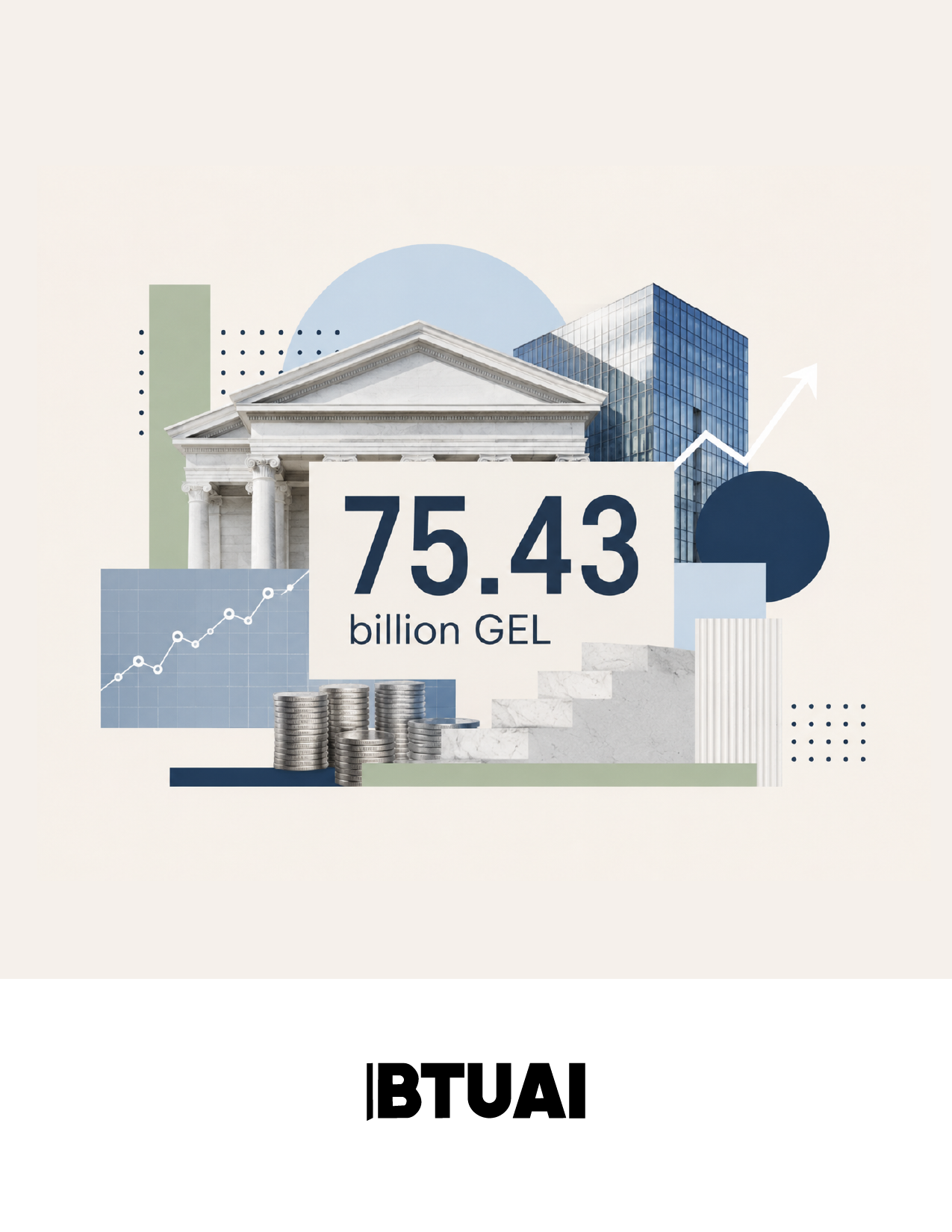
By the end of June 2026, loans issued by Georgia’s banks, excluding interbank lending, reached GEL 75.43 billion. The portfolio increased by roughly GEL 1.3 billion in one month, while annual growth excluding exchange-rate effects reached 14.47%. This expansion continued despite an 8.25% policy rate and 5.8% inflation. The central question is therefore not only how much banks are lending, but who is borrowing, in which currency, and whether credit growth is creating productive capacity or future vulnerability.
Why This Matters to Almost Every Georgian Household and Company
Credit growth is not merely a banking statistic. It affects home purchases, business inventories, equipment investment, construction, car finance and household consumption. For many Georgian firms, a bank loan is the fastest available source of growth capital; for households, it is the main way to spread the cost of housing and other major purchases over time.
The GEL 75.43 billion portfolio therefore tells two stories. One is continued economic activity and confidence in future income. The other is future repayment pressure. Credit supports development when financed assets raise productivity or living standards and income remains sufficient to service the debt. It becomes a source of fragility when debt grows faster than cash flow and repayment capacity.
What the Internal Structure of the Portfolio Shows
Lari-denominated lending increased by GEL 985.05 million in June, while foreign-currency lending increased by GEL 311.13 million. The combined increase was GEL 1.29618 billion. BTUAI’s independently double-checked calculation confirms that this equals approximately 1.75% of the previous month’s GEL 74.13 billion portfolio.
The loan larization ratio stood at 58.37%. Based on the official total, BTUAI calculates that approximately GEL 44.03 billion of loans were denominated in lari and GEL 31.40 billion in foreign currency. These are derived calculations, not separately published NBG figures. A higher lari share reduces currency mismatch for borrowers whose income is also in lari.
Households Now Account for More Than Half of Bank Lending
Household lending reached GEL 40.11 billion. BTUAI’s verified calculation puts this at approximately 53.2% of the total loan portfolio. Household credit increased by GEL 701.19 million in June, accounting for about 54.1% of the total monthly increase.
This does not prove that household indebtedness is excessive. A proper assessment requires income, interest-rate, maturity, debt-service and delinquency data. It does show that household decisions are a central driver of credit expansion, making financial literacy and realistic stress-testing increasingly important.
Foreign Currency Still Dominates Corporate Lending
Resident legal entities held GEL 11.41 billion in lari loans and GEL 21.42 billion in foreign-currency loans, a total of GEL 32.83 billion. BTUAI calculates that approximately 65.2% of corporate lending was in foreign currency and 34.8% in lari.
This is not equally risky for every company. Exporters and tourism businesses with euro or dollar revenue may have a natural hedge. A firm earning mostly in lari carries a greater mismatch. The key decision is therefore not simply where the interest rate is lower, but whether the currency of debt matches the currency of cash flow.
Credit Is Growing While Money Is Not Cheap
As of 29 July, the National Bank of Georgia’s policy rate was 8.25%, while annual inflation in June was 5.8%. This is not a low-cost-money environment. Yet annual credit growth excluding exchange-rate effects was 14.47%.
The NBG’s May financial-stability assessment reported 14.9% annual credit growth in March, healthy bank capital and liquidity, and a credit-to-GDP ratio below its long-term trend. This context suggests that strong credit growth is not automatically evidence of systemic overheating, but it does not guarantee the safety of every borrower.
An Illustrative Georgian Business Case
Consider a Georgian small manufacturer seeking the equivalent of GEL 500,000 for new equipment. A foreign-currency loan may offer a lower nominal interest rate. But if 90% of the company’s revenue is in lari, a 10% exchange-rate deterioration can raise the lari value of its debt burden even if production has not improved.
The central management question is simple: can the company still service the loan if revenue falls by 15%, the rate rises or the exchange rate moves against it? Good credit finances expansion while leaving the borrower viable under a plausible downside scenario.
The Opportunity for Banks and Businesses
Credit-market growth creates an opportunity to distinguish productive investment from consumption, natural hedging from currency mismatch, and healthy expansion from optimistic leverage. Businesses can use credit for technology, energy efficiency, exports and productivity rather than merely covering current cash gaps. Banks can deepen products that combine lending with financial diagnostics and cash-flow planning, particularly for SMEs.
BTU Researchers’ Assessment
According to BTU researchers, the June data is important not only because banks lent more, but because total scale, the household share and corporate foreign-currency exposure are rising together. Georgia’s next challenge is therefore to improve the quality of credit alongside access: matching debt currency to income, assessing genuine repayment capacity, financing productive projects and making risks understandable to borrowers.
Key Findings
- Georgia’s bank loan portfolio reached GEL 75.43 billion in June 2026, with annual growth of 14.47% excluding exchange-rate effects.
- Most of the monthly increase came from lari lending, raising the nominal larization ratio to 58.37%.
- BTUAI calculates approximately GEL 44.03 billion in lari loans and GEL 31.40 billion in foreign-currency loans.
- Household loans accounted for approximately 53.2% of the portfolio, making household debt quality a central economic issue.
- Approximately 65.2% of resident corporate lending was in foreign currency, highlighting the importance of matching debt and revenue currencies.
- Credit growth above 14% amid an 8.25% policy rate signals resilient activity but does not automatically establish borrower-level safety.
- The core opportunity for Georgia is to convert credit expansion into productive investment rather than the early consumption of future income.
Why This Matters for Georgia
Bank credit is one of the principal sources of capital in Georgia. SMEs often lack access to bond or equity markets, while mortgages remain the main path to home ownership for households. The quality of credit growth therefore affects economic expansion, financial stability, housing access and confidence in the lari. Well-structured and serviceable debt can broaden opportunity; poorly matched or overly optimistic debt can magnify the next shock.
Conclusion
A GEL 75.43 billion loan portfolio shows that demand for money and confidence in future income remain strong. But credit expansion cannot be an end in itself. A good household loan occupies a realistic share of income; a good business loan creates more productive value than its cost; and good credit growth strengthens the economy instead of accumulating the conditions for a future crisis. The next question is therefore not how much banks will lend, but how effectively that lending will become new income, productivity and durable opportunity.
Data and Main Sources
- National Bank of Georgia — June 2026 loan portfolio and interactive loan statistics.
- National Bank of Georgia — Monetary Policy Committee decision of 29 July 2026.
- National Bank of Georgia — Financial Stability and Monetary Policy Committees’ decision of 6 May 2026.
- IMF 2026 Article IV assessment of Georgia, as published by the NBG.
- BTUAI analytical processing and independently verified calculations.
This material is analytical and educational in nature. It does not constitute financial, investment, tax or legal advice. Professional advice should be obtained before making a specific decision.
Prepared by the academic team of Business and Technology University and the BTUAI Research Team, Tbilisi, Georgia.