

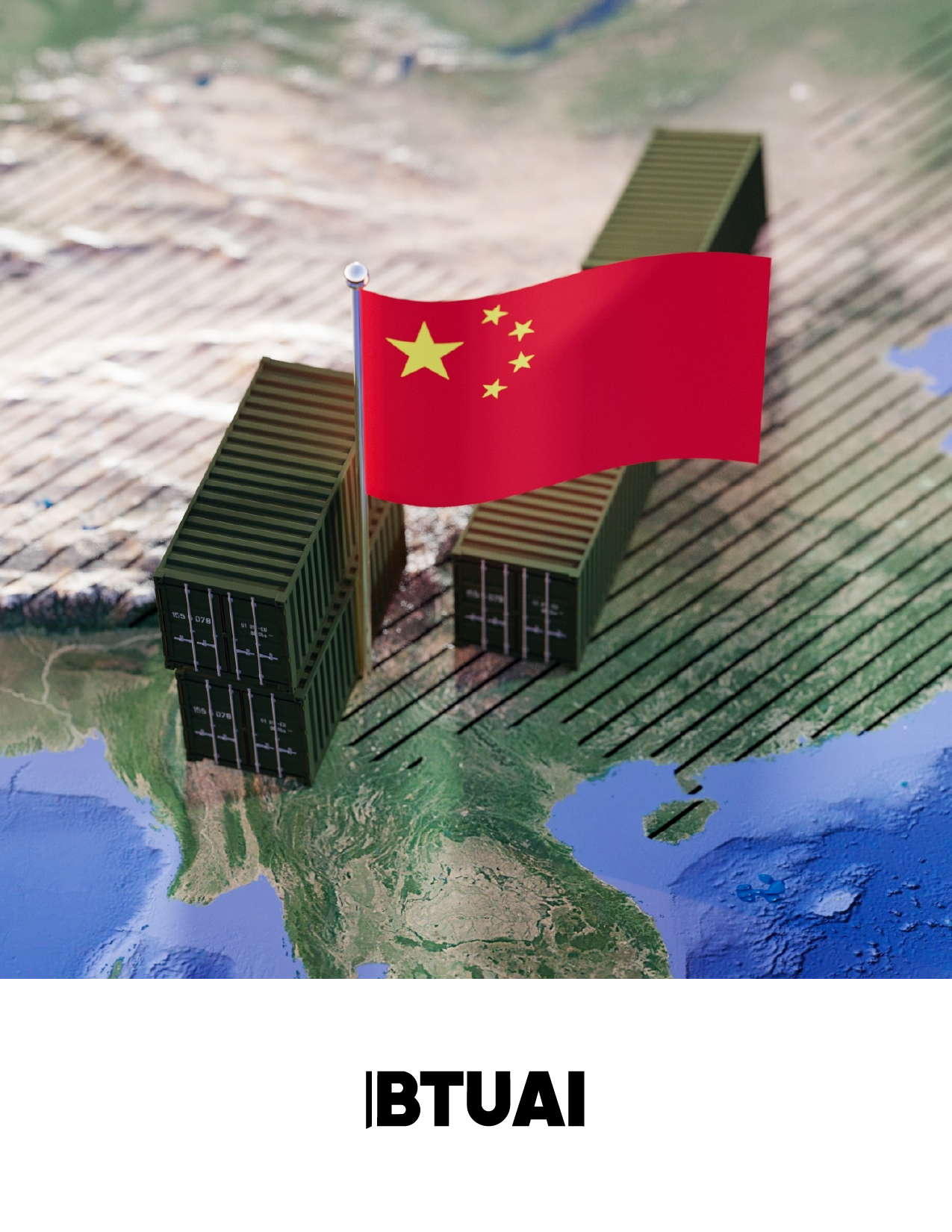

China is testing multiple routes to Europe at once. For Georgia, the Middle Corridor can no longer rely on being described as an alternative or shorter route: competition is increasingly about reliability, capacity, speed and the quality of an integrated logistics system.
The short answer
China’s push to test the Northern Sea Route shows that Asia-Europe trade is becoming more diversified. The New York Times reported on September 10 that the Chinese cargo ship Dubai Tower was completing a roughly three-week journey from Qingdao to England and that Sea Legend planned eight Arctic voyages during the season. The route can potentially save about two weeks, but ice, high insurance costs, seasonality, dependence on Russia’s northern coastline and uncertain schedules remain major constraints.
For Georgia, the strategic implication is not that the Arctic route will replace the Middle Corridor. It is that shippers and China itself are building options. Georgia’s geography creates value only when transit becomes a fast, predictable and scalable service. That challenge is tangible in 2026, with a new $372 million World Bank project for Georgia’s segment and official Georgian reporting of 21% growth in Middle Corridor freight in the first five months of the year.
Core indicators
| Indicator | Latest cited value | Meaning for Georgia |
| Northern Sea Route container ships | 13 in 2025 | Still experimental in scale |
| Suez container ships | More than 1,800 in 2025 | Main maritime route remains far larger |
| World Bank TC-GATE | $372m approved June 2, 2026 | New investment in capacity and resilience |
| Middle Corridor freight growth | +21%, Jan–May 2026 | Official signal of stronger current demand |
| Transport & storage turnover | GEL 3.5bn, Q2 2026 | Expansion of the logistics economy |
| Georgia–China merchandise trade | $1.046bn, H1 2025 | China is already a major trade partner |
Sources: The New York Times, World Bank, Geostat, Ministry of Economy and Sustainable Development of Georgia.
What the Arctic experiment actually means
The Northern Sea Route is shorter than the traditional routes via Suez or the Cape of Good Hope. The NYT article describes the 2026 Dubai Tower voyage carrying 1,300 containers of electric vehicles, batteries and other renewable-energy equipment. Its advantage is time; its weakness is reliability. The operating season is short, ice conditions are uncertain, specialized vessels and icebreaker support are needed, insurance costs are higher and much of the route depends on Russia’s northern coastline.
In 2025, only 13 container ships used the Northern Sea Route, versus more than 1,800 through Suez. According to calculations by BTU researchers, 13 is about 0.72% of 1,800 and the Suez count is roughly 138 times larger. This is a ship-count illustration, not a standardized cargo-volume comparison. It shows why the Arctic route is not yet a direct substitute for the Middle Corridor.
| Route | Advantage | Constraint | Signal for Georgia |
| Suez | Scale and mature network | Security and geopolitical shocks | Alternatives gain value during disruption |
| Northern Sea Route | Potentially shorter transit | Seasonality, ice, insurance, Russia dependence | A new option, but still very small |
| Middle Corridor | Multimodal route avoiding Russia and Suez | Multiple borders and transfer bottlenecks | Georgia can become a regional logistics node |
The Middle Corridor opportunity is large but conditional
The World Bank estimates that the right combination of investment and efficiency reforms could triple freight flows on the Middle Corridor and halve travel time by 2030. Its modeling also projects a 37% increase in trade among Kazakhstan, Azerbaijan and Georgia, and a 28% increase between those countries and the EU. These are scenario-based estimates, not guaranteed outcomes.
For Georgia, the more durable development opportunity is not simply to move Chinese cargo westward. The corridor can create more value if it also expands regional trade and supports warehousing, consolidation, distribution, customs, finance, insurance, light processing and digital logistics services inside Georgia.
Georgia’s logistics data show an expanding sector
Geostat reports that transportation and storage turnover reached GEL 3.5 billion in Q2 2026, up from GEL 2.7 billion a year earlier. According to calculations by BTU researchers, that is nominal growth of about 29.6%. Employment rose from 64,700 to 67,500, or 4.3%, while average monthly remuneration increased from GEL 2,490.1 to GEL 2,714.3, or about 9.0%.
These figures cover the whole transportation and storage sector and cannot be attributed entirely to the Middle Corridor. They do show that Georgia’s logistics economy is expanding during a period of stronger corridor demand.
| Transportation & storage | 2025 Q2 | 2026 Q2 | Calculated change |
| Turnover | GEL 2.7bn | GEL 3.5bn | +29.6% |
| Employment | 64.7k | 67.5k | +4.3% |
| Average monthly pay | GEL 2,490.1 | GEL 2,714.3 | +9.0% |
Source: Georgia’s National Statistics Office, Geostat. Changes calculated from source values and rounded to one decimal place.
2026: infrastructure is beginning to catch up
On June 2, 2026, the World Bank approved the $372 million Trans-Caspian Transport Corridor – Georgia Accessibility and Transport Enhancement (TC-GATE) project. It finances rail freight capacity, including new energy-efficient electric locomotives, modernization of key road segments and institutional reforms. The World Bank expects more than 900,000 people to benefit directly.
Georgia’s Ministry of Economy reported 21% growth in Middle Corridor freight in the first five months of 2026. A second phase of a new Poti port project also began in June. The common logic is clear: demand alone does not make a corridor competitive; Georgia needs capacity capable of absorbing that demand without congestion.
The bottlenecks are known
World Bank priorities identify rolling-stock shortages, especially locomotives in Georgia; constraints around the Akhalkalaki gauge-change node; Poti port and hinterland rail capacity; and the need for better digitalization of customs and border processes. The Middle Corridor is therefore not one infrastructure project. It is a chain whose performance is determined by its weakest handoff.
China is more than a transit customer
In January–June 2025, Georgia’s merchandise trade with China reached about $1.046 billion, equal to 8.8% of total merchandise trade. Imports from China were about $869.5 million and exports about $176.3 million. The corridor therefore intersects with an already important bilateral commercial relationship.
BTU Researchers’ Assessment
According to an assessment by BTU researchers, Georgia’s strategy should move from the idea of a transit country to the idea of a logistics platform. A transit-country model mostly counts tonnes and containers. A logistics-platform model tries to retain more value locally through warehousing, consolidation, distribution, light processing, customs, finance, insurance, cargo tracking and regional management functions.
Success metrics should therefore include door-to-door time and its variability, border dwell time, port and rail utilization, delay rates, logistics-service exports and value added — not only freight volume. Those indicators show whether geography is being converted into productivity.
Conclusion
China’s new trade routes do not undermine the Middle Corridor; they raise the performance standard it must meet. The Arctic route is still small, expensive and seasonal, but its development shows that China and global shippers want more options. Georgia has a real opportunity because demand is rising and investment is being made. Yet geography becomes a competitive advantage only through execution. A fast, predictable, digitally coordinated and value-adding corridor can make Georgia more important in an era of route diversification; a slow and fragmented one will simply face more alternatives.
Sources
The New York Times International Edition – “Arctic shortcut is a chance for China to flex its muscles”, 10 September 2026.
World Bank – The Middle Trade and Transport Corridor; TC-GATE Georgia project, 2026.
Georgia’s National Statistics Office, Geostat – transportation and storage; external merchandise trade; railway transport statistics.
Ministry of Economy and Sustainable Development of Georgia – 2026 Middle Corridor and Poti port updates.
Prepared by the academic team of Business and Technology University and the BTUAI Research Team, Tbilisi, Georgia.