



Key Takeaway
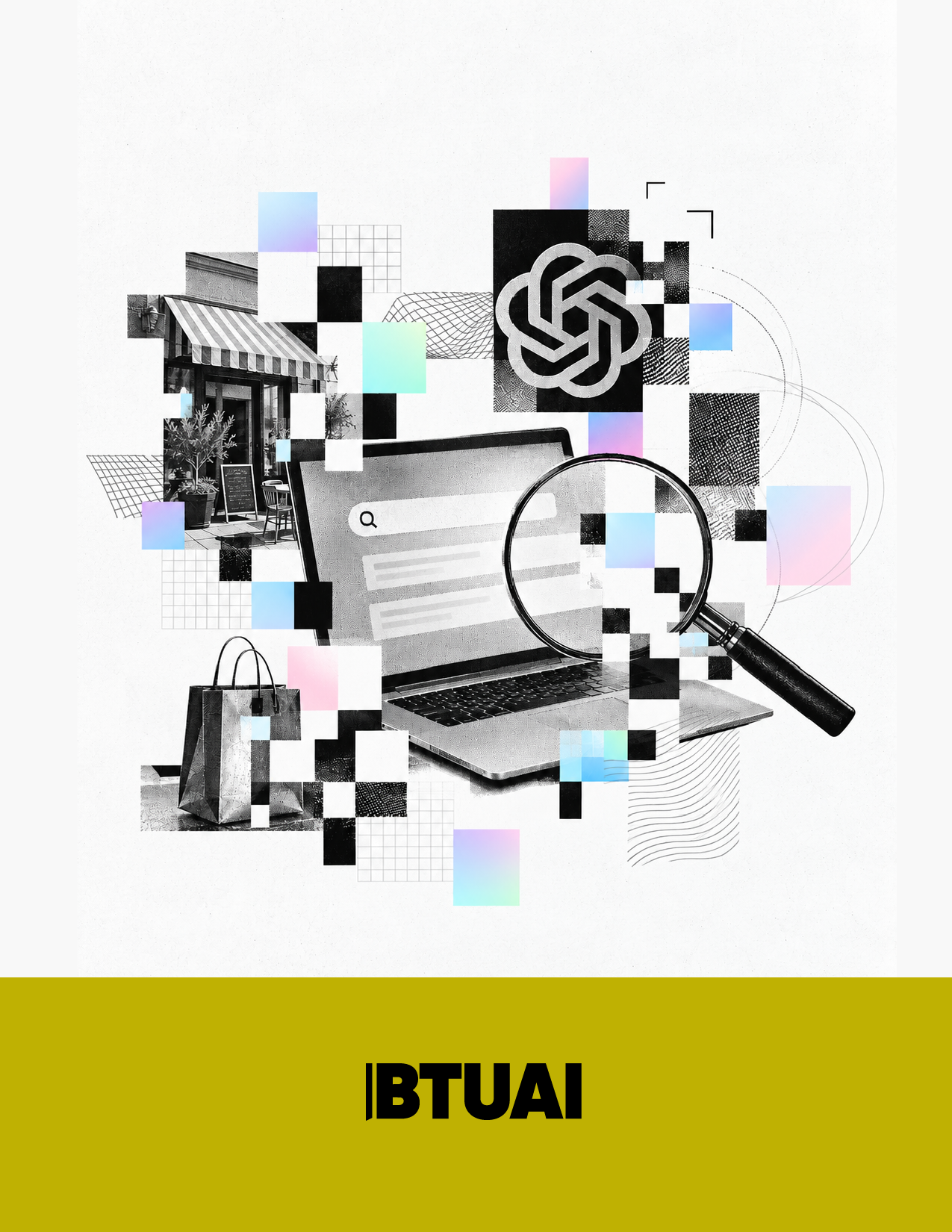
Customers increasingly encounter companies first through an AI-generated answer and only later through a website, social page, store or sales team. AI can already research products and services, compare alternatives, create shortlists and perform a growing share of the discovery process.
For Georgian companies, competition therefore begins earlier. If an AI tool omits a business, describes it inaccurately or fails to understand its real differentiation, the customer may exclude it before any direct contact.
According to BTU researchers, this creates a new management discipline: companies need to manage not only advertising and search visibility, but also the public knowledge environment from which AI systems form their descriptions.
AI Is Becoming a New Gateway to Customer Choice
In the traditional digital journey, customers searched, opened websites, read reviews and built comparisons themselves. Generative AI compresses those steps into a conversation.
OpenAI’s shopping research can clarify a user’s criteria, search across products, compare alternatives and return an interactive recommendation process. Google’s AI-shopping environment is similarly combining discovery, comparison and increasingly transactional functionality.
AI is therefore no longer only a source of information. It can become the customer’s first adviser.
International Evidence Shows the Decision Process Is Already Moving into AI
McKinsey’s 2026 European consumer research found that 63% of respondents used AI-powered tools to compare brands, models, prices and reviews. Around half also used AI to learn about products or categories and discover brands.
In Semrush’s 2026 survey of more than 1,000 US consumers, 50% reported making a purchase after using AI during research, while 22% reported completing a purchase directly inside an AI tool.
The studies use different markets and methodologies and should not be compared directly. Together, however, they point to the same shift: AI is changing not only search, but decision formation.
AI-Generated Descriptions Are a New Layer of Reputation
Business reputation used to be shaped mainly by what a brand said and what customers said. AI adds a third layer: the synthesized description.
When a customer asks which hotel, education provider, supplier or service is best for a specific need, an AI system may provide a shortlist and frame each option in a few sentences.
Those descriptions can be incomplete or wrong. AI may rely on outdated information, confuse similar businesses or miss a company’s differentiator if public content is too generic.
Digital reputation management therefore increasingly includes monitoring how major AI systems describe the company.
Generic Marketing Language Is Weak Input for AI
Phrases such as ‘high quality’, ‘professional team’, ‘individual approach’ and ‘trusted partner’ are common marketing language but provide little differentiation to an AI system.
AI performs better with concrete information: who the company serves, what problem it solves, where it operates, which conditions apply, what evidence supports its claims and which customer profile it fits best.
Google’s product documentation reflects the same practical logic. Price, availability, shipping, returns, SKU, brand and reviews can be expressed explicitly through structured product data. Structured data does not guarantee an AI recommendation, but it reduces ambiguity.
More Inquiries Do Not Always Mean More Real Demand
AI lets buyers create supplier lists and professional RFQs in minutes. A company can therefore see a rise in inbound messages without an equivalent rise in serious buying intent.
This matters most for specialist B2B and professional services, where value often comes from diagnosing the problem rather than simply sending a price.
A practical minimum is to classify incoming requests into three groups: ready for an offer, needs clarification, and likely market/price research only.
Customer Feedback Is Becoming Harder to Read
AI can help customers write, edit or polish reviews. As a result, online feedback may become more fluent while becoming less informative.
For strategy, a specific review that explains what happened, what failed and what worked can be more valuable than generic praise.
Companies should therefore evaluate feedback through two lenses: emotional tone and informational signal quality.
Georgia Already Has a Meaningful Online Buying Base
According to Geostat, 37.4% of internet users aged 15 and older had purchased or ordered goods or services online in the previous 12 months in 2025. The figure was 31.3% in 2024.
BTUAI’s verified calculation shows an increase of 6.1 percentage points, equivalent to approximately 19.5% relative growth. Among internet users aged 15–29, the 2025 rate was 61.1% – 23.7 percentage points above the overall figure.
These statistics do not measure AI-assisted purchasing directly. They show that a significant part of Georgian consumer choice already happens online. AI adds a new intermediary layer to an existing digital behavior.
The Georgian Language Is Becoming Part of Business AI Visibility
Georgia has an additional challenge: language. When there is little specific, current and reliable Georgian-language content about a business, AI-generated Georgian answers may be shallow or overly dependent on foreign-language sources.
This is especially relevant for local SMEs, regional services, tourism, education, culture and professional services with limited international coverage.
High-quality Georgian content therefore becomes a business knowledge asset – useful to people, search systems and AI systems at the same time.
Illustrative Georgian Mini-Case: A Hotel in Kakheti
Imagine two small hotels in Kakheti. One says only: ‘unique atmosphere, high-quality service, Georgian hospitality.’ The other provides concrete information on room count, location, family facilities, wine tasting, local breakfast, transfers, workspace, cancellation rules and ideal guest profiles.
The first copy may be emotionally pleasant. The second is far easier for an AI system to interpret when a customer asks for a family-friendly small hotel with wine experiences and a quiet setting.
This example does not claim that an AI system will rank hotels in a specific order. It illustrates the difference between generic promotional language and decision-useful information.
What Georgian Businesses Should Do
- Regularly test how major AI assistants describe the company in realistic customer questions.
- Correct outdated or inaccurate information at the primary public sources, not only inside internal documents.
- Replace generic claims with specific information about customers, problems, conditions and differentiation.
- Keep core product and service facts consistent across channels.
- Qualify inbound demand in B2B and specialist services.
- Analyze reviews for specificity and experience signal, not only star ratings.
- Build strong Georgian and English explanatory content when serving international or tourism markets.
- Treat AI visibility as a continuous reputation discipline rather than a one-off SEO project.
BTU Researchers’ Assessment
According to BTU researchers, AI-mediated customer choice may become a more significant shift for Georgian business than the addition of another marketing channel. The place where customers form their first impression is changing.
The biggest risk is to view AI only as an internal productivity tool and miss the external change: customers are using AI to evaluate companies.
Advantage will not belong only to the most famous brands. It can also go to businesses whose public information is specific, consistent, current and verifiable.
Key Findings
- AI is becoming a new intermediary in customer choice and may describe a business before direct customer contact begins.
- McKinsey’s 2026 research found that 63% of European consumers used AI tools to compare brands, prices and reviews.
- Semrush’s 2026 US survey found that 50% had made a purchase after using AI during research; this is not a direct measure of Georgian consumers.
- Georgia’s online-purchasing rate increased from 31.3% in 2024 to 37.4% in 2025, a gain of 6.1 percentage points.
- AI-assisted research can generate more inbound inquiries without the same increase in qualified demand.
- Generic marketing copy is weak machine input; specific and consistent information is becoming a visibility asset.
- High-quality Georgian-language public content matters for accurate AI descriptions of local businesses.
Why This Matters for Georgia
In a small market, customer shortlists can form quickly. If AI increasingly creates the first shortlist, the quality of the AI-generated description may matter especially in tourism, education, professional services, e-commerce and B2B.
This is also an opportunity for smaller companies. Improving AI visibility does not always require large advertising budgets. Accuracy, specificity, reviews and current public information can create meaningful advantage.
Conclusion
AI does not remove customer choice, but it changes how that choice is prepared. The customer may still decide, while AI increasingly shapes the initial shortlist, comparison and questions.
Georgian companies therefore face a new competitive question: what does AI say about us when we are not part of the conversation?
A company that manages that question systematically is not only improving AI visibility. It is strengthening digital reputation, sales quality and customer experience.
Data and Main Sources
- McKinsey & Company – Europe’s Agentic Commerce Moment: Decision Influence Is Here; Execution Is Coming, March 2026.
- Semrush – How AI Tools Influence the Modern Buyer Journey: A Survey of 1,000+ US Consumers, March 2026.
- OpenAI – Shopping Research and Product Discovery in ChatGPT, 2025–2026.
- Google – AI Shopping, Universal Commerce Protocol and Product Structured Data guidance, 2026.
- National Statistics Office of Georgia – Indicators of Using Information and Communication Technologies (ICT) in Households, 2025.
- BTUAI Research Team – Georgia-focused analytical interpretation.
Prepared by the academic team of Business and Technology University and the BTUAI Research Team, Tbilisi, Georgia.