


Main conclusion
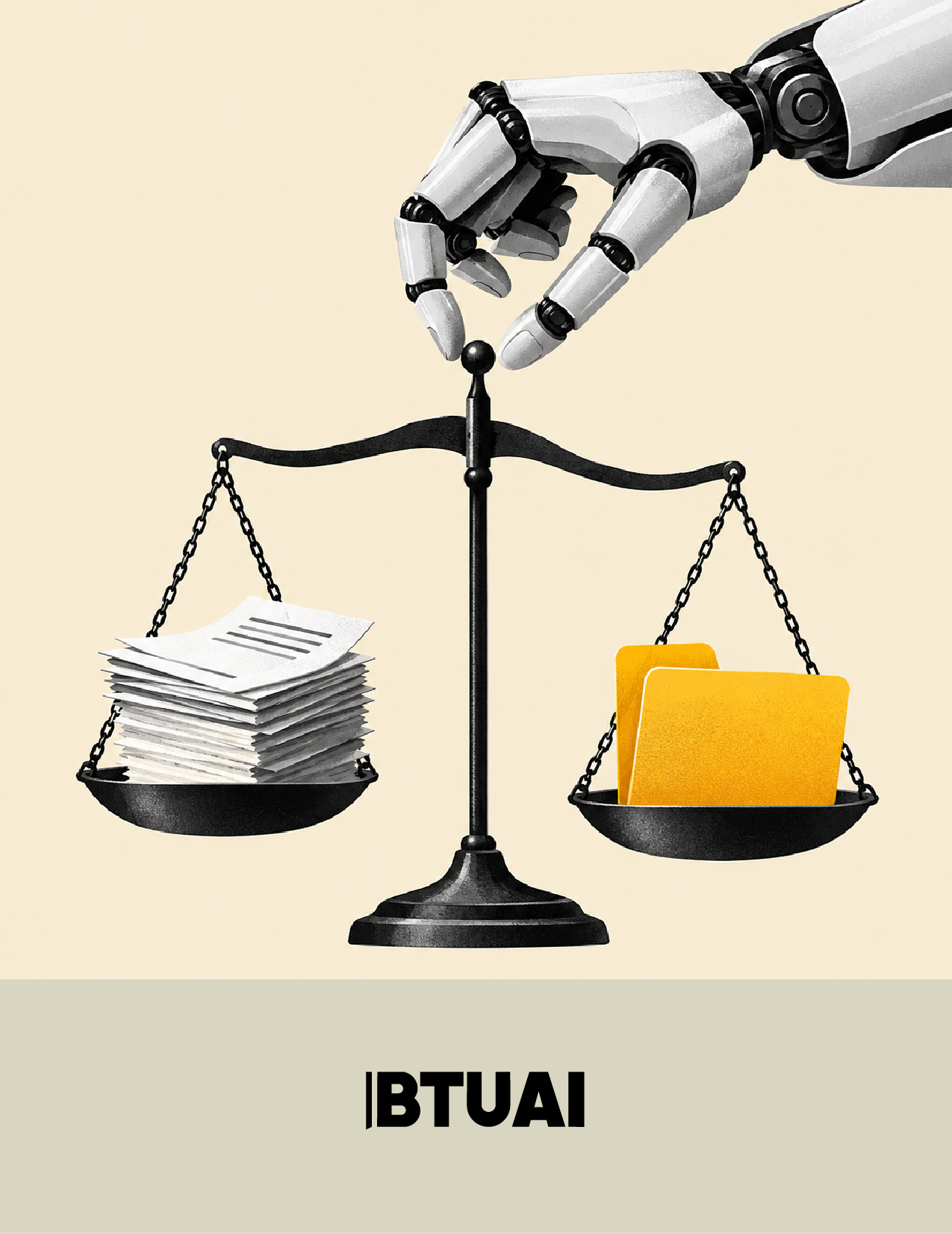
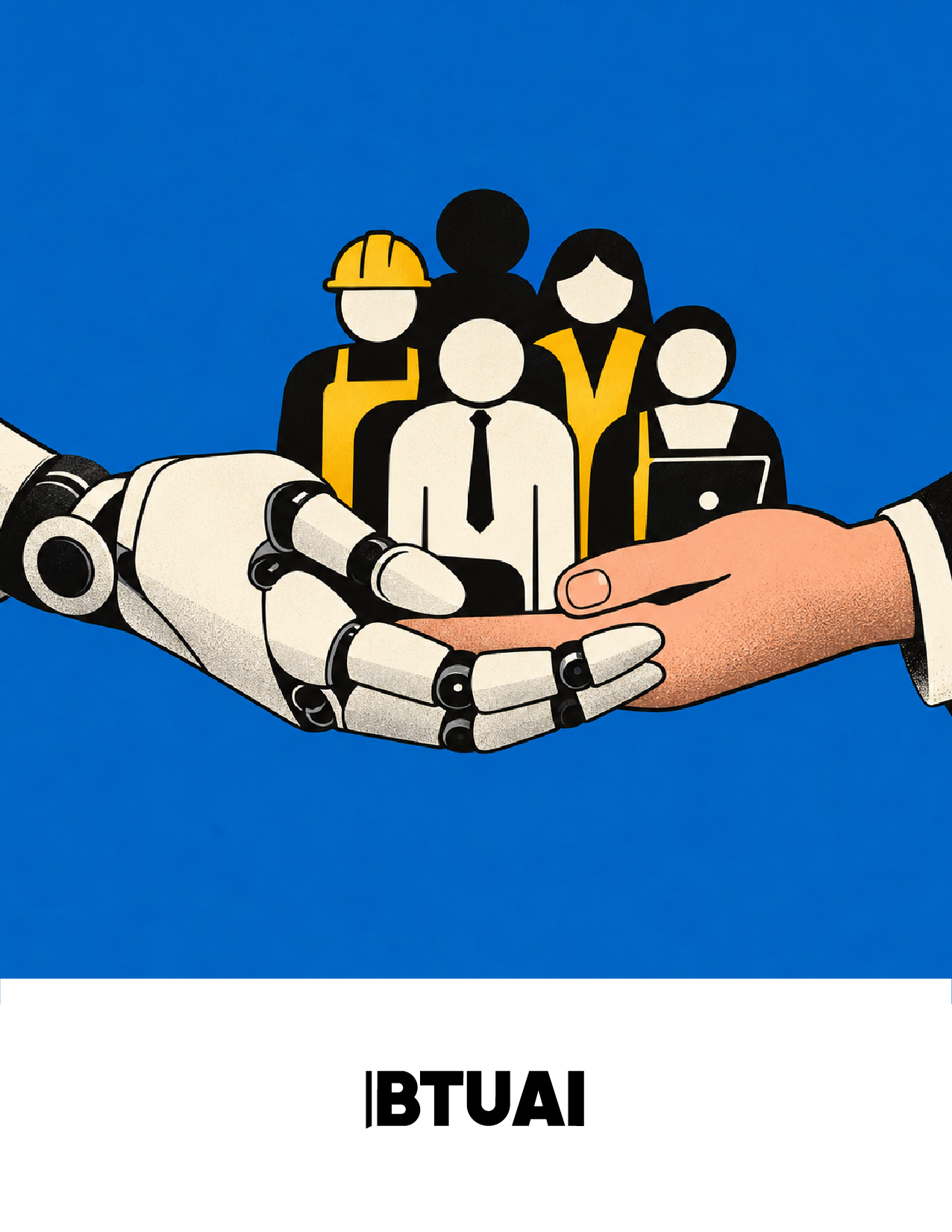
For Georgian business, the strongest starting model for artificial intelligence is not employee replacement but work redesign. A company should decompose jobs into tasks, assign repetitive and lower-risk work to AI, and redirect released time toward sales, service quality, data control, product development and new employee capabilities.
This matters especially in Georgia. The market is small, experienced specialists are difficult to replace quickly, and organisational knowledge is often stored in people rather than documented processes. Removing one position may reduce payroll while also removing client relationships, exception-handling experience and crisis capability.
BTU researchers recommend a staged model without automatic employment cuts: task mapping, a bounded pilot, an explicit time-dividend plan, role redesign, practical reskilling and a dual performance scorecard. Productivity should count as success only when time and cost fall without increasing errors, hidden verification work, customer risk or the loss of critical human skills.
Where Georgia stands
Geostat data show that 3.77% of internet-connected enterprises used specified AI technologies in 2025, up from 2.16% in 2024. BTU researchers calculate an increase of 1.61 percentage points, or about 74.5% in relative terms. Adoption reached 25.82% among large enterprises but only 3.38% among small firms. The opportunity is expanding quickly, yet formal organisational deployment remains concentrated.
A survey of Business Association of Georgia member companies describes a broader layer of experimentation. In the second quarter of 2026, 13% reported full integration in one or more processes and 47% were researching or planning adoption. Among users, 79% identified time savings and faster processes as the main benefit. A shortage of specialists was the leading barrier for 30%, while 65% planned to increase AI budgets over the next one to two years.
The figures measure different populations and definitions. Geostat records specified technologies at enterprise level; the association survey captures member companies at several adoption stages. Together they reveal a transitional condition: employees may already use chatbots, while workflow, accountability, data rules and performance measurement remain unchanged.
BTU’s study of 37 small and medium service firms found that early use usually begins with document preparation and data analysis. Formal training was rare and knowledge often spread informally between colleagues. The sample is small and sector-specific, but it illustrates the gap between access to a tool and genuine organisational redesign.
A job is not one task
A sales manager researches prospects, drafts messages, updates records, speaks with customers, interprets unstated needs, negotiates terms and remains accountable for promises. A finance employee collects documents, validates data, prepares reports, explains variances and decides when an issue requires legal or tax escalation. AI can accelerate drafts, classification, summaries and anomaly detection. That does not automatically replace relationships, contextual judgment, exception management or accountability.
The ILO cautions that exposure indicators show what technology could do, not what will happen to employment. Outcomes depend on work organisation, feasibility, skills and management choices. Evidence from roughly 5,200 customer-support workers offers a useful mechanism: an AI assistant increased issues resolved per hour by about 14–15% on average, with the largest gains among less experienced staff. The percentage is not universal, but the study shows how AI can diffuse effective practice and accelerate learning.
The Georgian task to capacity model
Task map
Describe actual work rather than only departments and titles: time, inputs, error consequences, review and accountability. Divide tasks into AI-prepared work, joint human-AI work, human-only decisions and redundant steps that should disappear. Hiring, dismissal, credit, health, legal obligations and material financial risk require meaningful human control.
Bounded pilot
Start with one process, such as meeting summaries, first drafts, catalogue descriptions, request classification, report preparation or knowledge search. Record a baseline, a process owner, permitted data, review rules and stop conditions. Do not convert a few weeks of time savings into an automatic employment decision; short pilots rarely capture seasonality, difficult cases, customer reactions or the full cost of errors.
Time dividend ledger
Decide in advance where released time will go: faster service, sales outreach, receivables control, quality checks, documentation, product testing or learning. In a 100-person company, if 20 employees recover 10% of working time, the result is capacity equivalent to two full-time work-years. At the Q2 2026 average business-sector monthly remuneration, the annual payroll value of that capacity is about GEL 59,316. This BTU calculation is not a saving or a dismissal target; it measures a resource to be redeployed.
Role redesign
Every redesigned role should state what AI performs, what the employee verifies, which decisions remain human-only and who is accountable. A worker must not become a passive approval click. New responsibilities may include process ownership, AI-output review, data quality, knowledge curation and automation coordination. In a small firm, one person may combine several responsibilities, but the mandate and time allocation must remain explicit.
Capability ladder
Not everyone needs to code. The base layer is task formulation, data protection, verification and incident reporting. The next layer is domain judgment: knowing when the system is unreliable and where exceptions occur. Higher levels cover workflow design, data governance, evaluation and control of agent mandates. Training should be tested on real work, not attendance, and critical manual capability should be exercised periodically.
Dual scorecard
Measure both business and human outcomes. Business indicators include cycle time, unit cost, errors, sales, response speed and quality. Human indicators include workload, overtime, independent capability, new skills, decision authority and trust. Faster output is not genuine productivity when hidden review time, error cost or employee overload rises.
How functions change
| Function | AI contribution | Expanded human role |
| Marketing | Research summaries drafts and variants | Positioning fact-checking and campaign decisions |
| Sales | Prospect preparation CRM updates and message drafts | Relationships negotiation needs and closing |
| Service | Classification answer drafts and knowledge search | Empathy difficult cases remedies and accountability |
| Finance | Document extraction reconciliation and anomaly flags | Explanation control approval and escalation |
| Human resources | Drafts learning materials and administration | Selection fairness feedback and development |
| Operations | Schedules forecasts and monitoring | Exceptions safety supplier coordination and risk |
A practical employment compact
Adoption without employment reduction does not mean that an organisation can never change. It means that short-term time savings from an AI pilot do not automatically trigger dismissal. Employees should know what changes, what remains unchanged, how success will be measured, which new responsibilities are available and how to contest an error or unfair decision.
BTU researchers recommend four rules: pilot-stage employment decisions should not rely only on AI time savings; internal mobility and reskilling should precede external reductions; employees should participate in workflow redesign; and consequential decisions should remain with accountable humans. This is also good implementation economics. Workers who see AI only as a replacement threat are less likely to surface process weaknesses and tacit knowledge.
The national opportunity
Georgia’s business sector employed 828,400 people in the second quarter of 2026. In a transparent BTU scenario, if only 10% participated in well-designed AI workflows and 5% of their time was effectively redirected, the capacity would equal about 4,142 full-time work-years. This is not a forecast of jobs or displacement. It is an illustration of scale.
Georgia’s strategic choice is whether such time becomes workforce reduction or new productive capacity. In a small economy, the second path is often more valuable: serve more customers, prepare export materials, test products, repair neglected data and build employee capability without equivalent mass hiring.
Final assessment
AI adoption without reducing employment is realistic when the company applies technology to tasks rather than titles and assigns a destination to released time. This does not reject efficiency; it converts productivity into revenue, service, quality and capability.
BTU researchers conclude that Georgian firms should replace the question of how many people AI can substitute with three more useful questions: how many low-value hours can be released, where will that capacity go, and which higher-value responsibility will the employee gain? That is the route through which technology can strengthen both the company and the professional value of its workforce.