



Main conclusion
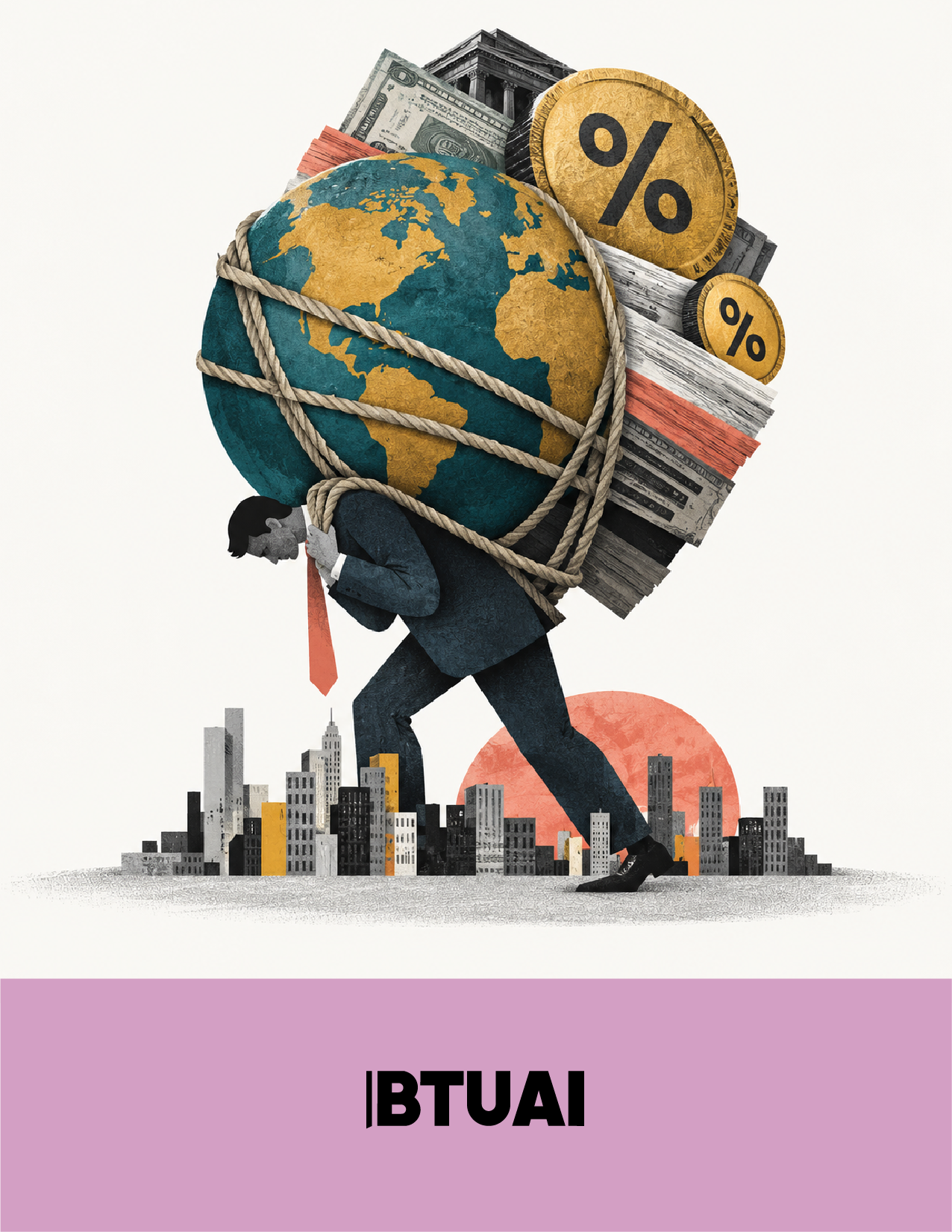
The world economy has entered a period in which high debt and relatively expensive money coexist. The IMF estimates that global public debt reached just under 94% of world GDP in 2025 and is projected to reach 100% by 2029. In September 2026, the US federal funds target range stood at 3.75–4.00%, while the European Central Bank’s deposit facility rate was 2.50%. This environment raises the price of capital and makes investors more selective toward smaller and riskier borrowers.
For Georgia, the risk is not limited to a mechanical increase in a foreign benchmark. A wider risk premium may matter more. When large economies issue debt at attractive yields, Georgia’s government, banks and companies must offer investors additional compensation. High global debt also increases the probability of abrupt market repricing, capital outflows and exchange-rate volatility.
BTU researchers assess Georgia as relatively resilient but not insulated. The transmission differs by sector: the state faces higher refinancing costs; banks face more expensive foreign funding and deposits; businesses face higher interest payments and currency mismatches; households face higher payments on new or variable-rate mortgages. The key distinction is timing. Higher rates do not reprice the entire debt stock immediately. New, floating-rate and soon-to-mature debt is affected first.
| Sector | Main channel | First line of defence |
| Government | Refinancing cost and FX exposure | Maturity management and fixed concessional funding |
| Banks | External funding, deposits and repricing | Liquidity, hedging and maturity matching |
| Business | Floating rates and currency mismatch | Cash-flow stress tests and natural hedges |
| Mortgages | Rate resets and household budget stress | Fixed terms, buffers and prudent refinancing |
Why global debt matters for Georgia
High debt does not automatically create a crisis. The pressure emerges when old, cheap debt must be replaced with new, more expensive funding. According to the IMF, global public interest spending rose from about 2% to nearly 3% of GDP in only four years. More budget money is therefore absorbed by past borrowing, leaving less for education, infrastructure and social protection.
Heavy issuance by major economies also crowds the market. If safe US or European bonds already offer attractive returns, a Georgian borrower must pay a premium. The final cost equals the benchmark rate plus compensation for country risk, liquidity, maturity, currency and borrower quality. A one-percentage-point increase abroad therefore need not translate into exactly one point in Georgia; the effect can be smaller, or larger if the risk premium widens.
Georgia’s starting position
At the end of the second quarter of 2026, Georgia’s gross external debt was $28.2 billion, equal to 69.3% of GDP over the preceding four quarters. The public sector accounted for $11.3 billion, including $9.1 billion for general government. Banks’ external debt stood at $10.8 billion. Foreign currency accounted for 83.1% of gross external debt.
These liabilities do not mature together and do not carry identical conditions. Some are long-term, fixed-rate or concessional; others are floating-rate or market-funded. The correct risk questions are therefore: how much must be refinanced soon, how much reprices with a benchmark, and whether the borrower earns income in the currency of the debt.
The National Bank of Georgia kept its policy rate at 8.25% in September 2026, while annual inflation was 5.6% in August. Lari funding is therefore expensive as well. A global shock can reach Georgia directly through foreign funding and indirectly through the exchange rate and inflation, potentially requiring domestic monetary policy to stay tight for longer.
Government
The budget risk appears at refinancing
A meaningful share of Georgia’s sovereign financing comes from international financial institutions and partner governments. Long maturities, concessional terms and fixed rates provide an important buffer. Yet the protection is not permanent. New infrastructure loans, bonds and maturing liabilities are priced under current market conditions.
BTU researchers calculate that a one-percentage-point increase adds about $1 million of annual interest for every $100 million of new or refinanced debt. The difference is $5 million on $500 million and $10 million on $1 billion. This is a sensitivity scenario, not a budget forecast: the actual result depends on the amount refinanced, maturity, currency and whether the rate is fixed or floating.
Exchange-rate risk is the second channel. Lari depreciation increases the domestic-currency value of foreign debt even if its dollar or euro amount is unchanged. The third channel is fiscal opportunity cost. A higher interest bill may remain legally manageable but still crowd out roads, schools, healthcare and social programmes.
BTU researchers do not view a complete halt to borrowing as the right response. Long-term debt for productive infrastructure can be justified when the economic return exceeds the full financing cost. The priority should be smoother maturity profiles, protection of fixed-rate funding, deeper local-currency markets and stress-testing large projects against higher rates and a weaker exchange rate.
Banks
Expensive funding does not automatically mean a banking crisis
Georgia’s banking loan portfolio reached GEL 76.45 billion at the end of August 2026 and grew 14.8% year on year after removing exchange-rate effects. Banks’ external debt was $10.8 billion at the end of the second quarter. Global funding costs therefore matter, but their impact depends on the mix of deposits, institutional credit lines, bonds and other funding.
If a bank renews $100 million of foreign funding at a rate one percentage point higher, the gross annual interest-cost difference is about $1 million before hedging and other expenses. Yet income may also rise when floating-rate loans reprice. The net effect depends on the timing, currency and rate structure of assets and liabilities, competition and borrower quality.
Pressure becomes more serious when liabilities reprice faster than assets, or when borrowers cannot absorb higher payments and credit losses rise. Deposit competition is another route: high foreign yields and domestic inflation can raise the return expected by savers, making local funding more expensive.
BTU researchers assess the joint management of dollarisation, maturity mismatch and borrower credit risk as the central task. Capital and liquidity buffers reduce the shock but cannot replace a client’s income. Banking resilience therefore also depends on early identification of stress and responsible restructuring.
Business
Currency mismatch is the key vulnerability
In August 2026, loans to resident legal entities amounted to GEL 11.20 billion in domestic currency and GEL 21.57 billion equivalent in foreign currency. BTU researchers calculate that foreign currency represented about 65.8% of the combined total. This does not make every company vulnerable: exporters, hotels and other firms may earn revenue in the same currency. The greatest risk lies with a company that borrows in dollars or euros but earns mainly in lari.
On a variable-rate business loan, an additional percentage point implies roughly GEL 10,000 of extra annual interest on GEL 1 million outstanding, before amortisation and fees. On GEL 10 million, the sensitivity is GEL 100,000. If lari depreciation occurs at the same time, both the lari value of the principal and the interest burden can rise.
Low-margin firms that cannot pass costs to customers are affected first. Retail, construction, import-dependent production and seasonal businesses may face expensive credit, weaker demand and costlier imports simultaneously. Firms then reduce inventories, delay investment or hiring, transmitting expensive money into the real economy.
BTU researchers recommend a combined stress test: a two-point rate increase, 10% lari depreciation and a 10% sales decline. If debt service is possible only through fresh borrowing under that scenario, the capital structure is already fragile.
Mortgage borrowers
Global rates reach households indirectly
A Federal Reserve or ECB decision is not copied directly into a Georgian mortgage. For lari loans, the more immediate factors are the NBG policy rate, inflation, bank funding costs, credit risk and competition. In August 2026, the average rate on new lari mortgages was 11.19%, 1.90 percentage points lower than a year earlier. This is an important reminder that local lending rates do not move in one direction at all times, even when global money remains expensive.
The risk persists if high global rates increase funding costs, weaken the currency or keep inflation elevated. New loans and floating-rate contracts are exposed; an existing fixed-rate loan is protected until its reset date. Borrowers should identify whether the rate is fixed, the benchmark used, the reset frequency and the full refinancing cost.
BTU researchers calculate that a GEL 100,000, 15-year annuity mortgage at 11.19% implies a monthly payment of about GEL 1,149. At 12.19%, the payment rises to about GEL 1,212, or GEL 64 more per month. At 13.19%, it reaches roughly GEL 1,278, or GEL 129 more. The illustration excludes insurance, fees and individual contract terms.
Interest is only one household risk. Higher utility costs, weaker labour income or an exchange-rate shock may occur at the same time. Mortgage safety should therefore be measured not by the ability to make the first payment, but by the ability to keep paying under a tougher scenario while retaining an emergency buffer.
The adverse scenario
The most damaging combination for Georgia would be high international rates together with a wider risk premium, lari depreciation and slower growth. Government financing would become more expensive; banks would face higher funding costs and credit losses; businesses would lose demand; and household income would weaken.
A milder and more likely scenario is gradual repricing. Old cheap debt expires, average interest costs rise over several years, and investment and consumption lose resources without a dramatic crisis. This is the least visible but potentially most persistent cost of expensive money.
What Georgia should do
- Publish a clearer multi-year profile of government refinancing, floating-rate exposure and interest expenditure, not only the headline debt stock.
- Stress-test public projects against higher rates, a weaker lari and construction-cost overruns together.
- Deepen the domestic lari bond market to reduce dependence on foreign currency and external investors, while recognising that local funding also carries a cost.
- Require banks to test borrowers against combined interest-rate and exchange-rate shocks, not only current income.
- Encourage businesses to match debt currency with revenue currency and avoid concentrating refinancing in one year.
- Help households understand benchmarks, reset dates, effective rates and the true cost of refinancing.
Final assessment
High global debt does not imply an inevitable Georgian crisis. Long-term institutional financing, banking supervision and the growth of lari instruments are meaningful buffers. Yet the high foreign-currency share of external debt and corporate credit makes Georgia sensitive to a simultaneous change in rates, exchange rates and confidence.
BTU researchers conclude that the goal should not be to predict the exact date of the next Fed or ECB cut. Georgia needs a debt structure that can withstand rates remaining high. For government, this means fiscal space and maturity management; for banks, liquidity and responsible lending; for businesses, currency and cash-flow matching; and for households, contract literacy and financial reserves. Expensive money hurts most not necessarily where debt is largest, but where short maturities, floating rates, foreign currency and unstable income coincide.
Disclaimer This material is analytical and educational. It is not financial, investment, tax or legal advice. Consult an appropriate professional before making a specific decision.