

Key Takeaway
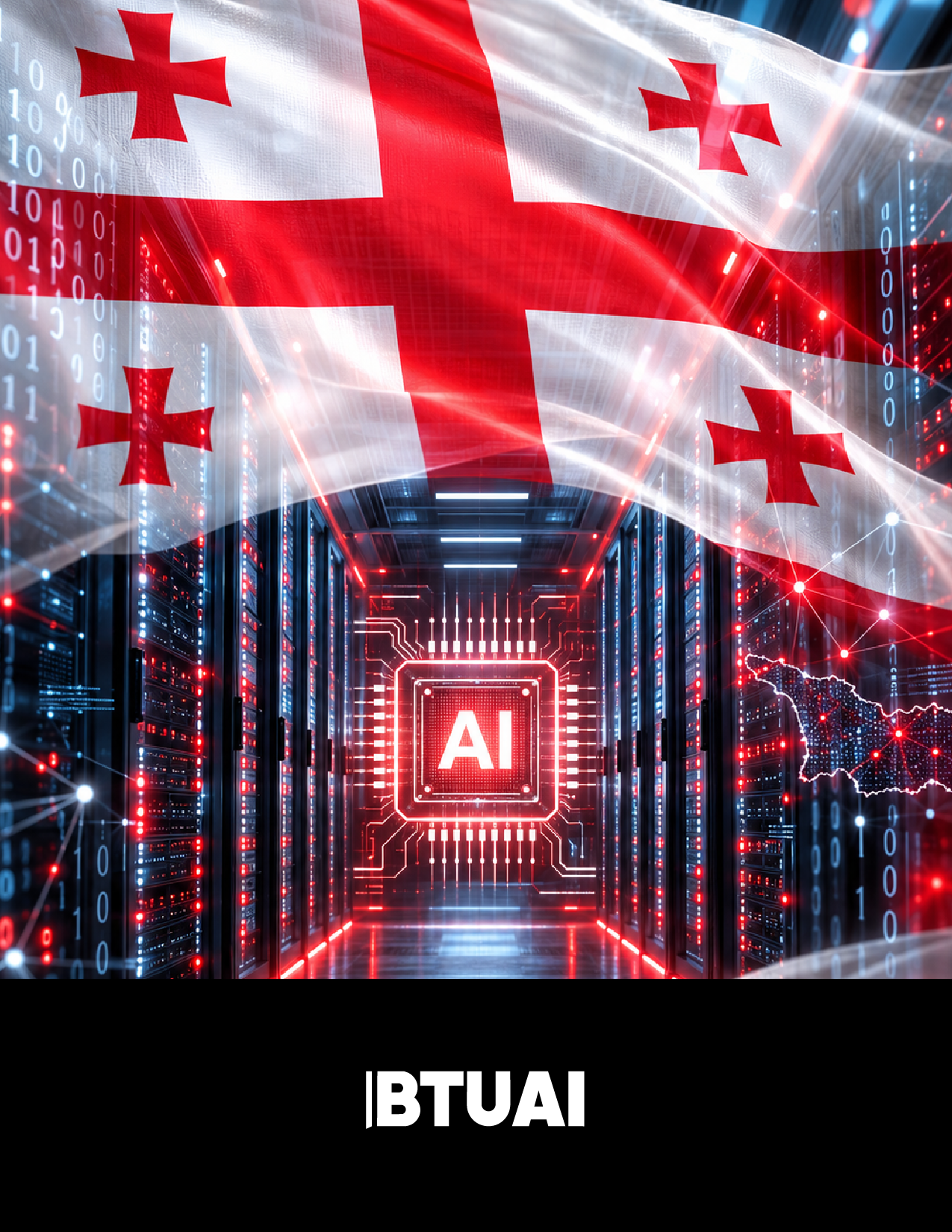
For a small country, AI sovereignty does not necessarily mean building a frontier model from scratch. A more practical capability is to control the local layers that global models cannot reliably create on their own: deep knowledge of the country and a technical description of how the local language carries meaning. Two initiatives at Business and Technology University – Georgia’s digital knowledge bank and the Georgian Language Digital Sovereignty Project – address these complementary layers. One asks what AI should know about Georgia; the other asks how AI should understand that knowledge in Georgian. Together, they form a more credible foundation for local AI capability than either data volume or language technology alone.
Knowledge volume and language understanding are different problems
An AI system can see millions of Georgian texts and still understand Georgia only superficially. It may recognize company names, cities, institutions, and historical facts but miss regional differences, the timing of events, sector-specific realities, or the relationships between Georgian institutions. Conversely, a model can possess information about Georgia and still misread who performed an action in a Georgian sentence, how a verb encodes participants, or what an idiom means in context.
That is why two infrastructures matter. The knowledge layer contains economic data, business information, regional context, companies, sectors, events, research, and historical material. The language layer describes the grammatical, morphological, semantic, and cultural structures required to interpret that knowledge accurately.
The Georgian digital knowledge bank: infrastructure for national context
BTU’s current official description states that its Georgian digital knowledge bank now contains up to 7 billion tokens of Georgian-language resources and up to one million research outputs. The collection spans economic and business information, sectoral and regional data, companies, scientific publications, research, analytics, media archives, educational resources, and other material intended to improve how AI agents and digital assistants work with Georgian context.
Language sovereignty: infrastructure for reading that knowledge correctly
BTU launched the Georgian Language Digital Sovereignty Project on June 9, 2026. Its stated goal is to help AI systems preserve Georgian semantic precision, grammatical logic, and cultural depth rather than merely read or translate surface text. The project has explored Georgian verb structures, natural sentences, likely AI error types, and a pilot evaluation architecture.
This is the layer a knowledge bank cannot supply simply by becoming larger. The knowledge system can tell AI which company, region, statistic, or event exists; language infrastructure helps the model understand who did what, how responsibility is encoded, what context is implicit, and where literal processing would distort meaning.
Two projects, one more complete AI stack
| Layer | What it gives AI | Risk if missing |
|---|---|---|
| Georgian digital knowledge bank | Deep context on Georgia’s economy, business, regions, companies, events, and institutions | AI may speak Georgian fluently but know the country only superficially |
| Georgian language digital sovereignty | Structured grammar, semantics, verb logic, idioms, error categories, and evaluation concepts | AI may see large quantities of Georgian text but misread meaning and responsibility |
| Combined use | Country context plus language structure and evaluation | Content and language remain disconnected, with no shared quality-control logic |
What digital sovereignty can realistically mean for Georgia
Digital sovereignty is often confused with producing every layer of technology domestically. For a small country, that is neither necessary nor realistic. Georgia can use global foundation models while maintaining strategic control over the layers that define its language, knowledge, evaluation criteria, and data governance.
The international context: language inequality is becoming AI inequality
UNESCO’s 2025 Global Roadmap for Multilingualism in the Digital Era connects language technologies to education, public services, digital participation, community governance, and data sovereignty. UNESCO notes that roughly 7,000 languages are in use worldwide but only about 1,000 are represented online. Its roadmap emphasizes language-community involvement, policy, capacity, research and development, infrastructure, and support for under-resourced languages.
Georgian is not an endangered language in the conventional sense, but it still faces a scale disadvantage in AI compared with English and other high-resource languages. That means the strategy cannot be “more Georgian text” alone. It requires curated domain knowledge, structural linguistic descriptions, evaluation tasks, and continuous updating.
Where the combined infrastructure could matter
If the knowledge and language layers mature together, they can affect areas where errors have real costs. Education systems can explain Georgian content more accurately; businesses can work with local markets, contracts, and customer language more effectively; public services can process Georgian requests with better context; media systems can distinguish historical from current information; researchers can connect Georgian sources with international evidence; and professional AI agents can operate with local sector knowledge rather than generic global assumptions.
This becomes especially important with agents. A chatbot error may be a poor answer. An agent can act on that answer – write a document, update a record, fill a form, prepare an analysis, or interact with a customer. In that environment, linguistic and contextual accuracy become operational safety issues.
BTU Researchers’ Assessment
According to an assessment by BTU researchers, the strategic value of combining the knowledge bank with the Georgian Language Digital Sovereignty Project is that they build two assets that are hardest to import: deep local context and a technical description of Georgian meaning. Compute and foundation models can be sourced globally; Georgia’s economic history, regional reality, grammatical logic, and locally meaningful evaluation criteria cannot be fully outsourced. Local control over these layers is a practical form of digital sovereignty.
Why This Matters for Georgia
The significance extends beyond technology. It affects the visibility of Georgian knowledge, the functional future of the language, business productivity, educational quality, research capacity, and the accuracy of public services. If global AI systems understand Georgian poorly and lack local context, Georgia risks receiving lower-quality digital services precisely as AI becomes everyday infrastructure. If the country develops its own knowledge, language, and evaluation layers, it can adapt global AI capabilities to local needs more effectively.
Conclusion
Giving AI more Georgian text is necessary, but it is not enough. AI must also understand the language, context, and relationships carried by that text. This is why Georgia’s digital knowledge bank and the Georgian Language Digital Sovereignty Project are more powerful together than separately.
Their success should ultimately be measured not in billions of tokens, but in outcomes: more accurate and timely answers about Georgia, fewer Georgian-language errors, safer professional agents, and stronger local capacity to define how technology understands the country. In that sense, knowledge infrastructure and language infrastructure are foundations of Georgia’s digital self-representation in the AI era.
Data and Main Sources
BTU – Georgian Digital Knowledge Bank: https://btu.edu.ge/tsodnis-banki/
BTU – Launch of the Georgian Language Digital Sovereignty Project: https://btu.edu.ge/btu-m-qarthuli-enis-tsiphruli-suverenitetis-proeqti-daitsqho/
BTU – Georgian Grammar for Artificial Intelligence – Stage 1: https://github.com/BTU-Business-and-Technology-University/georgian-grammar-for-ai
BTU – Georgian Language AI Modeling Dataset v1.1: https://github.com/BTU-Business-and-Technology-University/georgian-language-ai-modeling-dataset
UNESCO – Global Roadmap for Multilingualism in the Digital Era: https://www.unesco.org/en/global-roadmap-multilingualism
Universal Dependencies – UD Georgian GNC: https://universaldependencies.org/treebanks/ka_gnc/index.html
Prepared by the academic team of Business and Technology University and the BTUAI Research Team, Tbilisi, Georgia.