




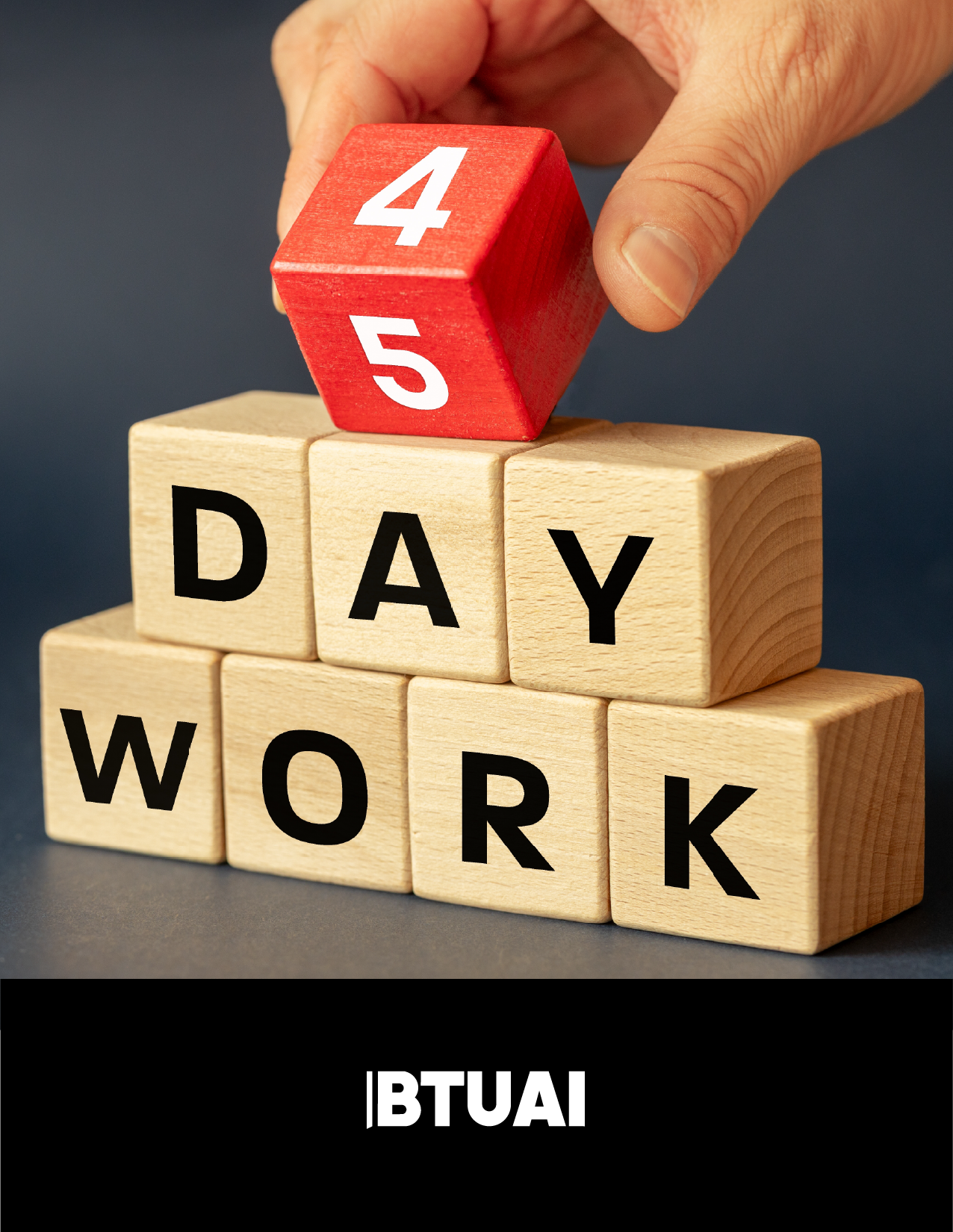
The idea behind the four-day week is simple: work less, get paid the same, deliver the same results. Over eight years, hundreds of companies across dozens of countries have tried it. This analysis from BTUAI goes through each of the major experiments in turn and answers one question: what has been confirmed, and what has not.
What is a four-day week?
Three different reforms travel under one name. The first is a genuine reduction: 32 hours instead of 40, with pay unchanged. This is the “100-80-100” model: 100% of the pay, 80% of the time, 100% of the output. The second is compression: hours do not fall, they are simply packed into four days, making the working day ten hours long. The third is a statutory change across an entire country. All three produce different results, and confusing them is the most common mistake in the debate.
Why are the results hard to assess?
Companies take part voluntarily. Before applying they work out whether it will succeed — and if not, they simply do not apply. The result is that the trials fill up with precisely the firms where the model has the best chance. Two further problems compound this: most experiments have no comparison group, and the results usually rest on what employees say rather than on what was measured.
What has been confirmed?
People genuinely do feel better. A 2025 study in Nature Human Behaviour, covering 141 companies and 2,896 employees, found reduced burnout and higher satisfaction. Crucially, the more hours an individual lost, the more their burnout fell — a relationship that chance does not explain. The German study, which measured sleep with fitness trackers, confirmed it: participants slept 38 minutes more per week, and time spent under stress fell by 89 minutes.
What has not been confirmed?
That it costs the company nothing. The Nature study did not measure productivity at all. The German study, which examined accounting records, found no change in revenue or profit, and sick days were unchanged too. The famous “35%” from the British trial is a comparison against pandemic-year 2021 — measured from the start to the end of the trial itself, growth was 1.4%.
What happens over the longer run?
Most experiments run for six months — which is exactly when the impressive numbers appear. The only independent two-year follow-up is the German one: by February 2026, 30% of the participating organisations had reverted to their previous schedule and a further 22% had changed the model. The reasons are practical — workload peaks, unstable order books, deadlines. These are precisely the problems a six-month experiment cannot see.
What are governments doing?
Less than it appears. Spain set aside €10 million for 60–70 companies; five received funding, roughly 5% of the budget. Scotland ran a year-long trial, got good results, and in 2025 declined the policy anyway. Portugal’s pilot, in which the state spent nothing, proved the most successful — 89% of companies continued. The largest live programme today is in Poland, but its results will not be known until 2027.
What is the conclusion?
The four-day week is probably a beneficial reform for employees, and that much is well demonstrated. Its value to employers, however, remains unproven. What would settle the argument is a study in which companies are randomly assigned to two groups and productivity is measured from accounting records over at least two years. No one has conducted one yet.
This analysis was prepared by the academic team of the Business and Technology University (BTU) together with BTUAI and draws on publicly available industry reports and research. The full report, with charts, is attached as a separate file.
Citation: Business and Technology University (BTU) & BTUAI. (2026). The Four-Day Week — What We Actually Know. Tbilisi, Georgia.