


Key Takeaway
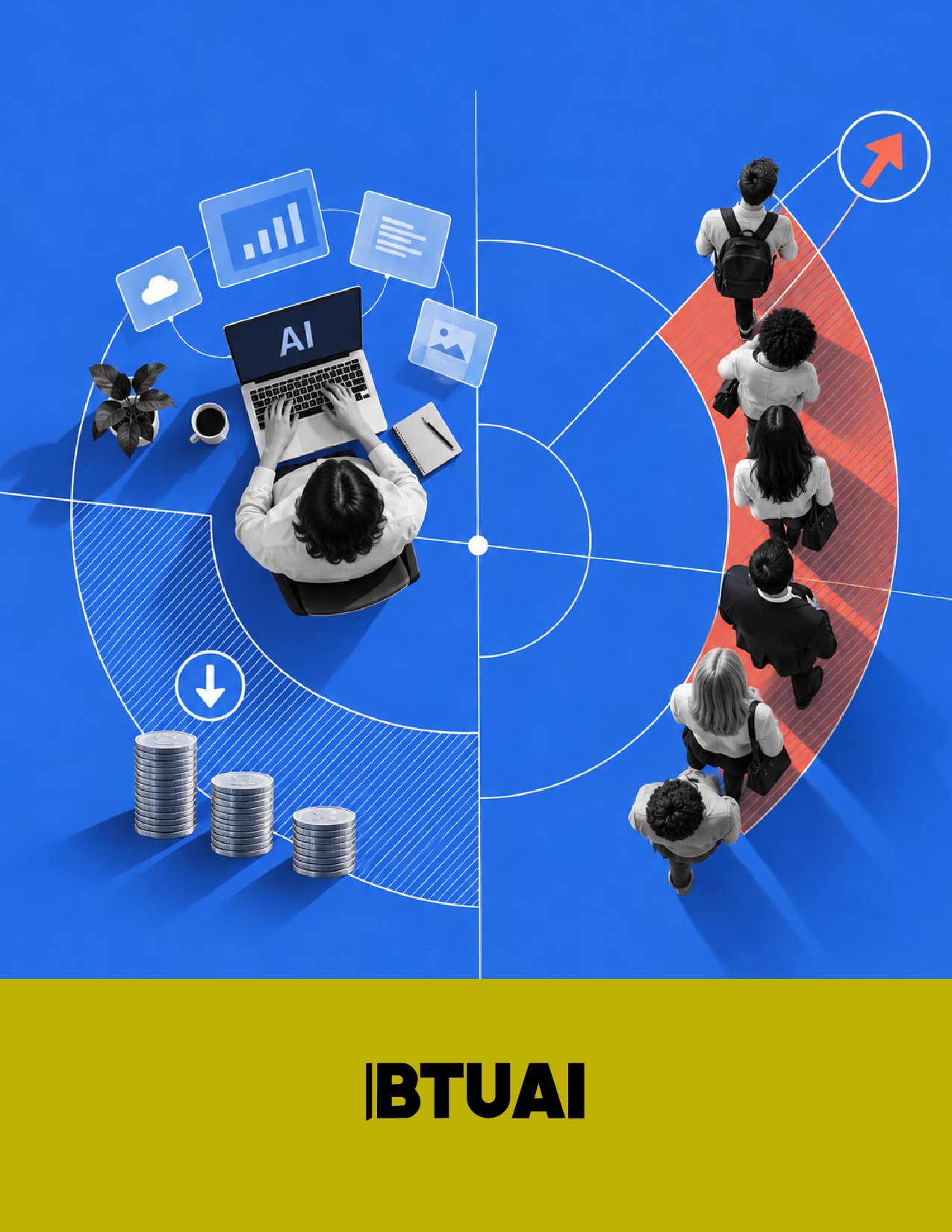
Artificial intelligence is lowering many of the upfront costs of starting a business. One person can now write code, create designs, draft marketing material, answer customer inquiries and perform parts of jobs that previously required a small team or outside contractors. But this mainly changes the production side of entrepreneurship. Customer attention, trust, sales and distribution do not automatically become cheaper – and in some markets it may become harder because AI enables far more competitors to enter at the same time.
The distinction matters especially for Georgia. As of July 1, 2026, Georgia’s National Statistics Office counted 192,717 active individual entrepreneurs. AI can meaningfully reduce the technical and operating barrier for many of them. It cannot remove the central economic question: who will pay for the product or service, and why will they choose this particular business?
Starting becomes cheaper. Competition does not
A September 21, 2026, Wall Street Journal report describes a wave of one-person businesses in China. Young founders are using AI to code, communicate with customers and promote products, while some local governments and incubators are supporting them with subsidized offices, housing and computing resources.
The same report shows the other side of the story. A survey of 1,500 one-person companies conducted by the Hangzhou-based incubator Honghub found that more than half generated less than $1,000 per month in revenue. One founder profiled in the article had roughly 1,000 users but only about 35 paying customers, and the business was losing money each month. Founders said finding customers and investment remained difficult. The survey is not representative of the entire Chinese market, but it captures the core problem: cheaper product creation does not create demand.
OECD evidence points in a similar direction. A 2025 report based on a 2024 survey found that roughly 31% of SMEs across seven economies used generative AI. Marketing and sales were the most common support functions for AI use. Yet the outcomes differed sharply: 65% of AI-using SMEs said the technology improved employee performance, while only 26% reported increased revenue.
That gap is economically important. AI can reduce the time and cost of producing an offer. Selling the offer follows a different logic.
Why customer acquisition does not become cheaper at the same pace
Customer acquisition is not simply the cost of an advertisement. It includes brand awareness, distribution, sales work, promotion, discounts, partnerships, customer support and the time between launching a product and receiving the first payment.
AI can improve some of those functions. One constraint, however, remains: customer attention is not expanding at the same speed as the number of offers competing for it.
If thousands of small businesses suddenly become capable of producing better copy, design, video and software, the supply of competent products and marketing increases. Consumers still have the same number of hours in a day.
According to an assessment by BTU researchers, this creates a central paradox of the AI economy: technology lowers the cost of creating supply while simultaneously increasing the amount of supply. The scarce resource therefore shifts from code and design toward attention and trust.
Georgia makes the problem especially visible
Georgia is a small market. Geostat reported 280,811 active economic entities as of July 1, 2026, including 192,717 individual entrepreneurs. The data do not show how many use AI or operate digital businesses, but they demonstrate how large the small and solo-business segment already is.
Among active entities, 74,934 were in wholesale and retail trade, 22,288 in information and communication, and 12,869 in professional, scientific and technical activities. These are precisely the kinds of sectors where AI can quickly increase the output of a small team.
But a small market introduces another constraint: many firms are competing for the same customers. If ten new digital services in Tbilisi target the same audience, AI can improve the advertising, content and service of all ten simultaneously. It does not follow that all ten gain more customers. Their offers may simply become harder to distinguish.
This is why Georgian founders should avoid a common AI-era mistake: assuming that building a good product quickly is equivalent to finding a market.
Code gets cheaper. Trust does not
The most easily automated parts of a digital business are often those customers cannot directly evaluate: initial code, first drafts, design variants, internal analysis and documentation.
Customer choice is shaped by a different set of factors. Does the product work? Will the company respond when something fails? Is pricing clear? Are refunds possible? Is payment secure? What do other customers say? Can the customer exit easily?
This matters in Georgia, where a relatively small market allows positive and negative experiences to travel quickly through personal recommendations, social media and professional communities. A small business may not need a massive advertising budget, but a trust deficit can be extremely expensive.
BTU research on Georgian consumer behaviour and retail suggests that price is only one part of perceived value. Reliability of delivery, clarity of returns and warranties, confidence in authenticity and service quality also matter. AI-generated marketing can bring a customer to the door. It cannot compensate indefinitely for weakness in the rest of the experience.
AI lowers the cost of marketing – which can make marketing harder
At first glance, this seems contradictory. If AI can produce advertising text, videos, design variants and campaign ideas, customer acquisition should become cheaper.
The problem is that competitors get the same capability.
When high-quality content was expensive to produce, the ability to create it was a differentiator. Now even a very small firm can generate many promotional variations each day. The amount of content competing for attention rises.
Businesses therefore remain dependent on distribution systems that already control large audiences: search engines, social platforms, marketplaces, app stores and creators. Changes in advertising prices or recommendation algorithms remain outside the control of the small business.
AI reduces the cost of producing marketing. It does not abolish the economics of distribution.
The first customer should become more important than the first product
For a small business, a better AI-era starting question may not be “What can I build?” but “Who has a problem they are already willing to pay to solve?”
The distinction is practical.
A founder who builds first and looks for customers later can now reach a polished product very quickly – only to discover that the market does not care.
If the process begins with a defined customer, a real problem and evidence of willingness to pay, AI becomes a powerful accelerator. It can create a prototype, prepare an offer, analyse feedback and shorten the iteration cycle.
This means the most important early metric may no longer be how quickly the product was built. More useful questions are: how quickly did the first paying customer appear, how many returned, how many arrived through referrals, and how many stayed once introductory discounts ended?
AI can make one person more capable, but it cannot fully outsource selling
AI is especially powerful for a one-person business because it allows one founder to perform several functions: research, writing, coding, reporting, support and some elements of sales.
There is still a limit.
For complex or high-value products, customers often buy not only functionality but accountability. A corporate client may like an AI-built tool, but will still want to know who will respond to a failure, protect data, fix errors and remain available over time.
The hardest problem for a one-person company may therefore be credibility, not technical capability.
AI can support trust-building. It cannot substitute for a reputation.
What Georgian small businesses should do
The first priority is to validate demand before building a complete product. Conversations with real customers, pre-orders or a paid pilot often provide more useful information than weeks of product development.
Second, founders should build distribution assets they control. Relying only on paid social advertising or recommendation algorithms is risky. Customer email lists, partnerships, professional communities, repeat sales and referrals are more durable.
Third, companies should measure the sales journey, not content volume: how many people see the offer, how many respond, how many try, how many pay and how many stay.
Fourth, AI should be used to improve service to existing customers, not simply to create more advertising. In many businesses, retaining a satisfied customer is economically more valuable than continually buying new attention.
Fifth, digital businesses in Georgia should think about exports early. If a service can be delivered online, dependence on a small domestic customer base can become a structural growth constraint.
Why this matters for Georgia
AI is a genuine opportunity for Georgia because it gives small firms and individual entrepreneurs access to capabilities that previously required larger teams and budgets. That matters for digital services, professional services, education products, marketing, software and small export-oriented companies.
But there is a policy and education lesson. Teaching people how to “build with AI” is not enough. Entrepreneurs also need customer research, sales, pricing, distribution, negotiation, brand trust and financial discipline.
As AI lowers the technical barrier to business formation, those commercial and human capabilities become more important.
Conclusion
AI is clearly lowering the cost of starting many businesses. But it is also making the difference between starting a business and building a successful business more visible.
Code, content, design and part of customer service are becoming cheaper. Attention, trust and willingness to pay remain scarce.
For Georgia, the opportunity is that one person or a very small team can create an internationally competitive product faster and with less capital. The risk is that many businesses will solve the production problem and discover the market problem too late.
The hardest question in the AI era may no longer be, “Can you build the product?”
Increasingly, the answer will be yes.
The hard question will be: “Can you persuade anyone to buy it from you?”
Data and Main Sources
The Wall Street Journal, “Burnt-Out Young People in China Launch AI Startups”, September 21, 2026.
OECD, Generative AI and the SME Workforce: New Survey Evidence, November 5, 2025.
OECD, AI Adoption by Small and Medium-Sized Enterprises, December 9, 2025.
Georgia’s National Statistics Office, registered and active entities by organizational-legal form, July 1, 2026.
Georgia’s National Statistics Office, active entities by economic activity, July 1, 2026.
BTU research and analytical materials on Georgian consumer behaviour, e-commerce and AI-enabled small business.
Prepared by the academic team of Business and Technology University and the BTUAI Research Team, Tbilisi, Georgia.