

Main
BTU researchers assess that deteriorating relations with the European Union are separating Georgia’s economic connections into different channels: funding for the authorities is withheld, while trade and some research cooperation continue. The economic risk includes both interrupted funding and weaker institutional support for companies and researchers trying to use the opportunities that remain.
Key Takeaways
- The European Commission’s 2026 report identifies EUR 121.3 million in bilateral funding directly benefiting Georgian authorities withheld since 2024; this is a cumulative figure, not a new annual loss for 2026.
- The Commission confirms continued implementation of the free-trade agreement and reports 17 Horizon Europe grants involving Georgia signed during the reporting period, with a total EU net contribution of EUR 3.4 million.
- BTU researchers assess that Georgian companies and universities should plan around the rules of each trade channel and programme: continuing access neither guarantees funding nor eliminates the economic consequences of deteriorating relations.
The European Commission’s report of 4 November draws an important distinction for Georgia. Deteriorating political relations, suspended support for the authorities, export conditions and a student’s participation in a programme are connected, but they are not the same decision. Confusing them can produce practical mistakes. A company may abandon an opportunity that still exists, while a public agency or university may mistake a continuing programme for a guarantee that earlier conditions remain unchanged.
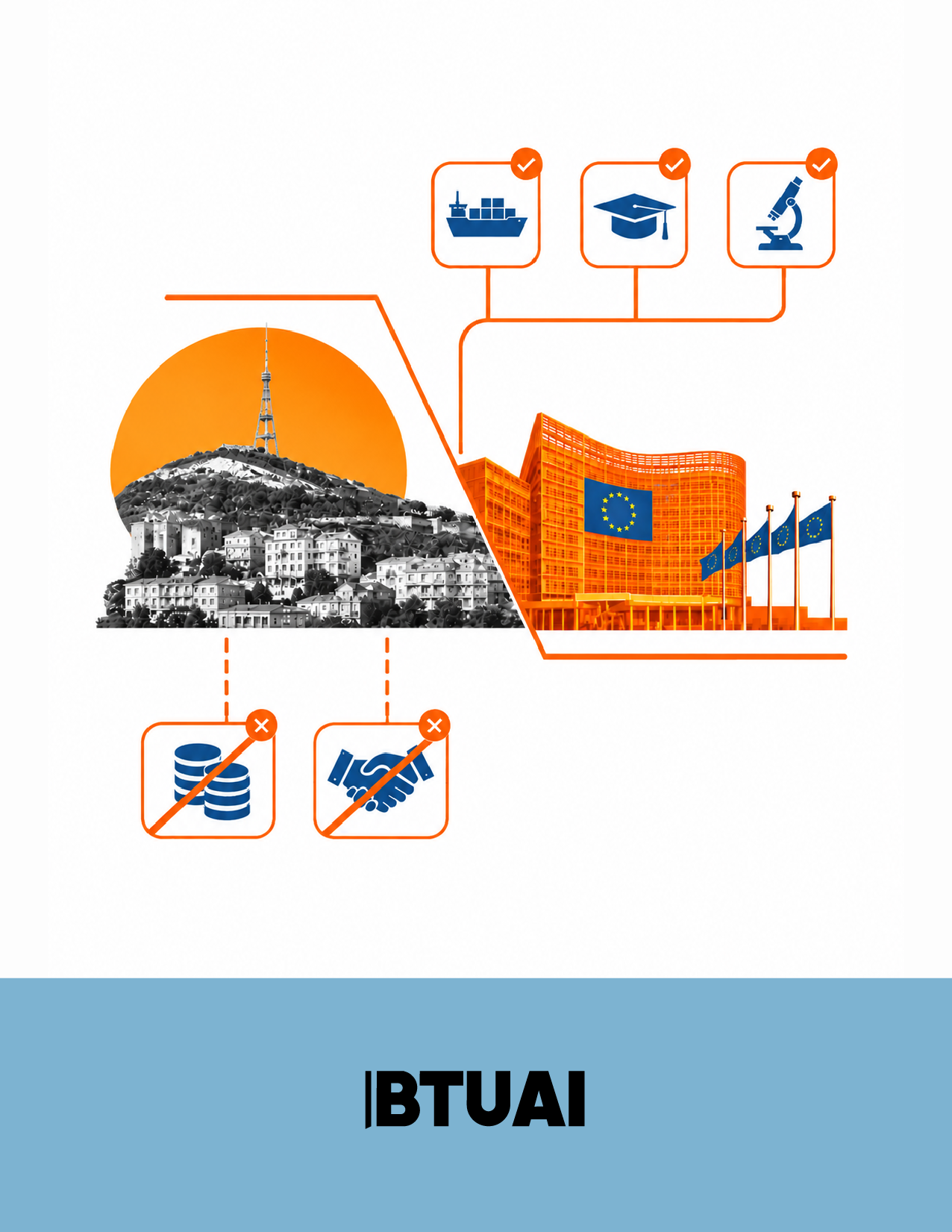
BTU researchers’ analytical assessment centres on separating these channels. The report simultaneously describes withheld funding for the authorities, interrupted institutional dialogue and continuing forms of cooperation. The condition of Georgia’s economic relationship with Europe therefore cannot be measured by adding up suspended funds. It also matters who has lost direct funding, who can still compete for support, and what businesses need to make use of the market already available to them. [1]
This is a country-wide economic issue. According to the same report, EU–Georgia trade in goods reached approximately EUR 5.18 billion in 2025. It records Georgian exports to the EU of EUR 873 million and imports of approximately EUR 4.3 billion. These are historical annual trade flows, not assistance or losses caused by the latest report. They indicate the breadth of a relationship involving producers, importers, transport providers and ultimately consumers. [1]
Separate channels of cooperation
| Channel | Status in November 2026 report | Meaning |
| Bilateral authority funding | EUR 121.3m withheld since 2024 | Cumulative, recipient-specific restriction |
| DCFTA | Implementation continued; institutional dialogue halted | Trade access and institutional cooperation differ |
| Horizon Europe | 17 grants involving Georgia; EUR 3.4m EU net contribution in reporting period | Signed grants, not universal entitlement |
| Erasmus+ | International dimension continues; authorities ineligible in 2026 | Applicant and action-specific eligibility |
| New EU programmes | Association paused since 2024 | Existing participation does not imply new access |
Source: European Commission, 2026 report, pp. 68–69, 78, 81–82. Comparison of statuses; amounts are not additive.
Funding restrictions have specific recipients
The most frequently cited figure is EUR 121.3 million. The Commission identifies it as bilateral funding withheld since 2024 that would directly benefit Georgian authorities under the EU’s neighbourhood and international cooperation instrument. Describing the entire amount as money newly lost this November would be misleading. So would treating it as the cancellation of support for every citizen, company and university. [1]
The interruption nevertheless has economic significance. Technical support for a public agency can benefit more than the agency itself. Better rules, administration and institutional capacity can also support private economic activity. But the report does not supply a reliable project-by-project model showing how much investment or employment will decline because of this suspension. Converting those effects into a precise euro loss would replace evidence with assumptions. The supported conclusion concerns a transmission mechanism, not a measured total loss.
Defence assistance must also be read separately. Support under the European Peace Facility has been suspended since 2024, and the report says no new assistance was provided in 2025. Its EUR 62.75 million figure describes assistance contributed in 2021–2023 for medical, engineering, logistics and cyber-defence capabilities. Adding that historical support to EUR 121.3 million to produce a total current suspension would combine incompatible categories: previously provided assistance and withheld bilateral funds. [1]
Timing matters as much as category. Publication of the report is new; not every restriction described in it is new. The document provides an updated official assessment of the existing situation. Its practical value lies in bringing distinct, verified statuses together rather than turning every political development into a newly announced financial shock.
An open market still requires institutions
The Commission explicitly states that implementation of the Deep and Comprehensive Free Trade Area, or DCFTA, continued. This is the economic component of the Association Agreement. At the same time, political and economic dialogue and subcommittee meetings within the agreement’s institutional structure remained halted. The existence of a trade framework and the institutional dialogue that develops it are different parts of the relationship. [1]
For a Georgian exporter, that distinction is practical. Continuing market access does not remove obligations concerning product safety, documentation and other applicable requirements. Existing trade demonstrates that goods continue to move. It cannot, by itself, establish how easily a new producer can find a first European buyer or satisfy that buyer’s requirements.
The report’s chapter on free movement of goods makes the institutional problem more concrete. The Commission identifies no progress in conformity assessment, the process of establishing whether a product meets its applicable requirements. It also records continuing cooperation in standardisation and metrology, while identifying market-surveillance procedures that remain out of line with EU rules. This is neither a picture of complete interruption nor of completed and smoothly functioning integration. [1]
BTU researchers assess that this is where a longer-term economic risk emerges. If existing trade access is not accompanied by institutional improvement, opportunities may remain easier to use for companies already able to meet compliance and partner-search costs. This is an analytical mechanism, not inequality measured by the report. For a smaller producer, testing, certification or finding an overseas partner can be a significant hurdle even where the market is legally accessible.
A large trade flow is also not a single measure of success. Imported equipment can increase productive capacity; consumer goods can expand choice; exports can generate domestic income. Because these activities serve different functions, adding a trade deficit to lost assistance explains little. The useful question is how the continuing relationship can support more Georgian production and higher-quality services.
Research cooperation remains partly open
The report gives universities and research organisations a particularly concrete picture. Georgia has been associated with Horizon Europe since 2021, and participation continues. During the reporting period, 17 grants involving Georgia were signed, with a total EU net contribution of EUR 3.4 million. This describes signed grants, not an unrestricted fund available to every Georgian organisation. Nor does it mean that each project received an equal allocation. [1]
These grants demonstrate that research cooperation is continuing. They do not establish that research funding automatically becomes an economic product. The report describes cooperation among universities, research centres and companies as fragmented and often dependent on individual projects. Technology transfer and mechanisms supporting commercial use of research remain underdeveloped. Georgia’s opportunity therefore involves connecting funded knowledge with problems that businesses actually need to solve. [1]
A stronger laboratory, for example, can create wider value when producers can use its capabilities. A research partnership can matter beyond the project when it improves skills, testing or product development. These examples explain a potential mechanism; they are not claims about outcomes of a particular completed project. BTU researchers assess that the economic value of the continuing research channel will depend on the quality of these connections.
Erasmus+ requires equally careful interpretation. The report says Georgia continues to benefit from the programme’s international dimension. However, as of 2026, Georgian authorities are not eligible under any Erasmus+ actions. Association with new EU programmes has also been paused since 2024. A student or university should infer neither blanket closure nor automatic eligibility for a particular competition. The relevant action’s conditions and the applicant’s status remain decisive. [1]
The wider economic meaning
These distinctions have two practical implications. First, misunderstanding an opportunity can itself be costly. Ignoring an active competition or prematurely abandoning a trade relationship reduces the options that actually remain. Second, continued access cannot be treated as compensation for deteriorating relations. Interrupted dialogue and limits on joining new programmes narrow future choices even where current contracts continue to function.
The report’s description is not a guarantee about the future. Research calls, partner decisions and institutional relations can change. Planning requires a distinction between a confirmed right of participation and support that is merely anticipated. A company or university can use an existing channel while recognising risks in the broader political environment. Those positions are compatible.
Georgia’s relationship with Europe consists of several mechanisms, each with its own status. Withheld funding is a real restriction, and continuing trade and research are real opportunities. BTU researchers assess that the economic task is to use the access that remains while preserving the institutional capabilities that turn it into broader public benefit. The essential distinction is between a formally open door and an opportunity that organisations can actually use.
Questions and Answers
Has all EU support ended?
No. The report distinguishes withheld bilateral funding benefiting the authorities from continuing programmes and forms of participation.
Is EUR 121.3 million a loss for 2026 alone?
No. It describes bilateral funds withheld since 2024, not a loss confined to 2026 or November.
Has free trade stopped?
The report confirms continued DCFTA implementation. Interrupted institutional dialogue is not equivalent to cancellation of the trade agreement.
Can universities participate in any European programme?
No. The programme, specific call and applicant status require separate checks; association with new programmes is paused.