


Key Takeaway
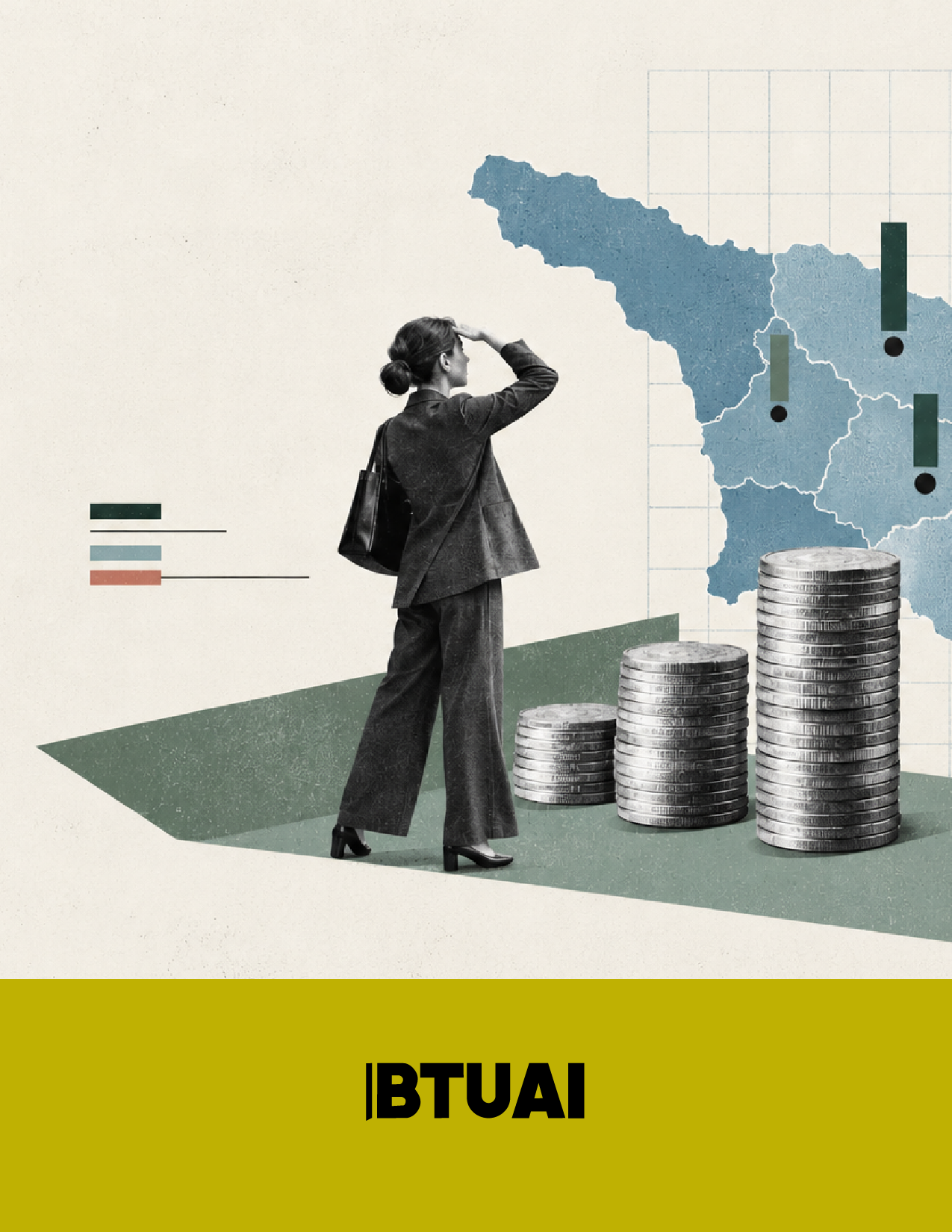
At the end of 2025, Georgian state-affiliated public entities held approximately GEL 1.1 billion in commercial banks. The detailed split was GEL 833 million in demand and card accounts and GEL 264 million in term deposits, including GEL 237 million placed for one to two years. The balance is not automatically “idle money”, but it raises a central public-finance question: how much is necessary operating liquidity and how much is temporary surplus that could be managed for the state as a whole?
BTUAI’s independently verified calculation places the balance at approximately 1.1% of 2025 nominal GDP and 3.4% of consolidated budget expenditure, equivalent to about 12.5 days of average spending. The issue is therefore not the existence of deposits, but fragmented visibility, the timing of budget transfers and the quality of cash-flow forecasting.
The Balance Fell, but Remains Historically High
The balance rose from GEL 316 million in 2019 to a peak of GEL 1.28 billion in 2024, an increase of about 4.05 times. It then declined by GEL 170 million, or 13.3%, to GEL 1.11 billion in 2025.
Even after the decline, the 2025 balance remained 3.5 times the 2019 level and 2.2 times the 2021 level. The data do not support a fourfold increase from 2021 to 2025; the roughly fourfold expansion occurred between 2019 and the 2024 peak.
What the GEL 833 Million in Demand Accounts Tells Us
GEL 833 million represented about 75.0% of the rounded GEL 1.11 billion total. The source categories sum to GEL 1.097 billion, so the often-cited 76% share should be read as rounded. Demand accounts may reflect genuine payment needs, but they may also reveal weak forecasting and oversized liquidity buffers. The decisive information is the age, purpose and expected payment date of each balance.
One- to Two-Year Deposits Are a Budget-Timing Question
Of GEL 264 million in term deposits, GEL 237 million – about 89.8% – had maturities of one to two years. Such deposits may be sensible when funds are legally available and competitively placed. But if the money is not needed for up to two years, the larger question is why it was transferred to the entity so early rather than remaining within the Treasury until payment approached.
Deposit Income Is Not Always a Net Gain
An entity may earn deposit interest while the central government borrows elsewhere at a higher rate. At the consolidated level, the state can lose money even though one institution reports interest income. This is why the IMF treats a Treasury Single Account as a core instrument for consolidating cash and reducing unnecessary borrowing.
International Practice: Consolidation Without Paralysis
Georgia established a fully functional Treasury Single Account in 2006. The current challenge is to improve visibility over balances held by state-affiliated entities outside the core structure. Portugal offers remunerated Treasury deposits; France links many operating accounts to one central cash position; Vietnam sought to consolidate more than 700 idle-balance accounts into five main accounts. The common principle is consolidated information, not the elimination of operational autonomy.
An Illustrative Georgian Mini-Case
Consider a public entity that receives GEL 30 million: GEL 10 million for near-term payroll and contracts, GEL 8 million in restricted grants and GEL 12 million for a project that will not pay contractors for nine months. A stronger system could leave GEL 18 million fully available while placing GEL 12 million in an internal remunerated Treasury account. The entity would retain ownership of the balance, while the wider government could reduce short-term borrowing. This is an illustrative scenario; actual treatment depends on legal and contractual restrictions.
What Georgia Should Change
Georgia needs a daily dashboard of public-entity balances, classification by purpose, evidence-based liquidity limits, internal remunerated Treasury deposits and, where feasible, automatic end-of-day sweeping. Quarterly disclosure should show balance type, interest income, bank concentration and funds that remain unused for 6, 12 or 24 months.
BTU Researchers’ Assessment
According to BTU researchers, the GEL 1.1 billion balance does not prove that every lari was wasted. It is large enough, however, to show that public cash management cannot remain a set of isolated banking decisions. Georgia’s opportunity is to extend its existing Treasury Single Account with real-time visibility and forecasting while preserving the operational autonomy of public entities.
Key Findings
- Public entities held approximately GEL 1.1 billion in commercial banks at the end of 2025.
- GEL 833 million was in demand and card accounts; GEL 264 million was in term deposits.
- GEL 237 million, or about 89.8% of term deposits, had maturities of one to two years.
- The balance fell by 13.3% in 2025 but remained 3.5 times its 2019 level.
- The balance equalled about 1.1% of GDP and 3.4% of consolidated expenditure.
- Deposit interest is not necessarily a net gain if the government borrows at a higher cost.
- The best reform combines cash consolidation with operational autonomy.
Why This Matters for Georgia
Better public cash management affects sovereign borrowing costs, programme execution, bank-concentration risk and public trust. The objective is not to spend money faster, but to avoid borrowing unnecessarily while temporary cash sits elsewhere in the public sector.
Conclusion
Georgia does not need to choose between closing every account and leaving the system unchanged. A modern Treasury can preserve authorised payments while seeing and managing the state’s combined cash position. The long-term choice is between fragmented balances and a public-finance system in which every lari has a purpose, a date and an accountable owner.
Data and Main Sources
- State Audit Office of Georgia – report on 2025 state-budget execution.
- National Statistics Office of Georgia – GDP in 2025.
- Ministry of Finance of Georgia – 2025 consolidated budget.
- OECD – Managing Government Cash, 2025.
- International Monetary Fund – Treasury Single Account.
- World Bank – Georgia and Vietnam TSA reforms.
This material is analytical and educational in nature. It does not constitute financial, investment, tax or legal advice. Professional advice should be obtained before making a specific decision.
Prepared by the academic team of Business and Technology University and the BTUAI Research Team, Tbilisi, Georgia.