



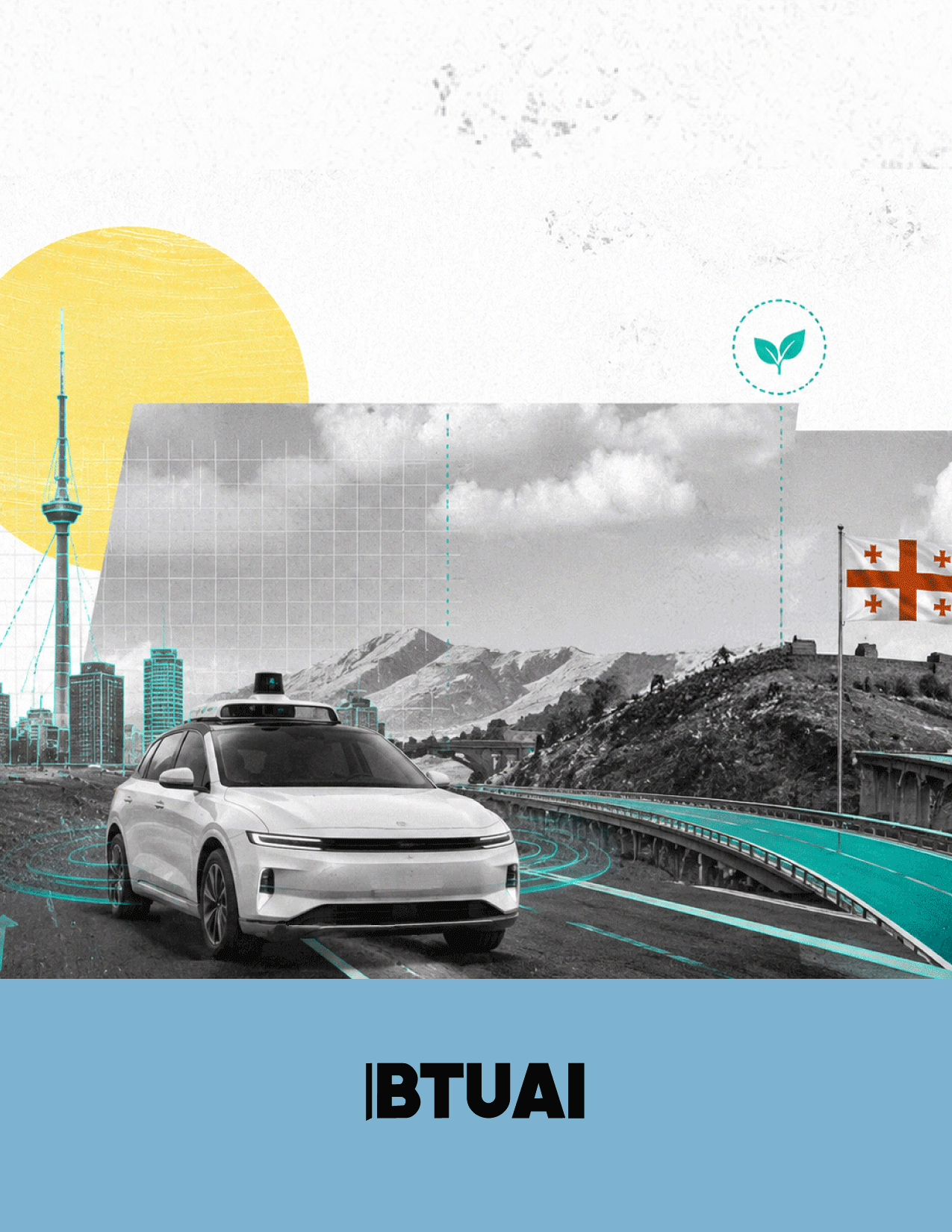
The car is changing quickly. It is no longer only a means of transport, an engine, steering wheel, tires and cabin. New-generation vehicles increasingly resemble moving digital platforms — with sensors, software, artificial intelligence, connectivity, battery-management systems, driver-assistance functions, data collection and continuous updates.
This change is especially important for Georgia. The country is not a car manufacturer, but it is an important regional market for vehicle imports and re-exports. Georgia’s car economy includes not only drivers, but also importers, dealers, service centers, insurers, banks, leasing companies, technical inspection, charging infrastructure, spare parts and the valuation of used cars.
In the age of AI vehicles, the value of a car will no longer be determined only by year of production, mileage, engine size and accident history. Increasingly, value will depend on battery health, software updates, sensor condition, cybersecurity, data protection, availability of autonomous functions, official service support and whether the local market can properly diagnose and maintain such vehicles.
BTUAI assesses that Georgia’s main task is to understand the digital transformation of the car market in advance. If the country sees this change only through import and sales, risks will grow. If it prepares properly, Georgia can become a regional center for vehicle service, electric-vehicle maintenance, AI-vehicle diagnostics and smart-mobility expertise.
Main idea
An AI vehicle is not only a better car. It is a technological system that connects transport, energy, data, software, cybersecurity, consumer behavior and infrastructure.
In the past, evaluating a car was relatively straightforward: year, mileage, engine, body condition, interior, accident history and spare-parts availability.
In the new reality, these questions are no longer enough. New questions must be added:
Does the car have active software support?
Does it receive safety updates?
What is the real condition of the battery?
Are the sensors functioning correctly?
Who stores the data collected by the vehicle?
Can local service centers diagnose it?
What happens if the manufacturer limits software services in a specific market?
How should such a vehicle be valued in the used-car market?
For Georgia, this means that the car market must move from evaluating only the “hardware” to evaluating “hardware + software + battery + data + service.”
How the car is changing
Modern vehicles are changing in several directions.
- The car is becoming a software product
Many important vehicle functions are controlled by software. Driver-assistance systems, braking and stability control, battery management, navigation, cabin comfort, voice commands, safety warnings and sometimes even driving or energy-use modes depend on software systems.
This means that a car can change after purchase. Updates may add features, fix errors or modify performance logic. At the same time, the end of software support can reduce the value of the vehicle.
- The car collects data
A smart vehicle constantly collects information: driving style, location, speed, braking patterns, battery condition, sensor data, driver habits, technical errors and sometimes the use of digital cabin systems.
This data can be used for safety, diagnostics and better service. But it also raises privacy questions: who owns the data, where is it stored, how is it used and does the consumer have control over it?
- The car connects to energy
The electric vehicle connects transport directly with the energy system. Mass electrification means that charging networks, electricity prices, grid capacity and battery management become part of transport economics.
For Georgia, this is especially important. Growth in electric vehicles must be coordinated with charging infrastructure, grid resilience, energy balance and urban transport policy.
- The car becomes a cybersecurity risk
The more a vehicle is connected to the internet and software systems, the more important cybersecurity becomes. Risks may include data leaks, system vulnerabilities, faulty updates or insecure connected devices.
A car is no longer only a mechanical object. It is a connected device that needs protection.
- Vehicle service is changing
Traditional car service required mechanics, spare parts and experience. In the future, service centers will also need software diagnostics, battery testing, sensor calibration, understanding of AI systems, basic cybersecurity knowledge and the ability to work with manufacturers’ digital platforms.
This is a major change for Georgia’s car-service sector.
Why this matters for Georgia
In Georgia, the car is one of the most important consumer assets. For many households, it is not only a means of mobility, but also an economic resource: commuting, taxi work, delivery, tourism, regional travel and small business.
At the same time, Georgia is heavily dependent on imported vehicles. Cars enter the country from the United States, Europe, Japan, Korea and China. Some remain in the domestic market, while others are re-exported.
The growth of AI vehicles and electric cars will change this model in several ways:
used-car valuation will become more complex;
service centers will need new skills;
technical inspection may need to include digital systems;
insurance may use driving-behavior data;
banks and leasing companies will need new risk models;
charging infrastructure will become a condition for market growth;
consumers will need more knowledge to avoid buying expensive but difficult-to-maintain vehicles.
Main changes for Georgia’s car market
- Used-car value will no longer be determined only by mileage
For electric and AI-powered vehicles, mileage remains important, but it is not enough. Two vehicles of the same model, age and mileage may deserve very different prices if one has better battery health, functioning sensors and active software support while the other does not.
In the future, Georgia’s car market will need new standard valuation indicators:
battery-health report;
software-version status;
history of safety updates;
condition of sensors and cameras;
charging history;
digital trace of accident or water damage;
availability of manufacturer support.
- Car service is moving from mechanics to data
Many Georgian service centers understand traditional vehicles very well. But AI vehicles require a different skillset.
They will need:
knowledge of electric systems;
high-voltage safety;
battery diagnostics;
sensor calibration;
software-error detection;
testing of advanced driver-assistance systems;
basic cybersecurity awareness;
compatibility with manufacturer platforms.
If these capabilities are not strengthened in time, Georgia may receive many technologically complex vehicles that cannot be properly serviced locally.
- Charging infrastructure will become a market barrier
A consumer’s decision to buy an electric vehicle depends not only on price, but also on charging availability. If a driver lives in an apartment building, has no private parking and lacks reliable charging points in the city or along roads, using an electric vehicle becomes difficult.
Georgia needs a charging-infrastructure plan for:
Tbilisi and major cities;
highways;
tourist regions;
hotels;
shopping centers;
apartment-building parking areas;
municipal spaces.
The EV market cannot grow only through imports. It requires energy and urban infrastructure.
- Insurance and finance will change
In the age of AI vehicles, insurance and finance will also change. For insurers, what matters will not only be the vehicle model, but also sensors, safety systems, driving behavior, software risk and repair cost.
For banks and leasing companies, residual value will be critical: how well the vehicle keeps its value after several years. In electric vehicles, this depends heavily on battery condition, manufacturer support and charging infrastructure.
- Importer responsibility will increase
If a vehicle is software-intensive, the importer carries greater responsibility. Consumers need to know:
whether the car is officially supported in the region;
whether its main digital functions work in Georgia;
what condition the battery is in;
whether software updates are possible;
whether spare parts and service are available;
what risks come with damaged or rebuilt electric vehicles.
This is especially important when importing damaged vehicles from the United States and other markets.
AI vehicles and personal data
One of the least discussed but most important issues is data protection.
An AI vehicle may collect information about routes, parking locations, driver habits, cabin devices, phone connections and sometimes voice commands. All of this relates to the user’s private life.
Georgia needs a clear public discussion:
What data does the car collect?
Where is the data stored?
Can the owner delete or transfer it?
What happens when a used car is sold?
Is the previous owner’s data removed?
Can this data be used in insurance, disputes or commercial services?
In the age of AI vehicles, selling a car is no longer only about transferring documents. It also requires managing digital profiles, accounts and data.
Key risks for Georgia
- Technologically complex imports without service capacity
If many AI-enabled and electrically complex vehicles enter the country without sufficient service, diagnostics and trained specialists, consumers will suffer.
- Misjudging battery condition
In an electric vehicle, the battery is one of the most expensive components. If the market lacks reliable battery testing, consumers may be misled.
- Loss of software support
Some functions may depend on manufacturer servers, regional support or subscriptions. If that support does not work, the vehicle’s value declines.
- Data-privacy risks
Consumers may not realize that their car stores routes, phone connections or other personal data.
- Weak cybersecurity culture
If service centers and users do not understand the cyber risks of connected vehicles, vulnerabilities may increase.
- Insufficient readiness of the electricity and charging network
Growth in electric vehicles will create new demand in cities and on highways. If infrastructure does not develop, the market may slow down or consumers may become dissatisfied.
Opportunities for Georgia
- Georgia as a regional vehicle-service center
If the country prepares specialists and service centers in time, it can become a regional hub for diagnosing and maintaining electric, hybrid and AI-enabled vehicles.
- New professional education
New professions will be needed: battery technician, high-voltage systems specialist, sensor-calibration specialist, vehicle software diagnostics specialist, EV service manager and smart-mobility data analyst.
- Better consumer protection
If standardized battery and software-condition reports are introduced, consumer trust will increase.
- Cleaner transport development
AI vehicles and electric vehicles can support better air quality if their adoption is planned together with energy, urban transport and charging infrastructure.
- Smart-city data
If processed securely and ethically, transport data can help improve traffic congestion, road safety, parking, public transport and urban planning.
What businesses should do
Importers, dealers and service centers should begin moving toward a new standard.
They need:
battery-health testing;
verification of software support;
diagnostics of sensors and cameras;
training in high-voltage safety;
clear explanation of digital functions for consumers;
procedures for deleting and transferring data during resale;
transparent information about real maintenance costs;
cooperation with insurance and finance sectors.
What the state should do
For the state, AI vehicles create a new type of regulatory and infrastructure challenge.
Several steps are needed:
a national map of charging infrastructure;
gradual modernization of technical inspection;
standards for EV battery and safety testing;
clearer data-protection rules for connected vehicles;
updated vocational education for car service;
stronger transparency in vehicle imports;
rules for installing chargers in apartment and commercial spaces;
an integrated view of electric vehicles and public transport in cities.
The main task is to ensure that technological change does not remain only market-driven. Standards, education and infrastructure are needed.
What universities should do
Universities will play an important role. AI vehicles combine engineering, computer science, energy, data analysis, cybersecurity, business, urban planning and law.
Educational and research directions are needed in:
AI in transport;
economics of electric vehicles;
battery-management systems;
automotive cybersecurity;
sensors and data analysis;
smart cities;
business models for charging infrastructure;
valuation of used electric vehicles;
transport-data ethics.
For BTU, this topic is especially natural because it connects business, technology, AI, energy and Georgia’s practical economic needs.
BTUAI assessment
BTUAI assesses that the age of AI vehicles should be seen as a new stage for Georgia’s car market. This change will not affect only drivers. It will transform imports, service, insurance, leasing, technical education, energy, urban planning and consumer rights.
Georgia’s main risk is that technologically complex vehicles may enter the country quickly while the market remains unprepared to evaluate, service and protect them properly.
The main opportunity is that Georgia can prepare early and develop new competence: servicing, diagnosing, evaluating and maintaining electric and AI vehicles, together with professional education and smart-mobility analytics.
The main conclusion is that the car of the future will no longer be only transport. It will become a moving digital device. Therefore, Georgia’s car market also needs a new language — not only the language of engines, but the language of software, batteries, data and safety.
Key findings
- An AI vehicle is not only transport, but a moving digital platform.
- Georgia’s car market must move from mechanical evaluation toward software, battery, sensor and data evaluation.
- Growth in electric vehicles is directly connected to energy and charging infrastructure.
- The car-service sector will need new skills: battery diagnostics, high-voltage safety, sensor calibration and software testing.
- AI vehicles collect data, creating new privacy risks for consumers.
- Georgia can become a regional hub for electric and smart-vehicle services if it develops skills and standards in time.
- The state should update infrastructure, regulation and vocational education.
- The future of the car is a combined system of transport, energy, data and AI.
Data and evidence base
Several key trends are visible in the global automotive industry:
growth in electric-vehicle models;
integration of AI assistants and voice systems into vehicles;
expansion of autonomous and semi-autonomous driver-assistance functions;
increasing importance of battery health in the used-car market;
role of software updates in vehicle value;
competition among Chinese, European and American manufacturers in electric vehicles;
importance of charging infrastructure for market growth.
For Georgia, the local evidence base should be strengthened: how many electric vehicles are imported, what their battery condition is, what types of damage are common in used imports, how accessible service is, where charging infrastructure is insufficient and how consumer behavior is changing.
Methodology
This report was prepared as part of BTUAI Research. The analysis is based on international trends in the automotive industry, electric vehicles, AI-enabled cars, the used-car market, charging infrastructure and connected mobility.
The materials are processed using analytical methods applied by BTU researchers, with the support of BTUAI.
The purpose of the research is not to recommend any specific vehicle, brand or technology, but to explain a transformation that may affect Georgia’s car market, consumers, businesses, energy system and regulation.
Limitations
The market for AI vehicles and electric vehicles is changing rapidly. Technology prices, battery quality, manufacturer support, software services and regulations may change quickly.
This material does not provide a recommendation to buy, sell, insure, lease or invest in any specific vehicle.
The implications described for Georgia are analytical scenarios and require additional research based on local data.
This material is analytical and educational in nature. It does not constitute financial, legal, technical, insurance or investment advice. Before making specific decisions, consultation with a relevant specialist is required.
Sources
International automotive-industry analysis of AI-enabled vehicles, electric vehicles, the used-car market and battery condition.
Global trends in automaker competition, charging infrastructure, vehicle software updates and connected transport.
BTUAI analytical interpretation based on Georgia’s car market, energy, consumer behavior and technology infrastructure context.
Frequently asked questions
What is an AI vehicle?
An AI vehicle is a car that uses artificial intelligence or advanced software systems for driver assistance, safety, navigation, voice interaction, energy management or processing sensor data.
What matters most when buying an electric vehicle?
Beyond price and mileage, battery health, charging infrastructure, service availability, software support and damage history are critical.
Can a car collect personal data?
Yes. Connected vehicles may collect information about routes, speed, driving style, technical condition and use of digital systems. Data protection therefore becomes important.
What does this mean for car service centers?
Service centers will need new skills: battery diagnostics, high-voltage safety, sensor calibration, software-error testing and electric-vehicle maintenance.
What is the main conclusion for Georgia?
Georgia should see the age of AI vehicles not only as a matter of importing new cars, but as a systemic transformation of the car market, energy, services, data protection and professional education.
Keywords
AI vehicles; electric vehicles; smart mobility; Georgian car market; used cars; battery health; charging infrastructure; vehicle data; car service; automotive cybersecurity; BTUAI; Business and Technology University.
Citation format
BTUAI Research Team. “When a Car Is No Longer Just Transport: What Georgia Should Consider in the Age of AI Vehicles.” Business and Technology University, BTUAI.ge, 2026.
Prepared by the academic team of Business and Technology University and the BTUAI Research Team.
Tbilisi, Georgia
BTUAI is an analytical platform of Business and Technology University that studies the impact of artificial intelligence, digital transformation, innovation, startup ecosystems, data analytics and emerging technologies on business, the economy, education and society. BTUAI materials are designed to explain complex technological and economic changes in a clear, reliable and Georgia-focused way.