




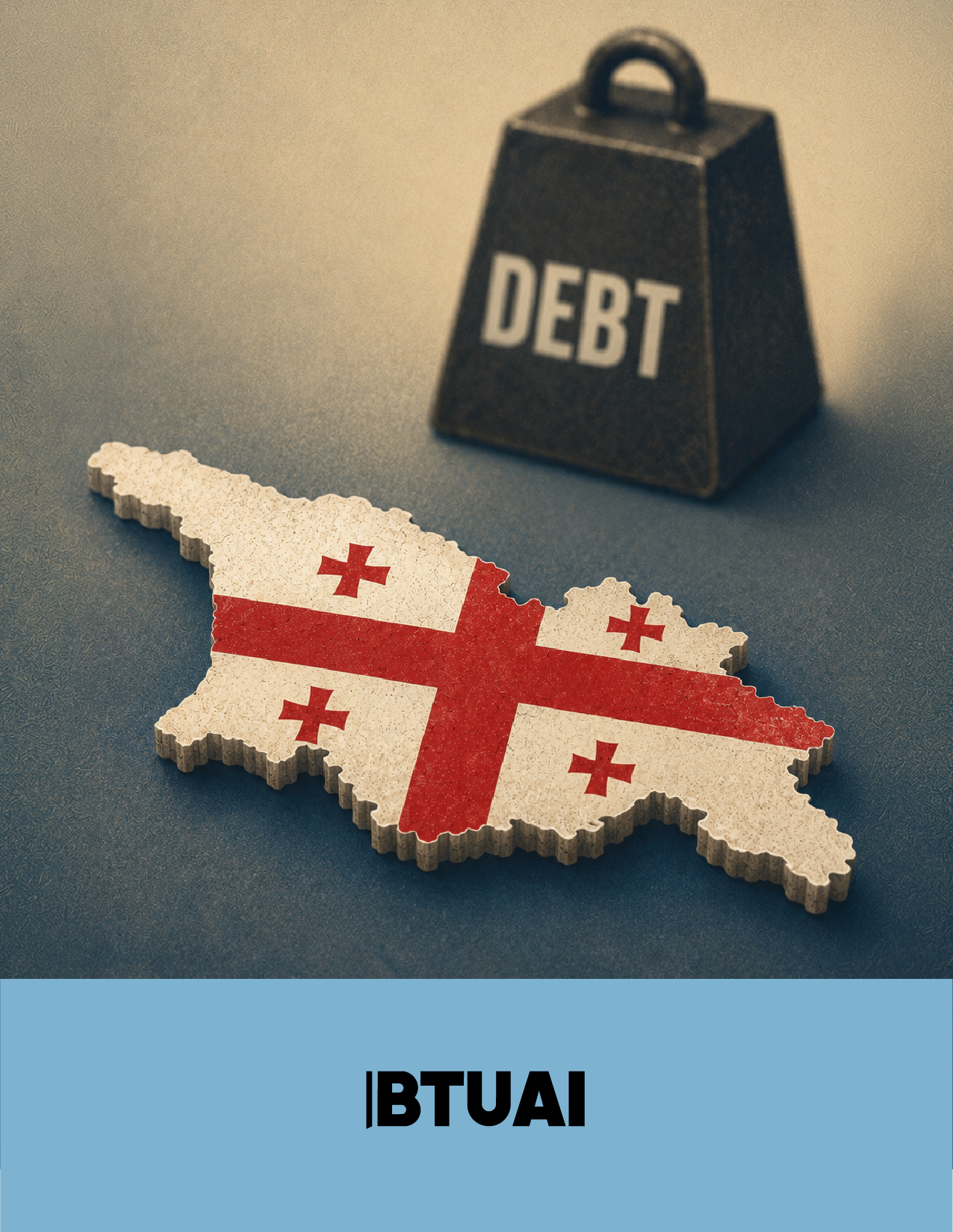
As of May 2026, Georgia’s external public debt stood at USD 9.121 billion. This was USD 158.1 million, or 1.8 percent, higher than in the same period of the previous year. In May 2025, external public debt amounted to USD 8.962 billion. During the reporting period, the National Bank of Georgia’s external liability stood at USD 289.4 million.
BTU researchers assess that the nominal figure alone – USD 9.121 billion – is not enough to determine whether the situation is alarming. Public debt must be evaluated in relation to the size of the economy, budget capacity, debt-service costs, currency risk, creditor structure and maturity profile.
In Georgia’s case, the main picture is this: external public debt is growing moderately, the largest creditors are international financial institutions, and public debt as a share of GDP remains below the high-risk threshold according to international assessments. However, this does not mean the issue can be ignored. External debt is denominated in foreign currency, so exchange rates, global interest rates and the quality of projects financed by debt remain important risks.
The central question is whether Georgia’s external public debt should be viewed as alarming, or whether it remains manageable in relation to the size of the economy.
A large number does not always mean a crisis
When citizens hear that Georgia’s external public debt exceeds USD 9 billion, the first reaction may be concern. This is understandable. Billions of dollars sound large, especially when people experience daily prices, wages, loans and taxes in Georgian lari.
But public debt is not the same as household or small-business debt. It must be compared with the overall size of the economy, budget revenues, economic growth, repayment schedules and the projects financed by borrowing.
If a country borrows at relatively favorable terms, over a long period and for infrastructure, energy, education, transport or other growth-enhancing projects, debt can be a development instrument. If debt is used for inefficient spending, short-term consumption or projects that do not create future income, it becomes a risk.
Therefore, the right question is not only “How much debt does the country have?” The right question is: “Can the economy service this debt, and what does this debt create for the future?”
What external public debt means
External public debt is the state’s external obligation to foreign creditors. It includes external liabilities of the government and, in some cases, other public institutions. It is not the same as total external debt of the country. Total external debt includes the external liabilities of the private sector, banks, companies and other residents.
The distinction matters:
- external public debt – external obligations of the state;
- external government debt – external debt directly undertaken by the government;
- gross external debt – external debt of all sectors of the economy;
- public debt-to-GDP – the main indicator often used to assess fiscal sustainability.
BTU researchers assess that these categories are often mixed in public discussion. A large dollar figure can automatically be perceived as a crisis, while proper assessment requires looking at economic scale and debt conditions.
Georgia’s debt picture in May 2026
As of May 2026, Georgia’s external public debt was USD 9.121 billion. This was 1.8 percent, or USD 158.1 million, higher than in May 2025.
External government debt stood at USD 8.831 billion. Of this, debt to multilateral creditors exceeded USD 6.777 billion, while debt to bilateral creditors amounted to USD 1.550 billion.
The largest creditors were:
- Asian Development Bank – USD 2.512 billion;
- International Bank for Reconstruction and Development – USD 1.908 billion;
- European Investment Bank – USD 1.186 billion;
- International Development Association – USD 366.2 million;
- European Bank for Reconstruction and Development – USD 218.9 million;
- International Monetary Fund – USD 134.5 million.
Georgia also had bilateral debt to countries including France, Germany, Japan, Austria and others.
This structure matters. A large share of Georgia’s external public debt is owed to international financial institutions. Such loans usually have longer maturities and more predictable terms than short-term commercial debt. But they remain debt and require repayment, monitoring and effective use.
Alarming or standard?
The key measure for evaluating Georgia’s external public debt is not only the dollar amount. It is public debt relative to GDP. According to the IMF’s 2026 assessment, Georgia’s public debt was below 35 percent of GDP. Georgia’s fiscal rule sets the debt ceiling at 60 percent of GDP.
Against this background, Georgia’s debt level does not appear to be in a high-risk zone by standard international indicators. It is significantly below the ceiling defined in the country’s fiscal framework. This does not mean debt is irrelevant. It means the current level does not, by itself, indicate a crisis.
In other words, USD 9.121 billion is a large nominal figure, but when assessed against the economy, the picture is more moderate. It would become alarming if debt grew much faster than GDP, debt-service costs began to pressure the budget, loans were short-term and expensive, or borrowed funds failed to generate economic benefits.
The current picture is better described as manageable, but requiring careful management.
Positive factors
The first positive factor is moderate annual growth. A 1.8 percent increase in dollar terms does not indicate a sharp jump in debt.
The second factor is creditor structure. The largest creditors are development banks and international financial institutions. This often means longer-term and relatively more favorable financing.
The third factor is the relatively low public debt-to-GDP ratio. If Georgia maintains economic growth, fiscal discipline and debt-service capacity, this level of debt is not generally considered alarming in international practice.
The fourth factor is that a significant part of external borrowing is linked to infrastructure and development projects. If these projects are implemented on time, with quality and economic impact, debt can become part of future growth.
Where are the risks
The first risk is currency. External debt is denominated in foreign currency. If the lari depreciates significantly, servicing debt in dollars or euros becomes more expensive in lari terms. This matters especially in a country where budget revenues are mostly in local currency.
The second risk is the global interest-rate environment. If borrowing becomes more expensive internationally, new financing or refinancing existing debt may become costlier.
The third risk is project efficiency. If debt finances infrastructure but projects are delayed, become more expensive or fail to create economic returns, debt quality weakens.
The fourth risk is dependence on external financing. Cooperation with international financial institutions is stable, but a large part of the debt still depends on external sources. Developing the domestic debt market, especially in lari, remains important.
The fifth risk is the political cycle. Debt is a long-term obligation, while budget decisions can be influenced by short-term political incentives. If future borrowing is used to finance current spending rather than productive investment, risks will rise.
Georgia in a few data points
As of May 2026, external public debt stood at USD 9.121 billion.
In May 2025, the same indicator was USD 8.962 billion.
Annual increase was USD 158.1 million, or 1.8 percent.
External government debt stood at USD 8.831 billion.
Debt to multilateral creditors exceeded USD 6.777 billion.
Debt to bilateral creditors amounted to USD 1.550 billion.
Debt to ADB was USD 2.512 billion.
Debt to IBRD was USD 1.908 billion.
Debt to EIB was USD 1.186 billion.
According to the IMF’s 2026 assessment, Georgia’s public debt was below 35 percent of GDP.
Georgia’s fiscal rule sets the debt ceiling at 60 percent of GDP.
What citizens should understand
For citizens, the main point is that external public debt does not automatically mean a crisis. All countries use debt, including advanced economies. The key issues are debt relative to GDP, debt-service costs and what the debt finances.
If debt is used for roads, energy, water systems, education, digital infrastructure or projects that support future growth, its meaning is different. If debt finances spending that does not create future income, risk increases.
Citizens should follow three questions: Is debt growing faster than the economy? Are debt-service costs increasing in the budget? Are debt-financed projects producing visible economic results?
What businesses should understand
For businesses, public debt matters because debt management affects country-risk perception, interest rates, currency stability, infrastructure projects and the investment climate.
If public debt is manageable, the country is seen as more stable by investors, banks and international partners. If debt rises too quickly, it may affect financing costs, tax expectations and macroeconomic risk.
At this stage, the main conclusion for business is that Georgia’s external public debt does not look like an immediate crisis signal, but the quality of debt use will directly affect infrastructure, logistics, energy, regional development and economic productivity.
What the state should do
The state’s main task is to manage debt not only by volume, but by quality.
First, Georgia should keep debt at a safe level relative to GDP. Debt should not grow faster than the economy in a way that creates a future budget burden.
Second, the share of lari-denominated debt should increase. This reduces exchange-rate risk and develops the domestic capital market.
Third, new external borrowing should be linked to projects with high economic impact: infrastructure, energy, water, logistics, education, digital systems and regional development.
Fourth, project evaluation should be strengthened. Debt should be assessed not only by the amount borrowed, but by the economic results it creates.
Fifth, communication should be transparent. The public should know not only the size of debt, but also its maturity, interest rate, purpose, currency and expected benefit.
BTUAI assessment
BTUAI assesses that, as of May 2026, Georgia’s external public debt is large in nominal terms, but it does not read as alarming when measured against the size of the economy. The public debt-to-GDP level remains within a manageable range according to international assessments and Georgia’s fiscal rule.
The main positive factor is that a large share of the debt is owed to international financial institutions, annual growth is moderate and public debt remains well below the legal ceiling.
The main risk is not today’s nominal amount, but the future quality of debt use. If new borrowing supports growth, infrastructure, energy, education and productivity, it can be a development instrument. If debt is absorbed by inefficient spending, it may become a future problem.
For Georgia, the right question is not simply: “Is USD 9.121 billion alarming?” The right question is: “Does this debt create future economic opportunity, and how well does the country manage its risks?” At this stage, the answer is that the indicator remains within a standard and manageable framework, but it requires strict discipline, a higher share of lari-denominated debt, careful project selection and constant transparency.
Key findings
- As of May 2026, Georgia’s external public debt stood at USD 9.121 billion.
- Compared with the same period of the previous year, debt increased by USD 158.1 million, or 1.8 percent.
- External government debt stood at USD 8.831 billion.
- Most external government debt is owed to multilateral creditors – more than USD 6.777 billion.
- The largest creditors are ADB, IBRD and EIB.
- The key indicator is not only nominal dollar debt, but debt-to-GDP, debt service, currency structure, maturity and creditor profile.
- According to the IMF’s 2026 assessment, Georgia’s public debt was below 35 percent of GDP.
- Georgia’s fiscal rule sets the debt ceiling at 60 percent of GDP.
- The current level does not indicate a crisis, but foreign-currency debt and project efficiency require constant monitoring.
- Debt quality will be determined by whether it supports economic growth, not only by its nominal size.
Data and evidence base
Main data:
- May 2026 – external public debt: USD 9.121 billion.
- May 2025 – external public debt: USD 8.962 billion.
- Annual increase – USD 158.1 million.
- Annual growth rate – 1.8 percent.
- National Bank of Georgia external liability – USD 289.4 million.
- External government debt – USD 8.831 billion.
- Debt to multilateral creditors – more than USD 6.777 billion.
- Debt to bilateral creditors – USD 1.550 billion.
Major creditors:
- Asian Development Bank – USD 2.512 billion;
- International Bank for Reconstruction and Development – USD 1.908 billion;
- European Investment Bank – USD 1.186 billion;
- International Development Association – USD 366.2 million;
- European Bank for Reconstruction and Development – USD 218.9 million;
- International Monetary Fund – USD 134.5 million.
Bilateral creditors:
- Austria – USD 9.3 million;
- France – USD 855.2 million;
- Germany – USD 566.6 million;
- Japan – USD 108.9 million.
Assessment framework:
- public debt relative to GDP;
- debt-service cost relative to budget revenues;
- currency structure;
- loan maturity;
- creditor type;
- economic impact of debt-financed projects.
Additional data Georgia should monitor:
- average interest rate on external debt;
- average maturity;
- annual debt-service schedule;
- share of debt in lari and foreign currencies;
- economic return of specific projects;
- debt-service share in budget revenues;
- exchange-rate stress scenarios.
Methodology
This report was prepared as part of BTUAI Research. The analysis is based on demographic, regional, economic and behavioral data, as well as general trends observed in publicly available sources. The materials are processed using analytical methods applied by BTU researchers, with the support of BTUAI.
The purpose of the research is not to provide personal assessments, but to identify broader trends and practical directions for business, education and society.
Limitations
This material is analytical and educational in nature. It does not constitute financial, investment, legal or tax advice. Before making a specific decision, consultation with a relevant specialist is recommended.
The analysis is based on data available as of May 2026 and relevant international assessments. A full debt-sustainability analysis requires detailed information on debt-service schedules, interest rates, currency structure, project returns and economic-growth scenarios.
Sources
Ministry of Finance of Georgia – public debt statistics and May 2026 external debt data.
Ministry of Finance of Georgia – monthly government debt reports.
National Bank of Georgia – gross external debt statistics.
International Monetary Fund – Georgia Article IV Consultation, 2026.
Organic Law of Georgia on Economic Freedom.
BTUAI Research Team – analytical processing.
FAQ
Is Georgia’s USD 9.121 billion external public debt alarming?
The nominal figure is large, but available indicators do not place Georgia in a crisis zone. The key measures are debt-to-GDP, debt-service costs and debt conditions.
Why is the dollar amount alone not enough?
Because larger economies can carry larger debt. Debt must be compared with GDP, budget revenues and the country’s ability to service it.
What is the main risk for Georgia?
The main risks are foreign-currency debt, exchange-rate movements, global interest rates and the effectiveness of debt-financed projects.
Why does creditor structure matter?
If a large share of debt is owed to international financial institutions, terms are often longer and more predictable. But the debt still requires servicing and effective use.
What should the state do?
The state should keep debt manageable, increase the share of lari-denominated debt, select high-impact projects and strengthen transparency.
What should citizens understand?
Debt can be either a development instrument or a risk. The decisive question is what it finances and how well the country services it.
Keywords
Georgia external debt; public debt Georgia; government debt Georgia; debt-to-GDP Georgia; fiscal sustainability Georgia; external public debt; ADB; IBRD; EIB; IMF; Georgian economy; public finance Georgia; BTUAI; Business and Technology University.
Citation format
BTUAI Research Team. “Georgia’s External Public Debt: Is It Alarming or Within a Standard Economic Range?” Business and Technology University, BTUAI.ge, 2026.
Authorship and BTUAI standard footer
Prepared by the academic team of Business and Technology University and the BTUAI Research Team.
Tbilisi, Georgia
BTUAI is an analytical platform of Business and Technology University that studies the impact of artificial intelligence, digital transformation, innovation, startup ecosystems, data analytics and emerging technologies on business, the economy, education and society. BTUAI materials are designed to explain complex technological and economic changes in a clear, reliable and Georgia-focused way.