


Executive summary
Artificial intelligence is no longer only a technology department issue. More companies now treat AI as part of a five-year business plan: how to reduce routine work, increase productivity, redesign management, redistribute human roles and build a new competitive advantage.
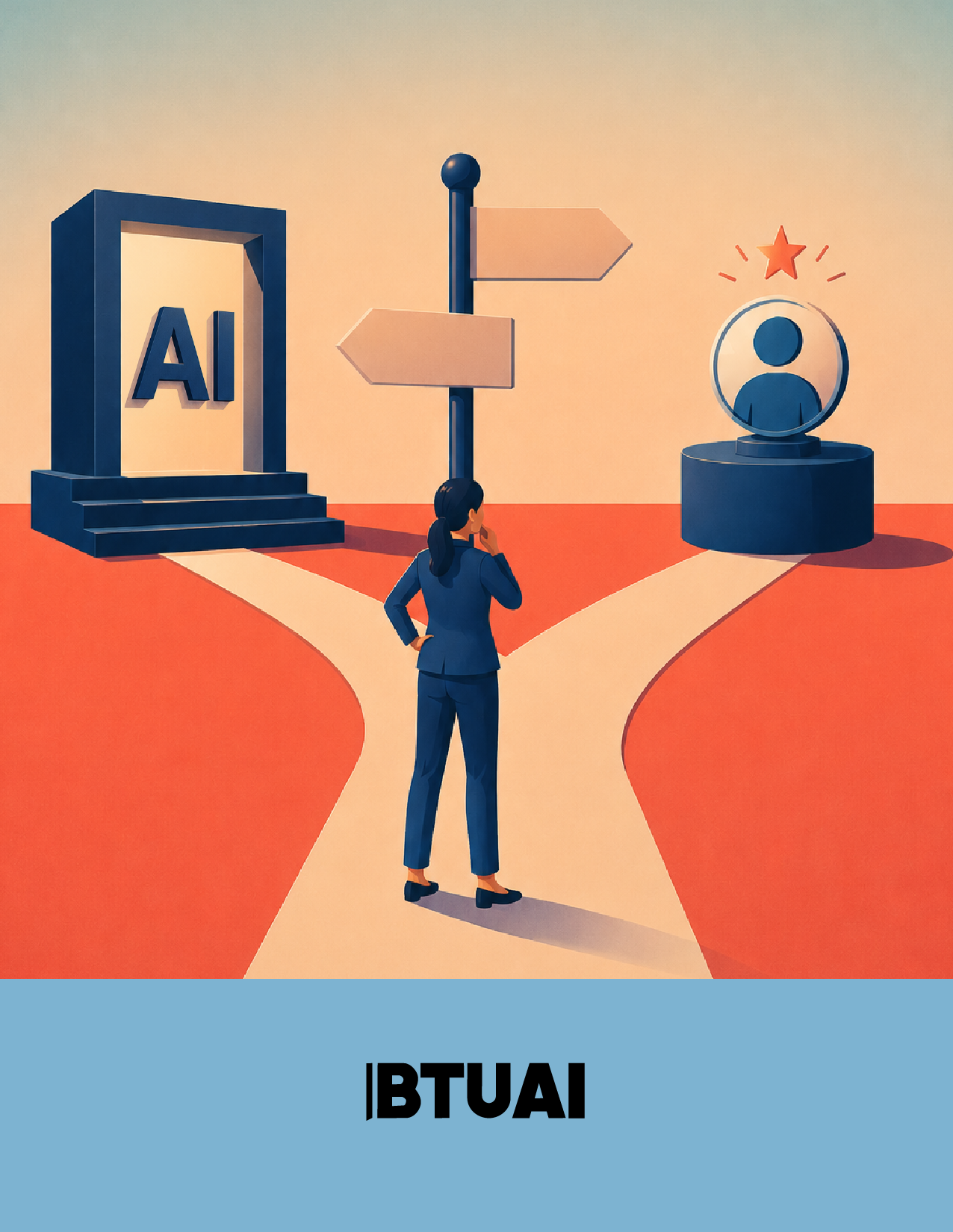
This means that the main question for employees is changing. In the past, a person asked: “What position do I hold in the company?” Now the question is more complex: “What role do I have in a company where AI is already part of the work process?”
International experience shows that AI does not affect all work in the same way. Some professions change quickly, while others change more slowly. Physical, human-facing, licensed or emotionally sensitive work is less immediately exposed to AI, while computer-based, document-heavy, analytical and repetitive work is more exposed to transformation.
For Georgia, this issue is especially important. In the first quarter of 2026, the information and communication sector accounted for 11.7% of business sector output. In the same period, the sector received USD 37.2 million in foreign direct investment, representing 13.7% of total FDI. This shows that Georgia’s digital economy is already economically visible, not only a future idea.
BTU researchers assess that the key question is this: will Georgian companies use AI only to reduce costs, or will they use it as a foundation for employee development and new work roles? For employees, the key question is equally clear: can they redefine their place in the AI-era company?
Georgia context: when the manager already knows what AI is for, but the employee does not
Imagine a Georgian company where the director is already attending AI meetings, asking how automation can be introduced, seeing competitors use AI in marketing, sales, finance, HR and customer communication. The director already has a plan: to reduce time, reduce cost, increase speed, improve data-based decisions.
At the same time, an employee continues to do the same work they have done for years: preparing reports, writing emails, filling spreadsheets, checking documents, answering clients, collecting information and assuming that experience alone will be enough.
But the future company will work differently. Experience will still matter, but it will not be enough by itself. Employees will need the ability to work with AI, check AI-generated outputs, give better tasks, read data correctly and do what AI cannot do well: understand context, build trust, manage relationships, carry responsibility and make ethical judgments.
This is why the question “Do you have a place in the future company?” is not meant to create fear. It is a preparation question.
What changes inside the company
AI is not only a new tool inside the company. It changes the structure of work.
The first change is the reduction of routine. Many tasks that once required hours can now be prepared in minutes: text summaries, data comparisons, email drafts, presentation outlines, customer-question classification and first versions of standard documents.
The second change is decision speed. Managers can receive summaries, identify trends and compare alternatives faster.
The third change is role redistribution. If AI prepares the first version of the work, humans are increasingly expected to check, improve, contextualize and take final responsibility.
The fourth change is a new hierarchy of skills. In many roles, knowing how to use software was once enough. Now the more important skills are task design, data literacy, critical thinking, creative problem-solving and the ability to detect AI errors.
BTU researchers assess that the main outcome of AI adoption is not only time saved. The main outcome is a new distribution of work between humans and machines.
Which employee becomes stronger
In the AI era, the stronger employee is the one who does not define their profession only as a list of tasks. If a person believes their value is only writing text, filling tables, reviewing documents or searching for information, their role becomes more vulnerable.
But if a person understands why the work is being done, what context it has, what risk it carries, what decision should follow and how the business will use the result, their value increases.
The future employee is not the one who competes with AI. The future employee is the one who manages AI.
- Such an employee knows:
- how to assign a precise task;
- how to check an AI output;
- how to detect wrong data;
- how to add Georgian context;
- how to protect customer data;
- how to turn AI-prepared material into a real business decision.
This becomes a new professional advantage.
Who faces the greatest change
AI does not change every job equally. The fastest change appears in roles where work is computer-based, repetitive, document-heavy, text-based, spreadsheet-based and can be broken down into clear rules.
This may include:
- standard report preparation;
- basic research;
- first drafts of text;
- preliminary data analysis;
- classification of customer questions;
- internal documentation;
- draft advertising and marketing texts;
- simple code components;
- administrative work.
Work that requires physical presence, emotional interaction, high trust, professional licensing, responsibility, complex human context or local experience is more protected.
But protection does not mean no change. Doctors, teachers, lawyers, managers, journalists, financiers, marketers, HR specialists and public officials will also need to learn how to work with AI.
What this means for Georgian business
For Georgian business, an AI plan can become a competitive advantage, but only if it is designed with employees, not against them.
If a company sees AI only as a cost-cutting tool, it may save time and money in the short term, but lose knowledge, trust and organizational culture in the long term.
If a company uses AI as a productivity system, the result is different: employees spend less time on routine tasks and more time on clients, quality, strategy, sales, innovation and new products.
This is especially important for Georgian small and medium-sized businesses. Small teams can gain digital support that previously belonged mainly to large companies. But this requires organized processes, clean data, employee training and safety rules.
Why this matters for Georgia
Georgia’s labor market is entering a new stage. The ICT sector is becoming more visible in the economy, companies are using more digital tools and career entry for young people increasingly depends not only on diplomas, but on practical skills.
If Georgian companies adopt AI early and responsibly, the country can increase productivity, improve service quality, give small businesses more capabilities and reduce the amount of work that consumes human time without creating enough value.
If the process is delayed, the risk is double. Companies may lose competitiveness, while employees may find themselves in a workplace where their old skills are no longer enough.
This is why an AI plan is not only the director’s responsibility. It is a shared issue for managers, employees, universities, vocational education, the state and business associations.
What companies should do
A company should begin its AI plan not by asking how many people can be replaced, but by reviewing how work is done.
The first step is a task map. The company should describe what work repeats daily, what takes too much time, where errors are frequent and where AI can give the team initial support.
The second step is role redesign. For every position, the company should ask: what part can AI do, what part remains human and what new skill will the employee need?
The third step is training. Employees should not only be told to “use AI.” They should be taught how to use it, how to verify it and how to protect data.
The fourth step is safety. AI should not have uncontrolled access to sensitive information, client data, financial files or internal decisions.
The fifth step is measurement. An AI plan should be evaluated not by fashion, but by real results: time saved, errors reduced, service improved, sales increased or new products created.
What employees should do
For employees, the worst strategy is waiting. If a company adopts AI and an employee remains only in old work habits, their role weakens.
Several practical steps are needed.
First, break down your own work. Employees should know what their work consists of: what is routine, what is analysis, what is relationship-building and what is decision-making.
Second, learn AI in your own profession. Not generally, but specifically: how AI can help with your documents, your clients, your data and your role.
Third, build verification skills. AI output should not be accepted as final truth. Employees must know how to check, where errors may appear and what sources to rely on.
Fourth, strengthen human advantages. Trust, communication, ethics, context, empathy, responsibility and creativity become more important.
Fifth, keep learning. In the AI era, professional stability no longer means knowledge acquired once. It means continuously renewed skills.
What education should do
In the AI era, the main task of education is not only to teach students how to use AI tools. The main task is to teach students how to think with AI.
This means:
assigning tasks clearly;
understanding data;
checking sources;
detecting AI errors;
building practical projects;
working in teams with humans and AI agents;
understanding ethical and legal responsibility.
This is especially important for Georgia. If the education system does not respond to AI-driven change early, the labor market will move faster than universities. Companies already need AI-ready employees, while many young people still lack experience in using AI professionally rather than only for simple assignments.
Where the opportunity is
Georgia’s main opportunity is productivity growth. Small teams can do more, regional companies can provide better services, young people can build projects faster and businesses can compete with larger players.
The second opportunity is new roles. AI creates not only replacement risks, but also new jobs: AI process manager, data quality specialist, AI safety coordinator, Georgian-language AI resource creator, AI-enhanced marketer, AI-enhanced analyst, AI-supported educator.
The third opportunity is strengthening the Georgian language in the digital environment. If companies work in Georgian, AI systems must also be able to process Georgian text, documents, customer messages and local context properly.
Where the risks are
The main risk is that companies build AI plans without employee development. In that case, AI may become a source of fear, mistrust and damage to work culture.
The second risk is inequality between generations and skill groups. Those who learn AI quickly move forward; those who do not fall behind.
The third risk is the weakening of entry-level positions. If companies transfer to AI the routine tasks through which young employees used to build professional judgment, a new path for practical learning will be needed.
The fourth risk is dependence on foreign platforms. If Georgian companies rely only on foreign AI systems that do not fully understand Georgian language and context, decisions may miss local realities.
The fifth risk is data security. Employees may unknowingly enter internal documents, client information or confidential data into AI systems.
BTUAI assessment
BTUAI assesses that the future company will not have room for employees who ignore AI, but there will definitely be a place for people who redefine their profession in the AI era.
An AI plan inside a company should not be just a technology initiative. It should be a human and organizational plan: how work changes, how productivity grows, how employees develop, how management changes and how the company protects responsibility.
For Georgia, this issue is especially important because national competitiveness will depend on how quickly Georgian businesses use AI not only to generate text, but to improve processes, raise service quality, support regional business and strengthen Georgian-language digital capacity.
BTU researchers assess that the future company will need people who can work with AI while strengthening their human advantage: context, responsibility, trust, critical thinking and decision-making.
The main conclusion is simple: if your boss already has an AI plan, you also need your own professional plan for the AI era.
Key findings
- AI is no longer only a technology tool inside companies; it is becoming part of organizational development.
- Employee value in the future company will depend not only on experience, but on the ability to work with AI.
- Computer-based, repetitive, document-heavy and analytical work will change fastest.
- Human value will remain in context, responsibility, trust, relationships, creative judgment and ethical evaluation.
- For Georgian business, AI can become a source of productivity if adoption is paired with employee development.
- Weakening of entry-level roles is one of the main risks, because young employees often learn professional judgment through routine tasks.
- Education systems should teach students how to work with AI, not only how to use AI.
- Georgian-language data and local context are essential for AI systems to work reliably in Georgia.
Data snapshot
In the first quarter of 2026, the information and communication sector accounted for 11.7% of Georgia’s business sector output.
In the same quarter, the sector received USD 37.2 million in foreign direct investment.
This represented 13.7% of total FDI in Georgia in the first quarter of 2026.
Information and communication ranked third in the sectoral structure of FDI.
International labor-market analysis shows that AI affects white-collar work especially where work is computer-based, text-based, data-based and linked to standardized analysis.
Further Georgia-focused research is needed on AI adoption in companies, employee AI skills, entry-level role transformation, retraining practices, quality of Georgian-language AI tools and internal data-security rules.
Methodology
This report was prepared as part of BTUAI Research. The analysis is based on demographic, regional, economic and behavioral data, as well as general trends observed in publicly available sources. The materials are processed using analytical methods applied by BTU researchers, with the support of BTUAI.
The purpose of the research is not to provide personal assessments, but to identify broader trends and practical directions for business, education and society.
This material uses international technology and labor-market trends on AI and the transformation of work, economic data on Georgia’s ICT sector and BTUAI analytical assessment in the context of Georgian business, education, the labor market, employee skills and the digital future of the Georgian language.
Limitations
This material is analytical and educational in nature. It does not constitute financial, investment, legal, HR, labor or technology procurement advice. Before making specific decisions, consultation with a relevant specialist is required.
AI is a rapidly developing field. Corporate adoption models, platform capabilities, labor-market responses and regulations may change quickly. This material explains the significance of the trend for Georgia and does not provide internal restructuring instructions for any specific company.
Georgia needs additional local research on AI adoption in companies, employee skills, changes in entry-level positions, retraining outcomes and data-protection practices.
Sources
WIRED, July–August 2026, Corporate AI-America special section, materials on AI and work, AI-native workplace expectations and labor-market uncertainty.
National Statistics Office of Georgia – Business Sector Results, Q1 2026.
National Statistics Office of Georgia – Foreign Direct Investment, Q1 2026.
BTUAI analytical processing for the context of AI, Georgian business, the ICT sector, education, the labor market and the digital future of the Georgian language.
Frequently asked questions
What does it mean that your boss already has an AI plan?
It means the company is starting to think about how AI can support productivity, cost reduction, service quality, data analysis and redistribution of work roles.
Does an AI plan mean employee reduction?
Not necessarily. A responsible AI plan should mean redesigning work, reducing routine tasks, retraining employees and moving people toward higher-value work.
Which employees are most exposed?
Roles that are repetitive, computer-based, text-heavy, document-heavy or linked to standardized analysis are more exposed to change.
How should an employee prepare?
Employees should break down their work into tasks, learn AI in their own profession, verify AI outputs and strengthen human skills such as communication, context, responsibility and critical thinking.
What should a company do?
A company should build an AI plan that includes task mapping, role redesign, training, safety rules and measurement of results.
Why does this matter for Georgia?
Because responsible AI adoption can support Georgian business productivity, service quality, education renewal and national digital competitiveness.
Keywords
AI and work Georgia; AI plan; future company; Georgian business; labor market Georgia; AI skills; digital transformation in Georgia; ICT sector Georgia; employee reskilling; Georgian language AI; AI adoption in Georgia; future of work Georgia; BTUAI; Business and Technology University.
Citation format
BTUAI Research Team. “Your Boss Already Has an AI Plan. Do You Have a Place in the Future Company?” Business and Technology University, BTUAI.ge, 2026.
Prepared by the academic team of Business and Technology University and the BTUAI Research Team.
Tbilisi, Georgia
BTUAI is an analytical platform of Business and Technology University that studies the impact of artificial intelligence, digital transformation, innovation, startup ecosystems, data analytics and emerging technologies on business, the economy, education and society. BTUAI materials are designed to explain complex technological and economic changes in a clear, reliable and Georgia-focused way.