




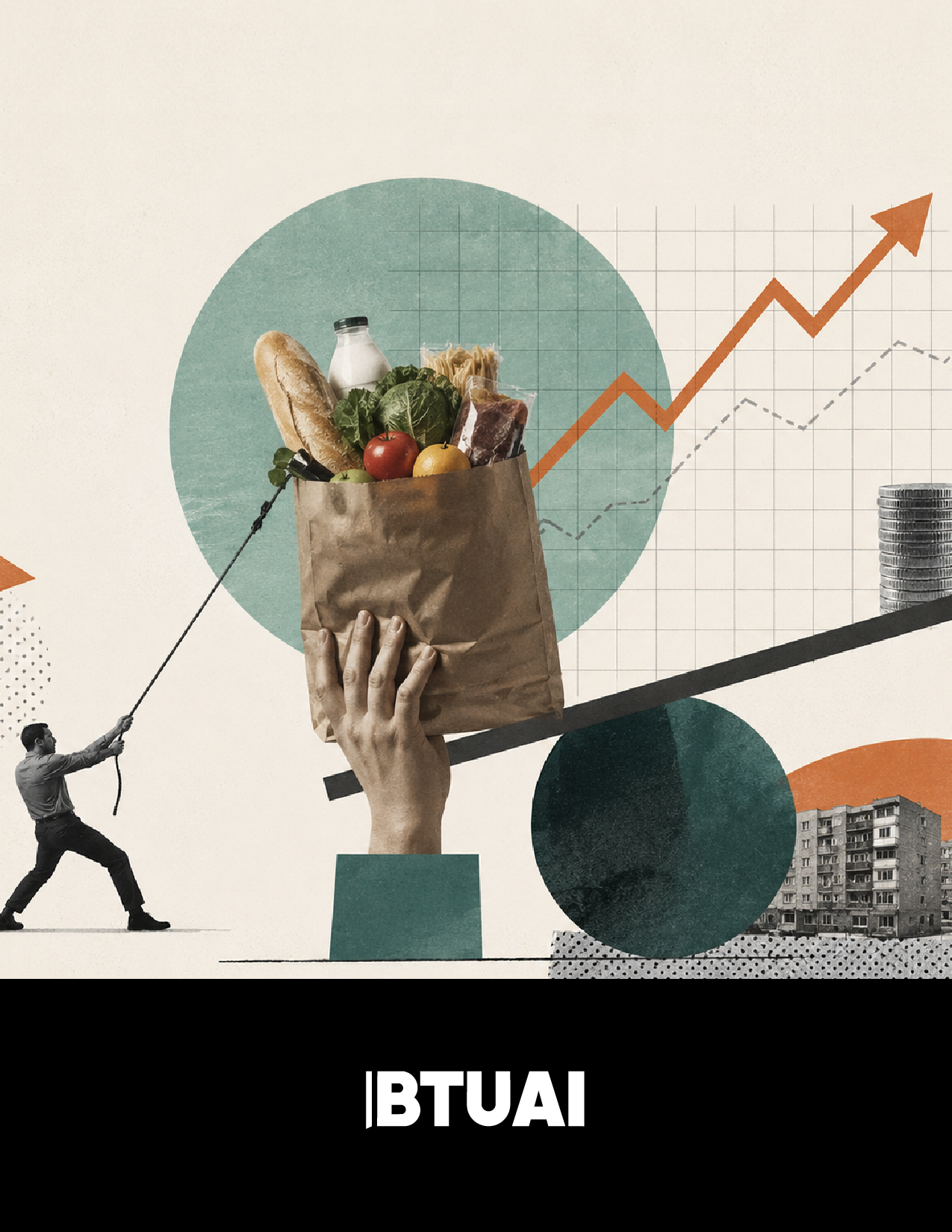
In Georgia’s May 2026 price picture, food no longer appears to be the fastest inflation driver. According to the Harmonised Consumer Price Index, food and non-alcoholic beverages increased by 4.7% year-on-year, while food itself increased by 4.9%. This is lower than at the beginning of the year: in January, the annual increase in food and non-alcoholic beverages reached 9.1%.
In monthly terms, May even showed a small easing. Food and non-alcoholic beverages declined by around 0.2% compared with the previous month, while food itself declined by around 0.5%. This means that the pace of food price growth has slowed.
But from a social and economic perspective, food remains one of the most sensitive problems. The reason is simple: food is a daily and necessary expense. People can postpone buying electronics, reduce entertainment or eat out less often, but they cannot opt out of food. For low- and middle-income households, food takes a large share of the budget, which means that even a 4–5% annual increase can be felt as a real financial burden.
BTU researchers assess that food inflation should not be analyzed only through a percentage figure. The key question is how strongly it affects household budgets, how food prices are connected to transport, energy, local production and imports, and how Georgia can reduce social vulnerability to food price increases.
There are different types of inflation. Higher fuel prices remind people of mobility. Higher utility costs remind them of housing. Higher electronics prices affect large purchases. But food inflation is the most everyday and human form of inflation.
Food is an expense that households face every day or every week. Bread, milk, meat, vegetables, fruit, oil, sugar, eggs, children’s food, beverages – all of these are frequent and necessary parts of the household budget.
This is why food inflation is not only an economic indicator. It is directly connected to household peace of mind, consumer sentiment, social inequality and quality of life.
When food becomes more expensive, people feel it quickly. When the pace of food price growth slows, this is a positive signal, but the problem does not fully disappear for households because prices are already at a higher level.
What happened in May 2026
In May 2026, food and non-alcoholic beverages were 4.7% higher year-on-year. Food itself increased by 4.9%. This means that food prices remained higher than in May of the previous year.
However, compared with the beginning of the year, the picture has softened. In January, the annual increase in food and non-alcoholic beverages was 9.1%. By May, it had declined to 4.7%. This indicates that the pace of food price growth slowed significantly.
In May, a small month-on-month decline was recorded. Food and non-alcoholic beverages decreased by around 0.2% compared with the previous month, while food decreased by around 0.5%. This may reflect seasonal factors, improved supply or temporary declines in some product prices.
Still, annual growth remains, and the impact on household expenses has not fully disappeared.
Why food remains the most sensitive problem
Food is special because demand for it almost never disappears. Economists often call it a category of essential consumption. If clothes become more expensive, a person may postpone buying them. If electronics become more expensive, an old device may be used longer. But daily demand for food remains.
Food also does not affect everyone equally. For a high-income household, higher food prices are unpleasant, but food may represent a relatively smaller share of the total budget. For a low-income household, food may be one of the largest expenses. This means the same price increase hurts poor and middle-income households much more strongly.
This is the main social meaning of food inflation: it increases inequality not because the price is different for everyone, but because the share of food in each household’s budget is different.
Food, transport and energy – parts of one chain
Food prices are not formed only on farms, in stores or in markets. Behind them stands a full chain: production, imports, storage, processing, transport, distribution, retail and final sale.
This is why food prices are affected not only by harvests or product shortages, but also by transport and energy. If mobility becomes more expensive, it becomes more expensive to bring food to stores. If energy becomes more expensive, storage, refrigeration, processing, production and retail costs increase.
In May 2026, transport prices increased by 14.7% year-on-year, while the operation of personal transport equipment increased by 23.1%. Housing, water, electricity, gas and other fuels increased by 6.8%, while the energy subgroup rose by 10.3%. This means that even if direct pressure on food slowed, the surrounding cost environment remained high.
This is why food price stability is not only an agricultural policy issue. It is also about transport, energy, logistics, storage, competition and local production.
Local production and import dependence
For Georgia, import dependence is one of the important issues in food prices. When a large share of products is imported, prices are affected by external markets, exchange rates, transport costs, logistics and trade conditions in neighboring countries.
Imports are necessary for a small economy. But if important food groups depend too heavily on external supply, price stability becomes harder.
Local production can partly reduce this risk, but only if it is efficient. The country needs not only more production, but better storage, processing, quality standards, farmer-market connections, cold chains, regional logistics and modern agricultural management.
If local products reach the market irregularly or are expensive to produce, they cannot reduce price pressure. If local production becomes more efficient and scalable, the food market will become more resilient.
Why the headline inflation rate is not enough
When overall inflation is 5.4%, food’s 4.7% annual increase may seem relatively moderate. But headline inflation does not always reflect the real experience of families.
For one household, the main expense may be food and transport. For another, rent and utilities. For a third, healthcare and medicine. This means a single average indicator cannot show how inflation affects different households.
Food is special in this sense because it is a fundamental expense in almost every household. Therefore, even a relatively lower percentage increase in food prices can feel heavier than a higher percentage increase in another category.
What food price dynamics mean for business
Food prices are not only a consumer issue. They matter for business as well.
Restaurants, cafés, hotels, food service businesses, grocery stores, distributors and local producers are directly affected by food price changes. If ingredients become more expensive, food service businesses must either raise prices or reduce margins. If consumers cannot accept higher prices, businesses come under pressure.
Food prices therefore also affect the service sector. If products become more expensive, restaurant menus, hotel breakfasts, café offers and corporate catering may also become more expensive.
Food inflation is, therefore, a bridge between household expenses and business pricing.
Where the opportunity is
Georgia has several opportunities in relation to food prices.
The first is strengthening local agricultural production. This does not mean producing everything locally, but identifying the product groups where the country has real potential.
The second is improving storage and logistics. Prices often rise not because a product does not exist, but because storing, transporting and delivering it to the market is expensive.
The third is developing processing. If a country sells only raw products, value remains limited. Processing creates more stability, longer shelf life, larger markets and better income.
The fourth is digital agricultural data. Farmers, distributors and policymakers need better information on demand, supply, prices, harvests and logistics.
The fifth is competition and transparency. If competition is weak or supply chains are opaque, price pressure is passed more heavily to consumers.
Where the risks are
The main risk is renewed acceleration of food prices because of transport and energy costs. If logistics and energy remain expensive, this may affect food prices in the coming months.
The second risk is social inequality. For low-income households, food takes a large share of the budget, so even a small percentage increase is strongly felt.
The third risk is import dependence. A shock in external markets or exchange rates can quickly pass into local prices.
The fourth risk is low productivity in local production. If local agriculture does not become more efficient, it cannot play a stabilizing role.
The fifth risk is a change in consumer behavior. If food becomes more expensive, households may shift to cheaper and lower-quality products, which can also affect wellbeing.
What Georgia should consider
Several questions are necessary to read food prices correctly:
- Which products are becoming more expensive?
- How much of the increase comes from imports?
- How much do transport and energy affect prices?
- Is the monthly decline seasonal?
- What is the spending structure of low-income households?
- How strong are local production and processing?
- How transparent is the supply chain?
The answers to these questions will show whether the easing in food prices is temporary relief or the beginning of more sustainable stabilization.
Why this matters for Georgia
Food prices in Georgia are not only economic statistics. They are about social stability, household budgets, regional production, agriculture, imports, logistics and quality of life.
If food prices are stable, families can plan expenses better. If food becomes more expensive quickly, people first change everyday consumption. This affects health, wellbeing, consumer sentiment and overall economic trust.
This is why food inflation analysis in Georgia should always be human-centered. The main issue is not only the percentage. The main issue is how that percentage appears on the family table.
BTUAI assessment
BTUAI assesses that food price dynamics in May 2026 show a dual picture. On the one hand, food is no longer the fastest source of inflation: annual growth in food and non-alcoholic beverages was 4.7%, and a small monthly decline was visible. This points to some easing of price pressure.
On the other hand, food remains the most socially sensitive expense. For low- and middle-income households, food prices are a daily financial reality. Therefore, even a 4–5% annual increase is a meaningful burden.
BTU researchers assess that Georgia’s main task is to analyze food prices not in isolation, but as part of a full system: transport, energy, local production, imports, storage, processing, competition and logistics together determine how affordable food will be for households.
The main conclusion is this: food inflation has slowed, but food remains the most sensitive and everyday economic problem for families.
Key findings
- In May 2026, food and non-alcoholic beverages were 4.7% higher year-on-year.
- Food itself increased by 4.9% year-on-year.
- In January, annual growth in food and non-alcoholic beverages reached 9.1%, higher than in May.
- In May, food and non-alcoholic beverages showed a small month-on-month decline.
- Food is no longer the fastest inflation source, but it remains the main burden for families.
- Low- and middle-income households feel food price increases more strongly.
- Food prices are affected by transport, energy, imports, local production, storage and logistics.
- Georgia needs a more resilient food market system – with local production, processing, cold chains, better logistics and market transparency.
Data snapshot
Food and non-alcoholic beverages, May, annual increase – 4.7%.
Food, May, annual increase – 4.9%.
Food and non-alcoholic beverages, January, annual increase – 9.1%.
Food and non-alcoholic beverages, May, monthly change – around minus 0.2%.
Food, May, monthly change – around minus 0.5%.
Overall Harmonised Consumer Price Index, May, annual increase – 5.4%.
Transport, May, annual increase – 14.7%.
Housing, water, electricity, gas and other fuels, May, annual increase – 6.8%.
Electricity, gas and other fuels, May, annual increase – 10.3%.
Methodology
This report was prepared as part of BTUAI Research. The analysis is based on demographic, regional, economic and behavioral data, as well as general trends observed in publicly available sources. The materials are processed using analytical methods applied by BTU researchers, with the support of BTUAI.
The purpose of the research is not to provide personal assessments, but to identify broader trends and practical directions for business, education and society.
In this specific material, the food and non-alcoholic beverages group of the May 2026 Harmonised Consumer Price Index is analyzed, along with annual and monthly food price dynamics and the relationship between food prices, transport, energy, imports, local production and household spending structures.
Limitations
This material is analytical and educational in nature. It does not constitute financial, investment, legal, tax or individual economic advice. Before making specific decisions, consultation with a relevant specialist is required.
The data reflects price dynamics for a specific period and is not sufficient to determine a long-term inflation trend. Sustainable conclusions require product-level, regional, seasonally adjusted and income-based analysis.
The Harmonised Consumer Price Index shows average price dynamics, but does not reflect the individual spending structure of every household.
Sources
Harmonised Consumer Price Index data for January–May 2026 published by the National Statistics Office of Georgia.
BTUAI analytical processing for the context of food inflation, household expenses, the impact of transport and energy, local production and Georgia’s economic environment.
Frequently asked questions
If food price growth has slowed, why does the problem remain?
Because food is a necessary and daily expense. Even a 4–5% annual increase is a meaningful burden for families, especially when income does not grow quickly.
Does the monthly decline in May mean food became cheaper?
There was a small decline compared with the previous month, but prices remained higher year-on-year. This is more a signal of easing than the end of the problem.
Why does transport affect food prices?
Food needs production, storage, processing, transportation and delivery to stores. If logistics becomes more expensive, this can affect final prices.
Why is food inflation especially difficult for low-income households?
Because food takes a larger share of their total budget. The same price increase therefore affects them more strongly.
What should Georgia do to reduce vulnerability to food prices?
Georgia should strengthen local production, processing, cold chains, efficient logistics, market transparency, farmer-market connections and the smart management of import dependence.
Keywords
food inflation Georgia; food prices; Harmonised Consumer Price Index; household expenses; cost of living; agriculture; local production; imports; logistics; energy prices; transport impact; social inequality; BTUAI; Business and Technology University; household budget.
Citation format
BTUAI Research Team. “Food Is No Longer the Fastest Inflation Driver, But It Remains the Main Burden for Families.” Business and Technology University, BTUAI.ge, 2026.
Prepared by the academic team of Business and Technology University and the BTUAI Research Team.
Tbilisi, Georgia
BTUAI is an analytical platform of Business and Technology University that studies the impact of artificial intelligence, digital transformation, innovation, startup ecosystems, data analytics and emerging technologies on business, the economy, education and society. BTUAI materials are designed to explain complex technological and economic changes in a clear, reliable and Georgia-focused way.