



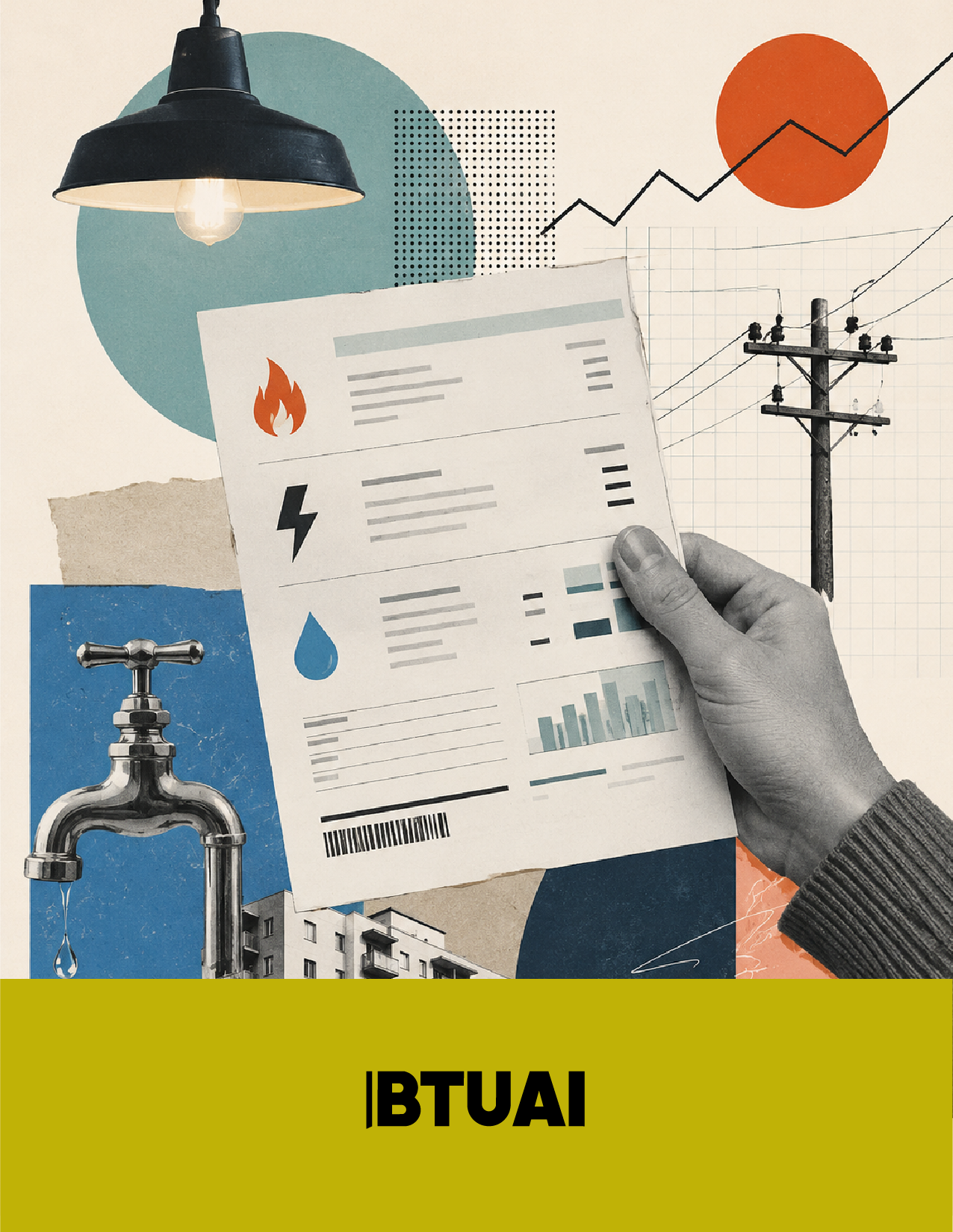
In Georgia’s May 2026 price picture, one of the most important but less visible sources of inflation was housing and energy-related costs. According to the Harmonised Consumer Price Index, the category “housing, water, electricity, gas and other fuels” increased by 6.8% year-on-year in May. Within this category, the energy subgroup – electricity, gas and other fuels – increased by 10.3% year-on-year.
April was especially notable, as monthly growth in this category accelerated sharply. Housing and utility-related costs are not one-off expenses. They are necessary monthly household costs and constant operating costs for businesses. This is why their increase can become a hidden source of inflation: it may not be as visible as food or fuel prices, but it slowly and continuously increases the cost of living.
BTU researchers assess that housing and energy are among the most sensitive parts of inflation because households cannot easily avoid these costs. A family may reduce entertainment, postpone buying electronics or choose a cheaper brand, but water, electricity, heating, gas and housing maintenance are everyday necessities.
The key question is this: is this a temporary price acceleration, or does the rise in energy, housing and utility costs reveal a deeper structural problem for Georgia – energy efficiency, housing quality, regulated prices and household cost vulnerability?
Georgian context: why utility inflation is hidden
When food becomes more expensive, people see it in stores. When fuel becomes more expensive, drivers feel it at gas stations. When electronics become more expensive, consumers may postpone purchases.
Utility cost inflation often works more quietly. Increases in electricity, gas, water, heating, housing maintenance and similar expenses enter household budgets every month. They may not appear as one dramatic shock, but month after month they reduce disposable income.
This is why housing and energy are hidden sources of inflation. They are not always the loudest, but they are among the most persistent. If a household has to pay more every month for utilities, it has less left for food, education, healthcare, transport or savings.
What happened in May 2026
In May 2026, the category “housing, water, electricity, gas and other fuels” increased by 6.8% year-on-year. This was higher than the overall annual consumer price increase and indicates that housing-related costs created separate pressure within inflation.
The energy subgroup increased even more sharply. Electricity, gas and other fuels were 10.3% higher year-on-year in May. This means that energy became more expensive faster than the broader housing-cost category.
Monthly growth in this category was especially high in April. This matters because annual inflation alone is not enough to understand price dynamics. If utility or energy costs increase sharply in one month, that increase remains in the overall price level in subsequent months and becomes a new baseline cost for households.
Why higher energy prices matter
Energy is one of the fundamental costs of the economy. It is needed at home, in offices, factories, shops, hotels, restaurants, hospitals, schools, data centers and almost every type of economic activity.
This is why higher energy costs do not remain in one category. If energy becomes more expensive, manufacturing costs, service costs, storage costs, cooling and heating costs, food service costs, hotel costs and general business operating costs also increase.
For households, energy is a condition of everyday life. Heating, lighting, water heating, cooking, refrigeration, washing machines and internet devices all require energy. Therefore, a 10.3% annual increase in energy-related costs is not only a technical indicator; it affects the everyday financial stability of households.
Housing costs and social inequality
Utility costs do not affect all households equally. For a high-income household, higher electricity or gas prices are unpleasant, but their share in total income is relatively smaller. For low- and middle-income households, utilities take a more important share of the budget.
This is why utility inflation is also a question of social inequality. The same percentage increase harms households differently. A family that spends a large share of income on food, transport and utilities feels price increases much more strongly.
This becomes especially important before winter and colder seasons, when heating costs increase. If energy prices are already higher, seasonal demand creates additional pressure on household budgets.
Business: energy as an operating cost
For businesses, higher energy prices are a direct operating cost. A store needs lighting and refrigerators. A restaurant needs a kitchen, heating, cooling and hot water. A hotel needs lighting, heating, cooling, elevators, laundry and guest comfort. A factory needs machinery, energy and production processes.
If energy costs increase, a business has three choices: reduce profit, raise prices or cut other costs. All three have economic consequences.
If a business raises prices, energy inflation passes into other sectors. If it reduces profit, investment and growth potential weaken. If it cuts other costs, this may affect quality, wages or employment.
This means that energy inflation is not only a household problem. It is also a question of business productivity and competitiveness.
Why energy efficiency is connected to inflation
Energy efficiency is often discussed as an environmental topic, but in the context of inflation it is also an economic issue. If a household or business can achieve the same result with less energy, its costs become more controllable.
Many residential buildings in Georgia were built with low energy-efficiency standards or are old. Heating and cooling such buildings is more expensive. Poor insulation, outdated windows, inefficient heating systems and irrational energy use increase household costs.
The same applies to business. Energy-efficient equipment, better insulation, smart management systems, LED lighting, solar energy and energy monitoring can reduce costs.
This is why energy efficiency is one of the long-term forms of protection against inflation.
Utility costs and housing quality
Housing-related inflation is not only about electricity and gas. It is also connected to housing maintenance, building condition, water, repair costs, heating, shared infrastructure and urban quality of life.
If the housing stock is not energy-efficient, households pay more. If buildings are poorly maintained, repair and shared costs increase. If urban transport and infrastructure are inefficient, housing costs become heavier alongside other expenses.
This means that housing inflation is also a broader urban issue. The city, building, utility system and energy consumption together shape a household’s monthly cost.
The role of administered prices
Part of utility and energy-related costs is often connected to regulated or administered prices. This means that prices are influenced not only by the market, but also by tariffs, regulations, public policy, energy infrastructure and regulatory decisions.
For this reason, price increases in this area are not only a consumer or business issue. They are also a public policy issue.
When administered prices increase, it is important for society to understand what caused the increase, how necessary it was, how it affects households at different income levels and whether there are support mechanisms for the most vulnerable groups.
Where the opportunity is
For Georgia, rising housing and energy costs also reveal several important opportunities.
The first is a policy for energy-efficient buildings. Improving energy efficiency in new and existing buildings reduces long-term costs for households and businesses.
The second is better management of utility expenses. Smart meters, consumption analysis, energy-saving tools and consumer information make costs more transparent.
The third is business energy efficiency. For small and medium-sized businesses, reducing energy costs is a direct source of competitiveness.
The fourth is local energy resources and diversification. The more stable and diversified the energy system is, the lower the risk of price shocks.
The fifth is social protection. When utility costs increase, targeted support is especially important for households for whom these costs are the heaviest.
Where the risks are
The main risk is that utility costs become a persistent source of inflation. If energy and housing-related costs increase regularly, they permanently change household spending structures.
The second risk is pass-through into business prices. Higher energy costs can affect food, services, tourism, manufacturing and retail prices.
The third risk is energy poverty. If a household spends a large share of income on energy and utilities, other essential needs become constrained.
The fourth risk is low housing-stock quality. Poorly insulated and outdated buildings increase costs and make households more vulnerable.
The fifth risk is inflation expectations. If citizens expect utility costs to rise further, this may change their consumption, saving and financial behavior.
What Georgia should consider
Several questions are important when analyzing housing and energy inflation:
- How much of the increase comes from energy prices?
- How much is driven by tariffs and administered prices?
- How different is the impact on low- and high-income households?
- How energy-efficient is the housing stock?
- How much can businesses reduce energy costs?
- Does higher energy cost pass into other product and service prices?
- What role can digital management, smart meters and energy monitoring play?
The answers to these questions will determine whether utility inflation is temporary pressure or a long-term economic and social problem.
Why this matters for Georgia
In Georgia, housing and energy costs are directly connected to quality of life. These are costs that affect every household and are difficult to reduce in the short term.
If utility costs increase, households have less left for other needs. If energy becomes more expensive for businesses, prices may increase. If the housing stock is inefficient, the country becomes more vulnerable to energy prices.
This is why utility cost inflation should be read not only as price statistics, but as a question of economic resilience, social protection, urban policy and energy efficiency.
BTUAI assessment
BTUAI assesses that the increase in housing and energy costs in May 2026 is one of the most important hidden sources of inflation. The 6.8% annual increase in the category and the 10.3% increase in the energy subgroup show that utility costs remain a significant pressure for households and businesses.
BTU researchers assess that the importance of this category is not only in its percentage increase. Housing, water, electricity, gas and heating are necessary costs that households cannot easily reduce. Their increase therefore affects low- and middle-income households especially strongly.
The main conclusion is this: utility costs are a hidden source of inflation because they simultaneously increase the cost of living, business costs and the risk of social vulnerability. Georgia’s response should not be limited to price monitoring. It should include energy efficiency, improvement of the housing stock, targeted social support and long-term energy-system resilience.
Key findings
- In May 2026, the category “housing, water, electricity, gas and other fuels” increased by 6.8% year-on-year.
- The energy subgroup – electricity, gas and other fuels – increased by 10.3% year-on-year.
- Monthly growth in this category was especially high in April, leaving a significant effect on the overall price level.
- Utility costs are necessary household expenses and are difficult to reduce in the short term.
- Higher energy prices also increase business operating costs and can pass into other prices.
- Low- and middle-income households feel utility inflation more strongly.
- Important responses for Georgia include energy efficiency, housing-stock improvement, utility-cost transparency and targeted social support.
Data snapshot
Housing, water, electricity, gas and other fuels – May, annual increase: 6.8%.
Electricity, gas and other fuels – May, annual increase: 10.3%.
Overall Harmonised Consumer Price Index – May, annual increase: 5.4%.
Overall Harmonised Consumer Price Index – May, monthly increase: 0.5%.
Monthly growth in the housing and energy-related category was especially high in April.
Methodology
This report was prepared as part of BTUAI Research. The analysis is based on demographic, regional, economic and behavioral data, as well as general trends observed in publicly available sources. The materials are processed using analytical methods applied by BTU researchers, with the support of BTUAI.
The purpose of the research is not to provide personal assessments, but to identify broader trends and practical directions for business, education and society.
In this specific material, the housing, water, electricity, gas and other fuels category of the May 2026 Harmonised Consumer Price Index is analyzed. Particular attention is paid to the impact of utility costs on household budgets, business operating costs, energy efficiency, social vulnerability and the risks of inflation pass-through.
Limitations
This material is analytical and educational in nature. It does not constitute financial, investment, legal, tax, energy or utility-related individual advice. Before making specific decisions, consultation with a relevant specialist is required.
The data reflects price dynamics for a specific period and is not sufficient to determine a long-term inflation trend. Sustainable conclusions require additional analysis of subsequent months, energy tariffs, seasonality, housing-stock quality, real incomes and business energy consumption.
The Harmonised Consumer Price Index shows average price dynamics, but does not reflect the individual spending structure of every household.
Sources
May 2026 Harmonised Consumer Price Index data published by the National Statistics Office of Georgia.
BTUAI analytical processing for the context of housing and energy costs, utility inflation, household expenses, business operating costs and Georgia’s economic environment.
Frequently asked questions
Why are utility costs a hidden source of inflation?
Because they are daily and necessary expenses. Their increase may not appear as visibly as food or fuel price rises, but it reduces household disposable income every month.
Why is the 10.3% increase in energy-related costs important?
Energy is needed by both households and businesses. Higher energy costs increase heating, lighting, production, service, storage and other operating expenses.
Who is most affected by utility inflation?
Low- and middle-income households are affected most strongly because utility costs take a larger share of their budgets.
Can higher energy prices pass into other prices?
Yes. If businesses face higher energy costs, this can affect food, services, manufacturing, tourism and retail prices.
What can be done?
Energy efficiency, better housing stock, smart consumption, lower business energy costs, targeted social support and energy-system diversification can reduce pressure.
Keywords
utility inflation; energy prices Georgia; housing costs; inflation in Georgia; Harmonised Consumer Price Index; electricity; gas; heating; energy efficiency; housing stock; household expenses; business costs; energy poverty; BTUAI; Business and Technology University.
Citation format
BTUAI Research Team. “Housing and Energy: Why Utility Costs Became a Hidden Source of Inflation in Georgia.” Business and Technology University, BTUAI.ge, 2026.
Prepared by the academic team of Business and Technology University and the BTUAI Research Team.
Tbilisi, Georgia
BTUAI is an analytical platform of Business and Technology University that studies the impact of artificial intelligence, digital transformation, innovation, startup ecosystems, data analytics and emerging technologies on business, the economy, education and society. BTUAI materials are designed to explain complex technological and economic changes in a clear, reliable and Georgia-focused way.