




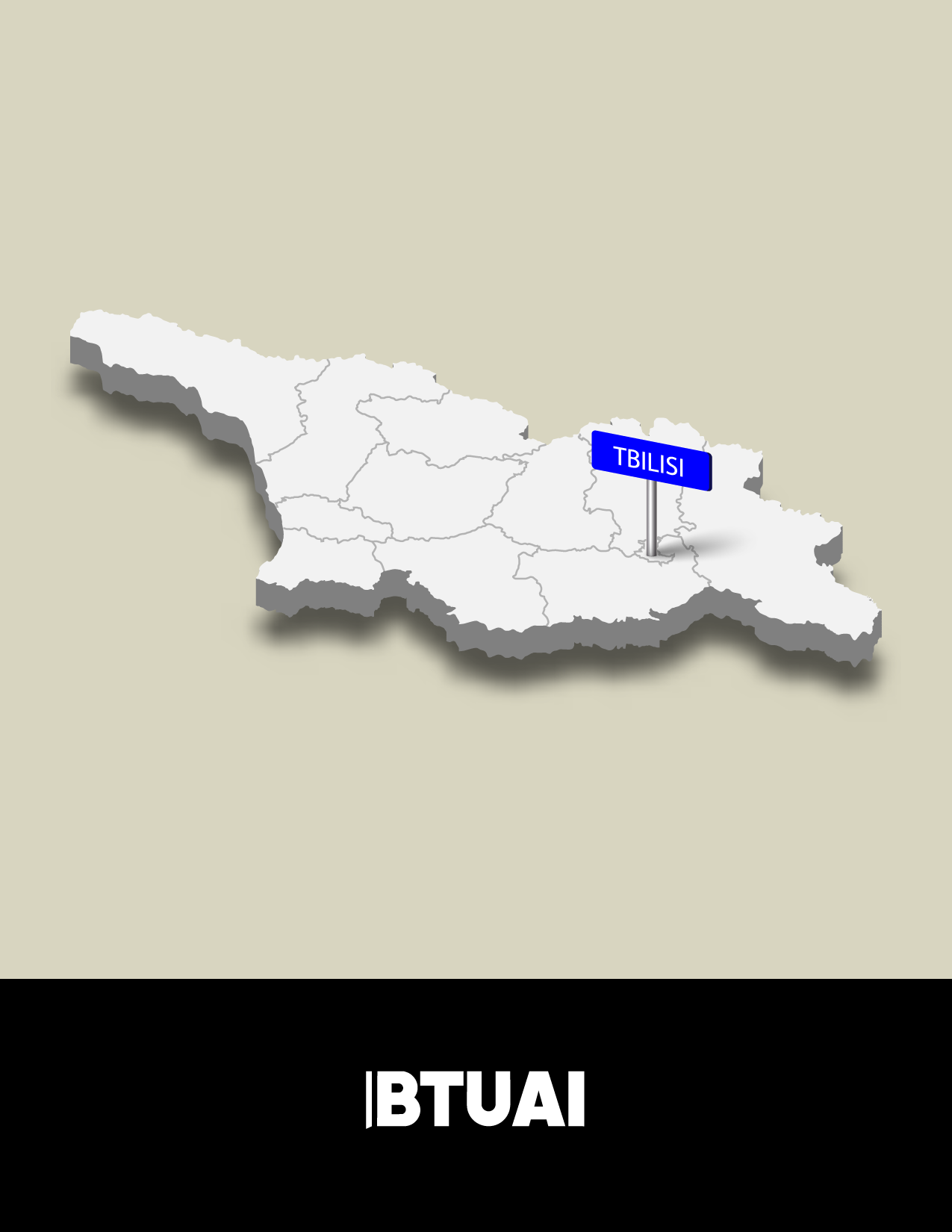
The first-quarter 2026 data once again reveals one of the most important structural challenges in Georgia’s economy: business activity is highly concentrated in Tbilisi. The capital accounted for 80.8% of total business sector turnover, 65.7% of output and 65.4% of business sector employment.
This means that Tbilisi is not only the administrative and political center of the country. It is also the main economic gravity point. A large share of major companies, financial services, talent, capital, professional services, infrastructure, decision-making centers and consumer demand is concentrated in the capital.
On the one hand, such concentration is partly natural: in a small country, the capital city often becomes the main economic gathering point. On the other hand, an 80.8% share of turnover is no longer only a matter of urban advantage. It is a signal of regional economic weakness, spatial concentration of business and an uneven development model.
BTU researchers assess that Georgia’s main challenge is not to weaken Tbilisi’s economy. On the contrary, a strong capital is necessary for the country. The real task is to make the regions not only places where people live, but also real economic centers of production, services, technology, tourism, agricultural processing, education and local business.
Georgian context: the economy is growing, but where is it growing?
When we say that Georgia’s business sector is growing, we should also ask: where is this growth taking place? If most growth is concentrated in one city, then the country’s economic success remains spatially limited.
Tbilisi creates opportunities, jobs, services, financial networks and business contacts. But when regions are weakly involved in this economic process, several problems appear: people move to the capital, local talent leaves regions, regional businesses remain small, local markets do not deepen, and the country’s economic life becomes excessively dependent on one city.
For Georgia, this is not only a statistical issue. It is simultaneously a social, demographic, educational, infrastructural and economic issue.
What happened in the first quarter of 2026
In the first quarter of 2026, Georgia’s business sector turnover reached GEL 62.0 billion, which was 10.7% higher than in the same period of the previous year. Output reached GEL 23.3 billion and grew by 12.4% year-on-year. The average number of people employed in the business sector reached 799.4 thousand.
But the regional distribution shows that this economic activity is extremely concentrated.
Tbilisi accounted for 80.8% of turnover. Adjara ranked second with 4.9%, followed by Kvemo Kartli with 3.7%, Samegrelo-Zemo Svaneti with 2.8% and Imereti with 2.4%.
The output picture is somewhat more balanced, but still strongly dependent on Tbilisi. The capital accounted for 65.7% of output, Adjara for 7.8%, Kvemo Kartli for 7.3%, Samegrelo-Zemo Svaneti for 6.2% and Imereti for 4.4%.
Tbilisi also leads in employment: 65.4% of business sector employees work in the capital. Adjara accounted for 9.5%, Imereti for 6.6%, Kvemo Kartli for 5.4% and Samegrelo-Zemo Svaneti for 3.5%.
These figures show that the regions participate in economic activity, but they still do not create sufficiently strong independent business dynamics.
Why Tbilisi is so strong
Tbilisi’s economic gravity has several causes.
First, capital and finance. Large companies, banks, investment decisions, consulting services and business networks are mainly concentrated in the capital. For businesses, this means easier access to finance, partners, legal services, marketing and talent.
Second, market size. Tbilisi is the largest consumer market. Many companies prefer to operate where customers, purchasing power and demand for services are stronger.
Third, talent. Higher education, professional networks, modern skills and a large share of the workforce are concentrated in the capital. This is especially important for technology, finance, management and professional services.
Fourth, infrastructure. Businesses need fast connections, offices, transport, digital services, administrative access and a service ecosystem. In this respect, Tbilisi is much stronger than the regions.
Fifth, the self-reinforcing effect. The more business and talent gather in Tbilisi, the more new businesses move to Tbilisi. This creates an economic cycle: companies go where clients, partners, talent and capital already exist.
Why this is a problem for the regions
Regional economic weakness does not simply mean that fewer businesses operate outside the capital. It means that local residents have fewer opportunities for quality employment, business growth, professional development and building an economic future connected to their place.
If business is limited in a region, a young person often sees two choices: move to Tbilisi or move abroad. As a result, the region loses talent, the market shrinks, business finds it harder to grow, and the local economy becomes even weaker.
This creates a circular problem: fewer businesses mean fewer jobs; fewer jobs mean migration; migration means a smaller market; a smaller market further reduces business motivation.
This is why strengthening regional economies is not only regional policy. It is a matter of the country’s long-term economic security.
Turnover and output show different pictures
It is notable that Tbilisi’s share in turnover is higher than its share in output. The capital accounts for 80.8% of turnover, but 65.7% of output.
This difference matters. Turnover often reflects the concentration of monetary flows, sales, large companies and centralized operations. Output better shows where real economic value is created.
When Tbilisi accounts for 80.8% of turnover but 65.7% of output, this may mean that regions play a relatively larger role in creating actual production and services than turnover figures suggest.
This is an important signal for Georgia: regional economic potential exists, but it needs stronger capital, market access, infrastructure, technology and business-growth mechanisms.
Adjara, Kvemo Kartli, Imereti and Samegrelo-Zemo Svaneti – regional anchors, but not yet at sufficient scale
Among the regions, Adjara, Kvemo Kartli, Imereti and Samegrelo-Zemo Svaneti have relatively stronger positions.
Adjara accounts for 4.9% of turnover, 7.8% of output and 9.5% of employment. This shows that Adjara is a relatively active economic region, especially due to tourism, services, logistics and the economic dynamics of Batumi.
Kvemo Kartli accounts for 3.7% of turnover, 7.3% of output and 5.4% of employment. This points to potential in production, energy, agriculture and industrial activity.
Imereti accounts for 2.4% of turnover, 4.4% of output and 6.6% of employment. This suggests that Imereti has more potential in employment and human resources than its turnover share shows.
Samegrelo-Zemo Svaneti accounts for 2.8% of turnover, 6.2% of output and 3.5% of employment. The region can become stronger in agricultural processing, logistics, energy, tourism and local production.
But the main picture remains unchanged: no region yet creates an economic scale strong enough to substantially reduce dependence on Tbilisi.
What must change for the regions
Strengthening regional economies requires not only infrastructure construction, but the creation of local economic functions.
First, regions need clear economic specialization. Not every region can develop everything in the same way. Some regions can become centers of agricultural processing, others tourism and the creative economy, others energy, logistics, small manufacturing, digital services or regional education.
Second, regional businesses must connect with larger markets. Local companies need better logistics, e-commerce, quality standards, branding, export support and access to supplier networks of larger companies.
Third, technological skills must grow in the regions. Today, digital services make it possible for high-quality work not to be concentrated only in Tbilisi. If digital education, remote-work culture, technology hubs and business services emerge in the regions, part of economic activity can become spatially redistributed.
Fourth, universities and vocational education should work with regional economies. Talent should be trained not only for the general labor market, but for the specific economic profile of each region.
Fifth, regional small and medium-sized businesses need access to finance and managerial support. A loan alone is not enough. They need business planning, market knowledge, digital tools, accounting, quality control, marketing and export readiness.
Where the opportunity is
Georgia’s regions have several real opportunities.
The first is agricultural processing. Georgia has long discussed agriculture, but higher value is created not only by producing raw materials, but through processing, packaging, branding and exports.
The second is tourism diversification. Tourism should not mean only Tbilisi and Batumi. Regions can develop wine tourism, eco-tourism, cultural, medical, sports, educational and digital-nomad-oriented tourism.
The third is small manufacturing. Food, furniture, textiles, construction materials, agrotechnology products and niche manufacturing can develop in the regions.
The fourth is digital services. Modern technology allows a designer, programmer, analyst, digital marketer, customer-support specialist or AI-data worker to work from a region.
The fifth is logistics and energy. Georgia’s geographic location can become an economic advantage for regions if transport, energy and production nodes are developed correctly.
Where the risks are
The main risk is that regional policy remains only a set of infrastructure projects and does not become a policy of economic specialization. A road, building or center does not create business by itself unless it is connected to talent, markets, capital and a concrete sectoral strategy.
The second risk is talent outflow. If high-quality jobs do not appear in the regions, young people will continue moving to Tbilisi or abroad.
The third risk is local-market isolation of small businesses. If regional businesses depend only on nearby customers, their growth opportunities remain limited.
The fourth risk is digital inequality. If regions do not have high-quality digital education and technological infrastructure, they will become even more distant from the new economy.
Why this matters for Georgia
Tbilisi’s economic gravity is both a strength and a limitation for Georgia. A strong capital is necessary, but an excessively concentrated economy is risky in the long term.
The country needs growth that is visible not only in Tbilisi, but also creates a future in the regions. This means more jobs in regions, more small and medium-sized businesses, more local production, more digital opportunities, more vocational education and greater local economic identity.
If Georgia’s economy depends only on one city, the country’s growth potential will remain limited. If regions become part of value creation, the country will become more resilient, inclusive and competitive.
BTUAI assessment
BTUAI assesses that the first-quarter 2026 regional data shows one of the most important structural challenges of Georgia’s economy: business activity is overly concentrated in Tbilisi. The capital accounts for 80.8% of turnover, 65.7% of output and 65.4% of employment. This means that Georgia’s economic model remains highly centralized.
At the same time, the data shows that regional economic potential exists. The regional share in output is relatively higher than in turnover. This means that regions create value, but do not yet have enough scale, capital, market access and business networks.
BTU researchers assess that Georgia’s next development stage should focus on strengthening regional economies not only through infrastructure, but also through specialization, technology, skills, local business support and the transfer of digital-economy opportunities beyond the capital.
The main conclusion is this: Tbilisi’s economic strength should remain an advantage for the country, but Georgia’s future growth depends on whether the regions can acquire independent economic functions.
Key findings
- In the first quarter of 2026, 80.8% of business sector turnover was concentrated in Tbilisi.
- Tbilisi also accounted for 65.7% of output.
- 65.4% of business sector employment was in the capital.
- Tbilisi’s share in turnover is higher than in output, showing strong concentration of monetary flows and large-company operations.
- Regions play a relatively more important role in output than in turnover, indicating local productive potential.
- Adjara, Kvemo Kartli, Imereti and Samegrelo-Zemo Svaneti are the most visible regional economic anchors, but their scale remains small compared with Tbilisi.
- Georgia’s main challenge is regional economic specialization, stronger SMEs and the transfer of digital opportunities outside the capital.
- Strengthening regional economies is essential for long-term resilience, employment and social balance.
Data snapshot
Business sector turnover in the first quarter of 2026 – GEL 62.0 billion.
Business sector output – GEL 23.3 billion.
Average number of people employed in the business sector – 799.4 thousand.
Tbilisi’s share in turnover – 80.8%.
Adjara’s share in turnover – 4.9%.
Kvemo Kartli’s share in turnover – 3.7%.
Samegrelo-Zemo Svaneti’s share in turnover – 2.8%.
Imereti’s share in turnover – 2.4%.
Tbilisi’s share in output – 65.7%.
Adjara’s share in output – 7.8%.
Kvemo Kartli’s share in output – 7.3%.
Samegrelo-Zemo Svaneti’s share in output – 6.2%.
Imereti’s share in output – 4.4%.
Tbilisi’s share in employment – 65.4%.
Adjara’s share in employment – 9.5%.
Imereti’s share in employment – 6.6%.
Kvemo Kartli’s share in employment – 5.4%.
Samegrelo-Zemo Svaneti’s share in employment – 3.5%.
Methodology
This report was prepared as part of BTUAI Research. The analysis is based on demographic, regional, economic and behavioral data, as well as general trends observed in publicly available sources. The materials are processed using analytical methods applied by BTU researchers, with the support of BTUAI.
The purpose of the research is not to provide personal assessments, but to identify broader trends and practical directions for business, education and society.
In this specific material, data on enterprise activity in the first quarter of 2026 is analyzed in the context of regional economy, spatial concentration of business activity, dependence on the capital, opportunities for small and medium-sized businesses and regional development.
Limitations
This material is analytical and educational in nature. It does not constitute financial, investment, legal, tax or individual business decision-making advice. Before making specific decisions, consultation with a relevant specialist is required.
The data reflects a quarterly picture of the business sector and is not sufficient to determine long-term regional trends. Sustainable conclusions require multi-year and sectoral analysis.
Regional distribution depends on enterprises’ actual addresses and statistical classification, which in some cases may not fully reflect the physical location of economic activity.
Sources
National Statistics Office of Georgia – “Results of Enterprise Activity, First Quarter of 2026.”
BTUAI analytical processing for assessing Georgia’s regional economy, business activity concentration, the role of small and medium-sized enterprises and spatial development.
Frequently asked questions
Why is Tbilisi’s 80.8% share in turnover important?
It shows that the monetary scale of the country’s business activity is almost entirely concentrated in the capital. Such concentration increases regional inequality and dependence on one city.
Does this mean there is no economy in the regions?
No. Regions play an important role in output and employment, but they do not yet have enough scale, capital and market access to reduce dependence on Tbilisi.
Why is Tbilisi’s share in output lower than in turnover?
This may indicate that monetary flows and large-company operations are more concentrated in Tbilisi, while part of real productive activity is also created in the regions.
What should be done for the regions?
Regions need economic specialization, support for local businesses, technological education, better logistics, access to finance, digital services and links to larger markets.
Is Tbilisi’s strong economy a problem?
No. The problem is not Tbilisi’s strength. The problem is that regions do not strengthen in parallel. Georgia needs both a strong capital and strong regions.
Keywords
Tbilisi economy; regional economy Georgia; business activity; business turnover; output; regional development; economic concentration; spatial economy; small and medium-sized businesses; employment in regions; Georgian economy; BTUAI; Business and Technology University; business concentration; regional development; spatial economy.
Citation format
BTUAI Research Team. “Tbilisi’s Economic Gravity: Why Is Georgia’s Business Activity Concentrated in the Capital?” Business and Technology University, BTUAI.ge, 2026.
Prepared by the academic team of Business and Technology University and the BTUAI Research Team.
Tbilisi, Georgia
BTUAI is an analytical platform of Business and Technology University that studies the impact of artificial intelligence, digital transformation, innovation, startup ecosystems, data analytics and emerging technologies on business, the economy, education and society. BTUAI materials are designed to explain complex technological and economic changes in a clear, reliable and Georgia-focused way.