



Key Takeaway
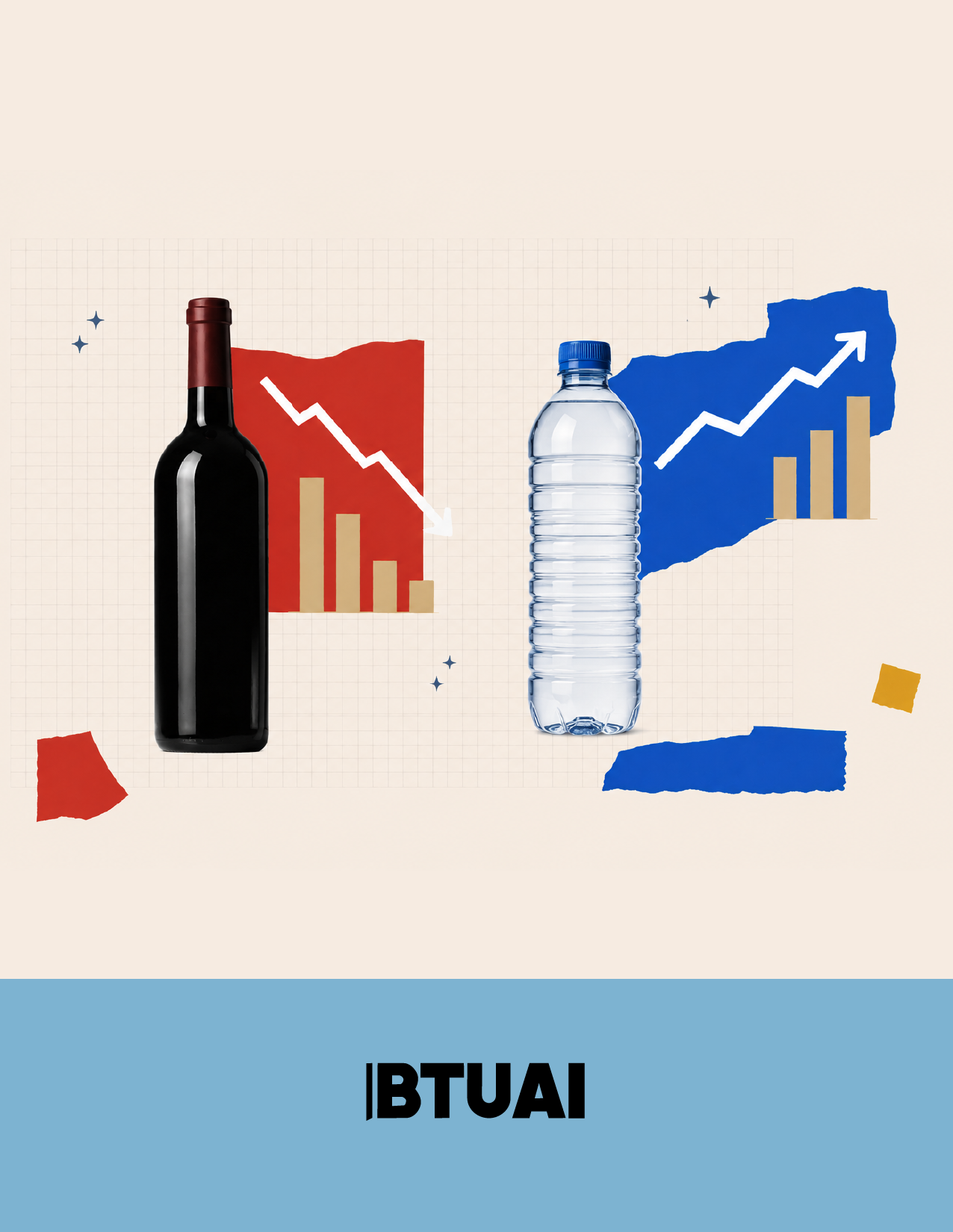
In the first half of 2026, total wine exports fell by 3.7% year on year to USD 117.2 million, while domestic wine exports declined by 4.8% to USD 115.2 million. At the same time, the two water commodity groups increased by a combined 17.5% in total exports to USD 200.7 million; domestic exports rose by 17.4% to USD 199.9 million. Water is not replacing wine in cultural value or unit economics. The data instead reveal two different export models: wine built on origin and identity, and water built on scale, distribution and repeat consumption.
One National Symbol Slowed, While an Everyday Product Accelerated
Georgian wine is one of the country’s most recognisable export products, connecting agriculture, tourism, culture and national identity. Water is a different business: less symbolic, but purchased more frequently and dependent on distribution, availability and logistics.
Geostat’s preliminary data show that total wine exports declined from USD 121.6 million to USD 117.2 million, while domestic wine exports fell from USD 121.0 million to USD 115.2 million. The small difference confirms that almost all wine exports are domestic in origin. Total exports of unsweetened mineral and fresh waters rose by 12% to USD 101.0 million, while domestic exports rose by 11.9% to USD 100.9 million. Total exports of sweetened mineral and aerated waters increased by 23.8% to USD 99.7 million; domestic exports increased by 23.6% to USD 99.0 million.
Combined Water Exports Are Now Much Larger Than Wine Exports
Together, the two water categories increased from USD 170.8 million to USD 200.7 million in total exports, a verified rise of 17.5%. Domestic exports of the same categories increased from USD 170.3 million to USD 199.9 million, or 17.4%.
In the first half of 2026, combined total water exports exceeded wine exports by USD 83.6 million. On a domestic-export basis, the gap was USD 84.7 million and the combined water total was about 1.7 times wine exports. The comparison requires caution: water combines two commodity groups, while wine is one group. It indicates export scale, not unit value or profitability.
Wine accounted for about 3.0% of Georgia’s total exports, while the two water categories together accounted for approximately 5.2%. Wine offers origin, cultural identity and premium-positioning potential; water is more dependent on volume, distribution, repeat purchase and logistics. The available data do not support a direct comparison of value added per unit or profit margins.
A Six-Month Decline Does Not Prove a Wine Crisis
A 3.7% annual decline is meaningful but does not establish a long-term crisis. Wine exports are seasonal and sensitive to shipment timing, distributor inventories, exchange rates and the performance of major markets.
Exports of wine to Russia fell from USD 72.8 million to USD 69.9 million, and Russia remains a major market. A modest decline there can materially affect the category total.
At the same time, diversification is visible. The National Wine Agency reports that Georgia exported about 784,000 litres of wine to Germany in the first half of 2026, 22% more than a year earlier. This is not enough to replace the scale of Russia, but it shows that growth in higher-income European markets is possible.
Why Water May Be Growing Faster
Water follows a different commercial model. It is immediately understandable to consumers, is purchased frequently and can be distributed through retail, hotels, restaurants and corporate channels. However, the direct contribution of these factors to the 2026 export increase has not been measured separately.
Unsweetened water benefits from health and natural-origin positioning. Sweetened mineral and aerated waters compete in the broader soft-drinks market, where flavour, packaging, price and distribution determine success.
Georgia’s advantage lies in natural resources and origin stories. Its weakness is transport economics: water is heavy and requires significant shipping volume per dollar of value. Success in distant markets therefore depends on strict control of packaging, logistics and channel economics.
An Illustrative Georgian Mini-Case: One Company, Two Export Models
Consider a Georgian company that produces wine and is also developing a premium water brand. Wine would need origin storytelling, specialised retail, restaurants and professional tastings. Water would depend on repeat orders, hotel and retail coverage, supply reliability and packaging efficiency.
Managing both products with the same export model would waste opportunity. Wine requires value explanation; water requires constant availability. Export strategy should begin with the economics of the product, not only the destination country.
What Georgian Businesses Should Notice
For wine producers, the objective is not simply to recover the lost 3.7%. The deeper task is to balance markets, raise value per litre and build repeat demand in markets where Georgian wine remains small but growing.
For water producers, rapid expansion also creates risks. Growth requires sustainable source management, consistent quality, packaging efficiency, production capacity and control over distributors. Revenue can rise faster than profit if logistics and promotional costs increase.
Policy support should also distinguish between the categories. Wine needs premium positioning and cultural marketing; water needs retail partnerships, logistics support and market-access execution.
BTU Researchers’ Assessment
According to BTU researchers, the first-half data reveal two different export business models. Wine carries Georgia’s identity and high-value potential but is more exposed to market concentration and demand volatility. Water is growing in a mass, repeat-consumption market, but its competitiveness depends heavily on logistics, packaging and distribution. Georgia should not choose one over the other; it should strengthen each through a distinct strategy.
Key Findings
- Total wine exports fell by 3.7% to USD 117.2 million in the first half of 2026; domestic wine exports fell by 4.8% to USD 115.2 million.
- Unsweetened water exports increased by 12%, while sweetened mineral and aerated waters grew by 23.8%.
- Combined total exports of the two water categories rose by 17.5% to USD 200.7 million; domestic exports rose by 17.4% to USD 199.9 million.
- Combined water exports exceeded wine exports by USD 83.6 million, although the comparison combines two water categories against one wine category.
- The decline in wine was partly linked to a lower result in Russia, while wine volume exported to Germany increased by 22%.
- Wine and water require different export capabilities: premium storytelling for wine, and scale, logistics and distribution for water.
- Georgia’s opportunity is to diversify its beverage exports simultaneously by product, market and business model.
Why This Matters for Georgia
Wine and water connect regional agriculture, manufacturing, packaging, logistics and tourism. A decline in wine affects growers and wineries; water growth creates opportunities for production and distribution. The contrasting results show why export policy should be tailored to product economics rather than applying one model to all agri-food goods.
Conclusion
Georgian wine lost some ground in the first half of 2026, while water exports continued to expand. This is not a story of water replacing wine. It is a sign that Georgia’s beverage exports contain two different growth paths: a high-value product built on history and origin, and a mass-market product built on repeat consumption.
Without change, wine may remain dependent on a few large markets and water growth may become low-margin volume. With the right strategy, wine can grow in value and market diversity, while water can improve scale and brand strength. Sustainable success will be measured not only in export dollars, but in markets, companies and value created per unit.
Data and Main Sources
- National Statistics Office of Georgia – External Merchandise Trade, January–June 2026.
- National Statistics Office of Georgia – Domestic Exports, January–June 2026.
- National Wine Agency of Georgia – Georgian wine exports to Germany, January–June 2026.
- National Wine Agency of Georgia – Georgian wine export figures to European countries, 2025.
This material is analytical and educational in nature. It does not constitute financial, investment, tax or legal advice. Professional advice should be obtained before making a specific decision.
Prepared by the academic team of Business and Technology University and the BTUAI Research Team, Tbilisi, Georgia.