


Key Takeaway
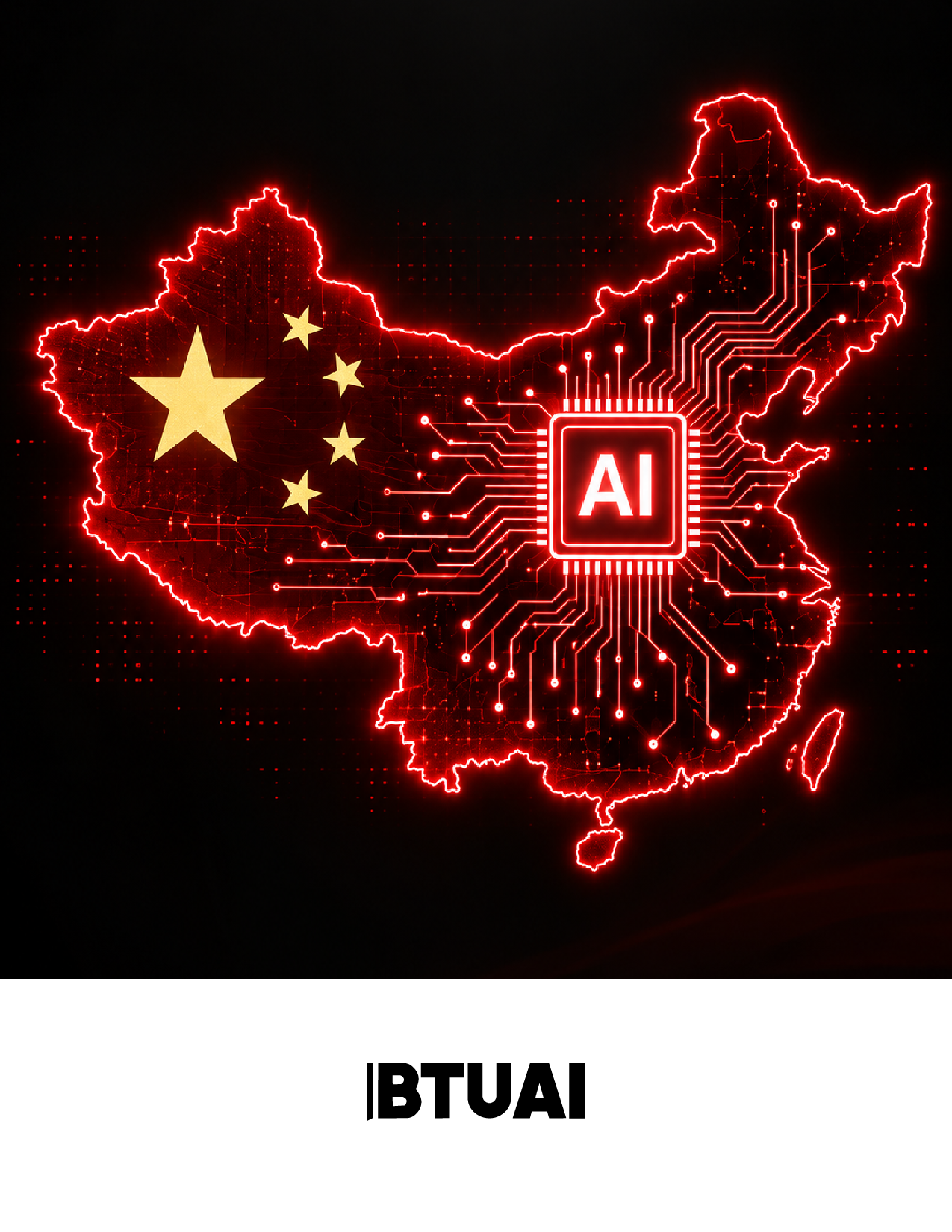
A September 15, 2026 Wall Street Journal report shows how artificial intelligence is increasingly framed in China as a core arena of technological competition with the United States. Beijing is simultaneously trying to strengthen domestic models, expand computing infrastructure, support open-source ecosystems and reduce dependence on foreign technology. Yet China is not ignoring safety: its official policy architecture is also developing AI risk and governance frameworks. For Georgia, the key lesson is that global AI competition is no longer determined by model quality alone. Chips, energy, data, talent, open-source ecosystems and technological standards are becoming equally important.
AI Has Become an Area of Geoeconomic Competition
The global AI race has moved beyond normal competition among technology companies. The United States and China are trying to shape entire ecosystems in which their chips, cloud infrastructure, software platforms, security standards and governance practices become global reference points. The Wall Street Journal describes Beijing’s view in these terms: AI is increasingly treated as a core engine of technological change and a key battleground in rivalry with the United States.
The two sides enter this competition with different strengths. The United States benefits from a concentration of leading private AI labs, advanced chip design, hyperscale cloud computing and deep venture-capital markets. China brings a huge domestic market, state coordination, manufacturing depth, fast infrastructure buildout and a growing effort to expand the international reach of open-source models. As a result, asking who is “winning” the AI race is becoming less about one benchmark and more about the competitiveness of an entire technology system.
China’s Response: Scale, Self-Reliance and Open Ecosystems
In July 2026, China’s National Development and Reform Commission and other agencies released an Artificial Intelligence Cooperation and Development Action Plan. It covers eight areas, including high-quality data, computing power, open-source ecosystems, industrial adoption, digital talent, rules and standards, governance, safety and ethics. The document also calls for broader access to intelligent computing services and international cooperation on AI infrastructure.
This matters because China’s objective is no longer simply to narrow a model-performance gap with American companies. It is also trying to build an ecosystem in which Chinese models, open-source tools and infrastructure offerings become viable choices for other countries. If that strategy scales, geopolitical competition in AI will increasingly become a contest over software ecosystems, data rules and technical standards.
China’s broader “AI+” agenda reinforces this approach by promoting adoption across industry, education and government. AI is therefore being treated not as a standalone software product, but as horizontal infrastructure for productivity, industrial upgrading and state capacity.
Advanced Chips Remain a Critical Constraint
Despite rapid progress, access to advanced semiconductors remains one of the hardest constraints for China. U.S. export-control policy has repeatedly limited access to high-performance chips and equipment needed to manufacture them. In January 2026, the U.S. Department of Commerce revised its licensing policy to allow case-by-case review for exports of Nvidia H200, AMD MI325X and similar chips to approved Chinese customers under specified security requirements. This was not full liberalization; it showed instead that export controls are being recalibrated as technology, national-security concerns and commercial incentives evolve.
China therefore faces a dual task: maximize the value of technology that remains accessible while building domestic alternatives in semiconductors, software and computing systems. At that point, AI competition becomes industrial policy as much as software innovation.
The United States Is Also Competing With a Full Stack
U.S. policy is moving in the same direction. The White House’s 2025 America’s AI Action Plan is organized around accelerating innovation, building American AI infrastructure and leading in international diplomacy and security. It explicitly promotes the export of full-stack American AI packages, including hardware, models, software, applications and standards. A June 2026 national-security directive further accelerated adoption of advanced AI across the U.S. national-security enterprise while calling for next-generation secure computing infrastructure.
This produces a notable convergence: neither Washington nor Beijing now treats AI as a software category alone. Both are constructing industrial, energy, security, education and diplomatic policies around the same technology competition.
Safety Is Also Part of China’s Strategy
An important nuance in the Wall Street Journal report is that China has not abandoned the safety question; rather, competitive urgency often receives greater emphasis. Official policy supports that more complex picture. China’s AI Safety Governance Framework 2.0 addresses risks associated with models and algorithms, data, systems, malicious use and potentially catastrophic outcomes. The more accurate contrast, therefore, is not “America worries about safety while China only worries about speed.” Both countries are trying to balance innovation and risk, but competitive pressure shapes the balance differently.
Why This Matters for Georgia
For Georgia, the most important implication is not that a small economy should try to join a frontier-model arms race. A more realistic strategy is to preserve technological choice, strengthen domestic capacity and manage critical dependencies. That means access to cloud services, secure data governance, Georgian-language resources, AI skills in universities and firms, reliable energy and diversified international technology partnerships.
Georgia’s information and communication sector already provides a meaningful base. According to Georgia’s National Statistics Office, Geostat, sector turnover reached GEL 2.3 billion in the second quarter of 2026, employment was about 53,000, and average monthly remuneration was GEL 4,463.9. According to calculations by BTU researchers, compared with the second quarter of 2025, turnover rose by about 4.5%, employment by 6.4% and average remuneration by 5.2%. These data do not measure the AI market specifically, but they do indicate the broader digital-sector capacity on which AI adoption and export-oriented services can build.
Geostat also reported 22,288 active entities in information and communication as of July 1, 2026. Again, these are not all AI companies. The figure should not be interpreted as the size of Georgia’s AI industry. It does, however, show that digital services are supported by a relatively broad business base rather than only a handful of large firms.
Georgia’s Opportunity Is Flexibility, Not Scale
According to an assessment by BTU researchers, Georgia’s most realistic AI opportunities lie in three areas. First is rapid adoption: smaller firms and institutions can experiment with international and open-source tools without carrying the fixed costs of building frontier models. Second is Georgian-language and local-data capability, an area where global providers naturally face weaker commercial incentives and local universities and firms can create differentiated value. Third is regional digital services: if Georgia strengthens cybersecurity, data governance, skills and energy reliability, it can position itself as a service platform for the Caucasus and neighboring markets.
The main risk is technological fragmentation. If the United States and China develop increasingly separate ecosystems for chips, cloud services, models and data rules, smaller countries may face more difficult choices over compatibility, security and long-term partnerships. Georgia’s technology policy should therefore not be reduced to deciding which AI model to use. More important questions concern data portability, critical-infrastructure security, multi-platform interoperability and whether education can supply the skills required by rapidly changing systems.
What Decision-Makers Should Consider
For Georgian companies, a practical priority is technological flexibility: cloud and AI architectures that can work across providers rather than creating irreversible dependence on a single platform. For government procurement, security, data location, standards compatibility and long-term vendor risk should receive greater weight. Universities need to teach not only how to use AI, but also model evaluation, data engineering, cybersecurity, the economics of compute and semiconductors, and technology policy.
Conclusion
China is indeed accelerating the AI race, but the real story is broader than closing a technical gap with American models. Beijing is trying to build a complete ecosystem – from data and computing power to open-source platforms, industrial deployment and international standards. The United States is responding with its own full-stack infrastructure and international deployment strategy. AI in 2026 is therefore becoming an instrument of economic influence and geopolitical positioning as well as technological innovation. For Georgia, this is an important signal, but not an argument for blindly choosing one bloc. The national interest lies in diversified access, stronger domestic capabilities and infrastructure that preserves room for choice as global AI competition intensifies.
Data and Main Sources
- The Wall Street Journal, “China’s Main AI Focus Is on U.S. Rivalry”, September 15, 2026, p. A5 – user-provided PDF.
- The White House, “America’s AI Action Plan”, July 23, 2025.
- U.S. Bureau of Industry and Security, semiconductor export licensing policy for China, January 13, 2026.
- National Development and Reform Commission of China, Artificial Intelligence Cooperation and Development Action Plan, July 17, 2026.
- Cyberspace Administration of China, AI Safety Governance Framework 2.0, September 15, 2025.
- Georgia’s National Statistics Office, Geostat – Information and Communication sector statistics, 2025 Q2–2026 Q2; active entities as of July 1, 2026.
Prepared by the academic team of Business and Technology University and the BTUAI Research Team, Tbilisi, Georgia.