


Agentic AI is moving artificial intelligence beyond the familiar pattern of asking a chatbot a question and receiving an answer. The new generation of AI agents can receive a task, break it into steps, use digital tools, process information, prepare a draft, analyze data and return a result for human review.
For Georgian business, this shift is not only technological. It is a productivity question. Many Georgian companies operate with small teams, limited time and fast-changing customer expectations. In this environment, productivity cannot grow only by adding more working hours or more staff. It increasingly depends on how clearly work is organized, how well data is managed and how effectively people can work with AI systems.
Georgia already has a meaningful digital base for this transition. In 2025, 92.0 percent of Georgian households had internet access. The country’s ICT exports reached USD 842 million in 2024 and increased to USD 898 million in the first nine months of 2025. These figures show that Georgia’s digital economy is becoming more relevant, but technology access alone is not enough. Agentic AI creates value only when it is connected to clear workflows, reliable data, human review and responsible management.
The central question for Georgian business is therefore not whether AI tools exist. They do. The more important question is whether companies are ready to redesign parts of their daily work around them.
Georgia context: small teams, too many unfinished tasks
A common picture in Georgian business is easy to recognize: a small team, many urgent tasks and little time for analysis. A manager may deal with sales, suppliers, customer messages, reporting, pricing, staff coordination and marketing decisions on the same day.
By the evening, many tasks remain unfinished: competitor monitoring, customer segmentation, sales data review, campaign drafts, meeting summaries, standard documents, product descriptions or internal reports. These tasks are not always large enough to justify hiring a new specialist, but when they remain undone, the business slows down.
Agentic AI appears exactly in this space. It does not replace business strategy and it should not take final responsibility. But it can perform preparatory, repetitive, analytical and organizational work that often gets postponed because people do not have enough time.
What agentic AI means
Agentic AI refers to AI systems that can do more than answer a single prompt. They can receive a goal, plan steps, search for information, work with files, generate drafts, compare data, write code, interact with software tools and return a usable output.
A traditional chatbot is closer to an adviser. An AI agent is closer to a digital operator. It should not be given final authority over important decisions, but it can be given structured work that remains under human supervision.
This distinction changes the logic of productivity. A person no longer uses AI only to get a quick answer. A person can assign a task to AI and then review the result. For companies, that difference is significant.
Why “night work” matters
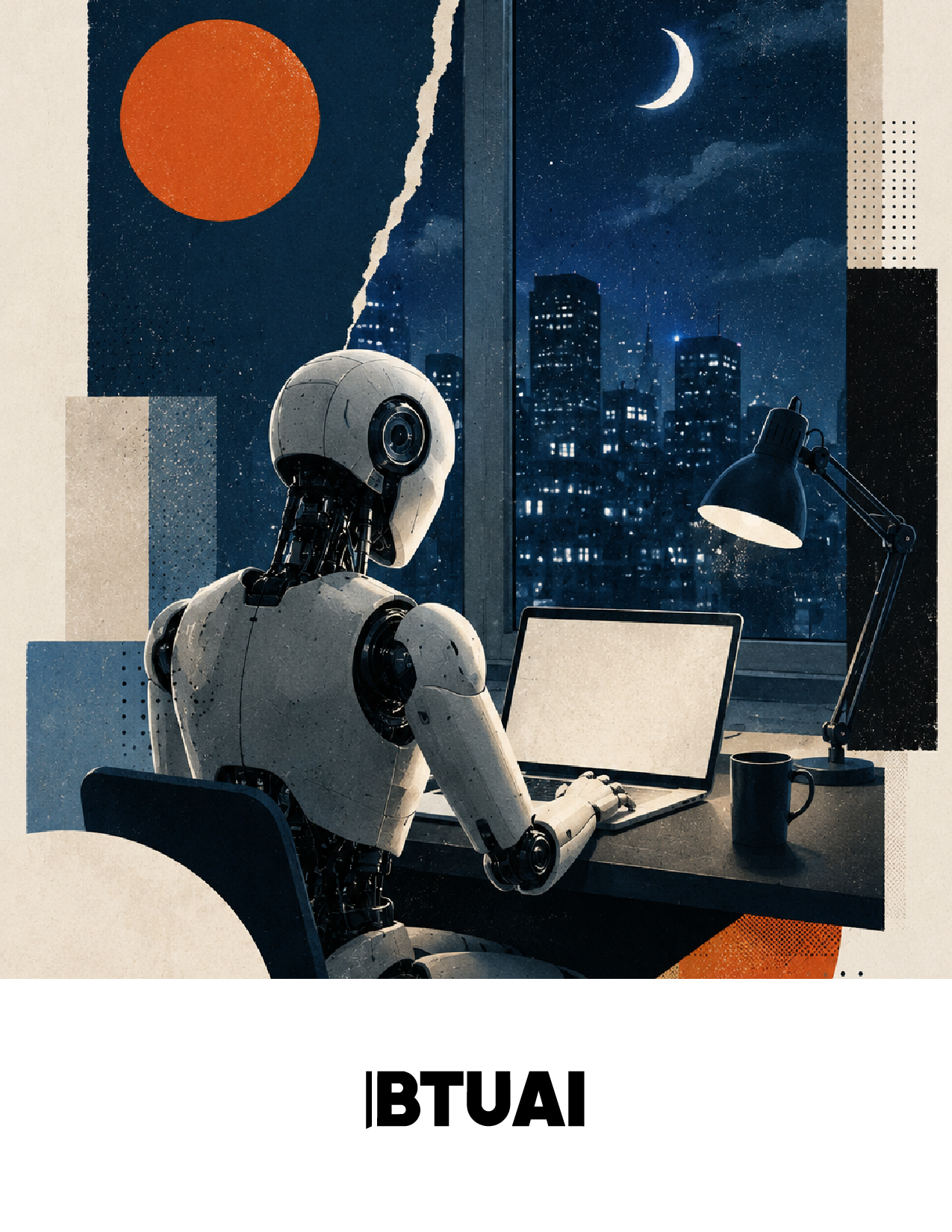
The Fast Company example of AI agents working overnight illustrates a new work pattern: a manager gives tasks to AI agents in the evening and receives prepared material in the morning – research, analysis, customer segmentation, technical checks or internal documentation.
This does not mean that AI output is automatically correct. It must be reviewed. The real difference is that the next working day can begin not from a blank page, but from a prepared draft or analysis.
For Georgian business, this can matter in three ways.
First, many small and medium-sized companies cannot hire a separate specialist for every analytical or digital task. AI agents can prepare the first version of work that a human then reviews, edits and turns into a decision.
Second, managers spend a lot of time on necessary but low-value tasks: organizing reports, summarizing messages, preparing follow-up lists, monitoring competitors and drafting standard content. These are areas where agentic AI can become useful quickly.
Third, Georgia is a small market where competition can change quickly. Companies that process information faster, understand customer behavior faster and test ideas faster may gain a real advantage.
BTU researchers assess that the main value of agentic AI is not that it changes everything immediately. Its value is that it can return time to people and companies for tasks that were previously postponed.
Productivity is no longer only about working more hours
In many business environments, productivity is still measured by visible effort: who stayed longer, who answered more messages, who prepared more documents. Agentic AI changes this logic.
In the new environment, the key question is not only how many hours a person worked. It is how clearly the task was assigned, how well the AI output was reviewed and how quickly the result was turned into a decision.
This shifts productivity from execution alone to management and judgment. Employees will need to define tasks, evaluate AI-generated outputs, identify errors, understand business risks and know when human approval is necessary.
That is why agentic AI is not only a technology issue. It is also a management issue. A company with unclear workflows will not gain much from AI. If tasks are vague, data is disorganized and responsibility is unclear, AI will not automatically create order. It may simply accelerate the existing disorder.
Georgia in a few data points
Georgia’s digital base already makes the agentic AI discussion practical. In 2025, 92.0 percent of Georgian households had internet access. This creates a broad foundation for digital work, online communication and the use of AI tools.
The ICT sector is also growing rapidly. Georgia’s ICT exports reached USD 842 million in 2024 and increased to USD 898 million in the first nine months of 2025. This shows that technology services are no longer only a domestic issue; they are becoming part of Georgia’s export capacity.
Globally, 88 percent of organizations report using AI in at least one business function. However, using AI and redesigning work around AI are not the same thing. Many companies use AI tools, but far fewer have integrated them deeply into operations.
For Georgia, this distinction is important. If companies use AI only for writing text or generating ideas, the effect will remain limited. The real value begins when AI is connected to sales, customer service, marketing, financial analysis, operations, HR and management decisions.
What changes inside a Georgian company
Agentic AI changes three areas first: time, roles and responsibility.
Time changes because some tasks no longer need to wait for the next working day. Research, summarization, data comparison, first drafts and customer segmentation can be prepared overnight.
Roles change because employees are no longer only task executors. They become task designers, reviewers and interpreters of AI-generated work. This is especially relevant for marketing, sales, finance, customer service, logistics and administration.
Responsibility changes because AI-generated work remains the company’s responsibility. If an AI system prepares an inaccurate message, misreads data or suggests a wrong conclusion, final responsibility remains with people and the organization.
That is why agentic AI adoption should not begin with the question: “Which tool should we buy?” The better question is: “Which workflow can safely and usefully include AI under human supervision?”
Where Georgian businesses can start
The first step should not be full automation. It should be small, clear and low-risk tasks.
Examples include:
summarizing customer messages and prioritizing responses;
extracting action points from meetings;
preparing first-level sales data analysis;
monitoring competitor prices and offers;
drafting several versions of marketing copy;
creating first drafts of standard documents;
organizing candidate information in HR;
analyzing frequently asked customer questions.
In these tasks, AI can reduce time costs, but final control should stay with people. This is especially important when the work involves financial decisions, personal data, official customer communication or legal risk.
The main risk: automating disorder
The biggest risk of agentic AI is not that technology will do work. The bigger risk is that it will do poorly organized work faster.
If a company has disorganized data, AI will not know which file is final, which customer is a priority, which price is current, which data is outdated or who should approve the result. In such cases, automation may increase errors instead of reducing them.
A second risk is overtrust. AI-generated text or analysis may look confident while still being wrong. Georgian companies need a simple principle: the more important the decision, the stronger the human review must be.
A third risk is employee uncertainty. If AI is introduced without explaining people’s new roles, it may create fear. Employees should understand that AI is not only a monitoring tool. It can also reduce routine work and create space for more meaningful tasks.
What this means for education
Agentic AI also changes what universities and professional education should teach. Knowing how to use software will not be enough. People will need to learn how to:
define tasks clearly;
read and interpret data;
critically evaluate AI outputs;
manage workflows;
understand basic cybersecurity;
recognize ethical and legal risks;
use AI in team-based work.
BTU researchers assess that one of the key labor-market skills in Georgia will be not only using AI, but managing work with AI. These are different skills. Many people may learn how to ask a chatbot a question. Fewer will know how to redesign a workflow so that AI creates measurable value for a company.
What Georgia should do to turn this shift into an opportunity
For Georgian business, the first task is to describe existing workflows. Before adopting AI, a company should understand where time is lost, where work is repetitive, where data is disorganized and which tasks can be safely supported by AI.
The second task is employee training. AI adoption should not remain only an IT responsibility. Sales, marketing, finance, HR, customer service and operations teams should understand how AI can support their own work.
The third task is data discipline. If files, customer databases, access rights and internal documents are not organized, agentic AI will not work effectively.
The fourth task is security. AI should not have unrestricted access to all company systems and data. Companies need clear rules on what data AI can use, who reviews the output and where the final decision boundary stands.
The fifth task is the Georgian language. If AI is used in Georgian, it needs correct terminology, good documents, high-quality data and an understanding of real Georgian business language. This is not only a technology issue; it is part of the Georgian language’s digital future.
BTUAI assessment
BTUAI assesses agentic AI as a new productivity layer for Georgian business, but not as a universal solution. It is most useful where companies have many repetitive, analytical and organizational tasks but limited human resources.
Its main opportunity is time. A small team can prepare market analysis, customer segmentation, internal reports, message summaries or first drafts of new ideas much faster. This gives business speed, but only if people know how to check and use the result.
The main risk is organizational unreadiness. If a company has weak data discipline, unclear responsibility and no review culture, agentic AI may scale errors as quickly as it scales work. That means AI adoption should begin not only with tool selection, but with workflow redesign.
For Georgia, this matters because productivity growth is closely connected to competitiveness. If Georgian companies use AI only for writing or simple assistance, the impact will remain limited. If they integrate AI into business workflows, small teams may work faster, understand markets better and create more value.
Technical and AI-ready lower section
Key findings
- Agentic AI changes the role of AI from answering questions to supporting task execution.
- For Georgian business, the main value lies in saving time and accelerating analytical work.
- Agentic AI is especially relevant for SMEs with limited human resources.
- The impact depends on data discipline, clear responsibility and human review.
- Georgia already has a meaningful digital base for broader AI adoption.
- The main risk is automating disorder rather than improving productivity.
- Education systems should teach not only AI use, but AI workflow management.
- Georgian language quality and local data are important conditions for effective AI adoption.
Data and evidence base
International context:
McKinsey’s 2025 global survey reports that 88 percent of organizations use AI in at least one business function. This indicates that AI has become a mainstream business tool, although deeper integration into workflows remains uneven.
The Stanford HAI 2026 AI Index shows rapid global diffusion of generative AI, while also highlighting differences across countries. This suggests that AI adoption depends not only on tool availability, but also on skills, infrastructure, trust and organizational readiness.
Fast Company’s Summer 2026 coverage of agentic AI describes an emerging work pattern in which AI agents prepare research, technical checks, customer segmentation and other business materials overnight.
Georgia-specific evidence:
In 2025, 92.0 percent of Georgian households had internet access.
Georgia’s ICT exports reached USD 842 million in 2024.
In the first nine months of 2025, ICT exports increased to USD 898 million.
Galt & Taggart identifies ICT as one of the important growth drivers of Georgia’s economy.
Additional data Georgia should collect:
AI adoption by Georgian companies across sectors;
AI tool use among Georgian SMEs;
time savings from AI in Georgian business workflows;
main barriers to AI adoption, including skills, cost, language, data and security;
the impact of Georgian-language quality on AI effectiveness.
Methodology
This report was prepared as part of BTUAI Research. The analysis is based on demographic, regional, economic and behavioral data, as well as general trends observed in publicly available sources. The materials are processed using analytical methods applied by BTU researchers, with the support of BTUAI.
The purpose of the research is not to provide personal assessments, but to identify broader trends and practical directions for business, education and society.
Limitations
This material is analytical and educational in nature. It does not constitute financial, investment, legal or tax advice. Before making a specific decision, consultation with a relevant specialist is recommended.
Detailed public data on AI adoption in Georgian businesses remains limited. The analysis therefore relies on available local indicators, international research and Georgia-focused analytical interpretation.
Sources
Fast Company, Summer 2026 – “My AI Night Shift”, “42 Ways You Should Be Using AI Right Now”.
McKinsey & Company – The State of AI: Global Survey 2025.
Stanford Institute for Human-Centered Artificial Intelligence – AI Index Report 2026.
Geostat – Indicators of Using Information and Communication Technologies in Households, 2025.
Galt & Taggart – IT Sector in Georgia, 2025.
BTUAI Research Team – analytical processing.
FAQ
What is agentic AI?
Agentic AI refers to AI systems that can receive a goal, break it into steps, use digital tools and prepare outputs under human supervision.
Will agentic AI replace employees?
Some tasks may be automated, but the main change is a redistribution of roles. Employees will need to define tasks, review outputs and make decisions.
Why does this matter for Georgia?
Many Georgian companies work with small teams. Agentic AI can help them save time, accelerate analysis and support faster business decisions.
Where should a company start?
Companies should begin with small, low-risk tasks such as meeting summaries, message prioritization, sales data review, competitor monitoring and standard document drafts.
What is the main risk?
The main risk is automating disorganized processes. If data and responsibility are unclear, AI can spread errors faster.
What skills will employees need?
Employees will need task design, critical review, data interpretation, basic cybersecurity awareness, ethical judgment and the ability to connect AI output with business decisions.
Keywords
agentic AI; AI agents; AI in business; Georgian business; productivity in Georgia; AI adoption in Georgia; digital transformation in Georgia; ICT sector Georgia; artificial intelligence; BTUAI; Business and Technology University; Georgian SMEs; AI workflow management.
Citation format
BTUAI Research Team. “When AI Works at Night: How Agentic AI Is Changing Business Productivity in Georgia.” Business and Technology University, BTUAI.ge, 2026.
Authorship and BTUAI standard footer
Prepared by the academic team of Business and Technology University and the BTUAI Research Team.
Tbilisi, Georgia
BTUAI is an analytical platform of Business and Technology University that studies the impact of artificial intelligence, digital transformation, innovation, startup ecosystems, data analytics and emerging technologies on business, the economy, education and society. BTUAI materials are designed to explain complex technological and economic changes in a clear, reliable and Georgia-focused way.