


Executive summary
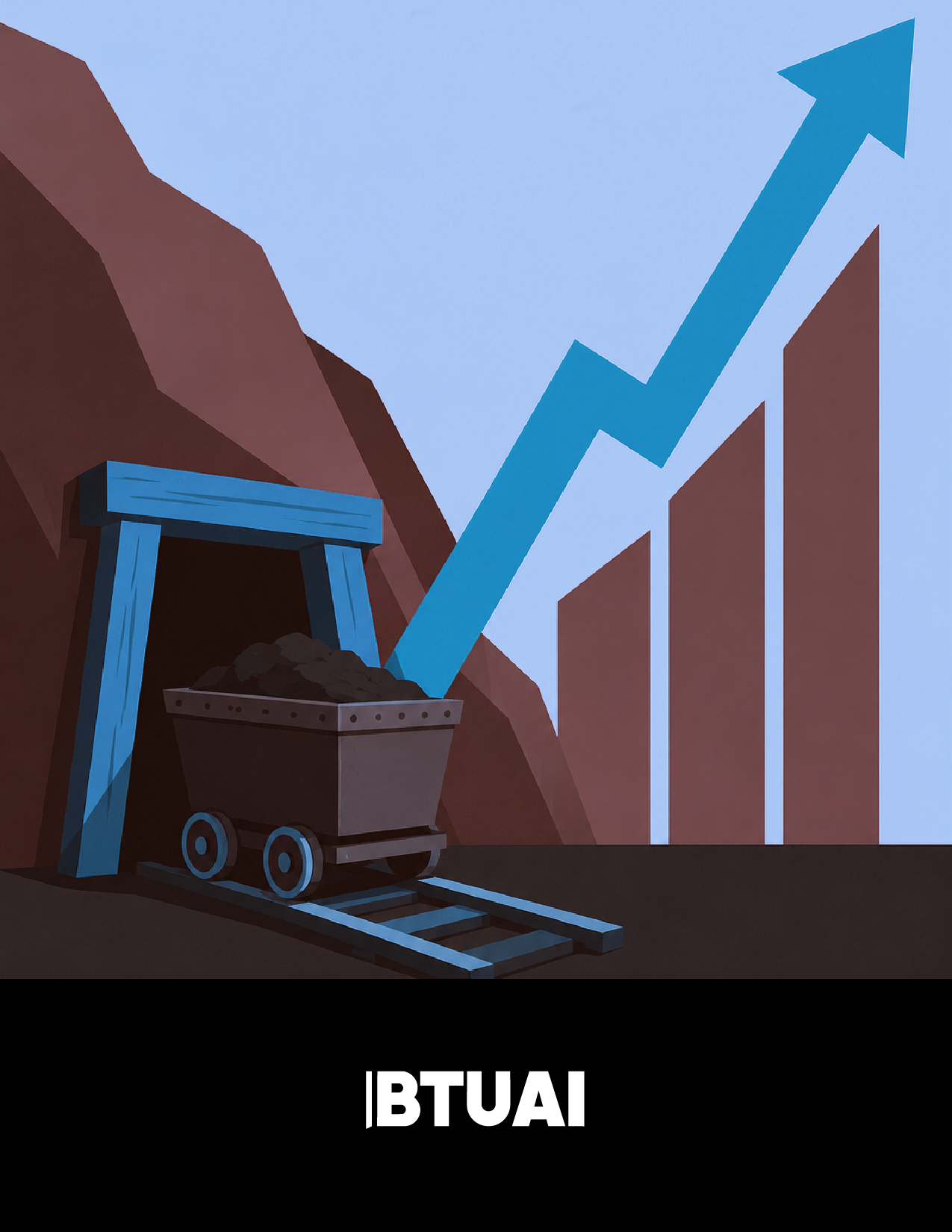
One of the most striking changes in Georgia’s first-quarter 2026 business sector data is the sharp rise in mining and quarrying. The sector’s turnover increased from GEL 379.3 million to GEL 758.0 million. The growth index was 199.8%, meaning the sector’s turnover in Q1 2026 was 199.8% of the Q1 2025 level – in effect, a near doubling. Output also increased significantly – from GEL 444.4 million to GEL 652.6 million, with a growth rate of 146.8%.
At first glance, this is a strong economic signal: the sector is selling more, producing more and becoming more visible in the overall business picture. But such sharp growth is not always interpreted in the same way. We need to distinguish whether we are seeing real production expansion, a price effect, stronger demand for a particular raw material, a one-off large transaction, a low-base effect or deeper sectoral strengthening.
BTU researchers assess that the near doubling of turnover in mining and quarrying is an important signal, but its economic meaning should be interpreted carefully. A sharp rise in one sector can improve the overall business picture, but it does not automatically mean that the entire economy is deepening or becoming more productive.
The key question is this: is this growth the beginning of a new sustainable trend, or is it a pronounced one-quarter effect that temporarily improves the overall economic picture?
when one sector changes the whole picture
When reading economic data, attention often goes to aggregate growth: how much turnover, output, employment or investment increased. But behind the aggregate number, there may be very different stories.
Sometimes the economy grows broadly – many sectors strengthen at the same time, jobs increase, production expands and productivity improves.
Sometimes the overall picture is lifted by one or two sectors. In such cases, growth appears in aggregate indicators, but development inside the economy is uneven.
The mining and quarrying case requires precisely this type of analysis. When a sector’s turnover almost doubles, it is certainly important. But for economic interpretation, it is not enough to say that “the sector grew.” We need to ask: why did it grow, how sustainable is the growth, how many jobs did it create, how much value remained in the local economy, and how much can this growth strengthen the economy in the long term?
What happened in the first quarter of 2026
In the first quarter of 2026, turnover in mining and quarrying reached GEL 758.0 million. In the first quarter of 2025, the figure was GEL 379.3 million. The growth rate was 199.8%, meaning that the sector’s turnover volume almost doubled compared with the same period of the previous year.
Output also increased significantly. In the first quarter of 2025, sector output was GEL 444.4 million, while in the first quarter of 2026 it reached GEL 652.6 million. The growth rate was 146.8%, meaning that output increased by about 46.8%.
Turnover growth was much higher than output growth. This difference is important. Turnover reflects sales and monetary flows, while output is more closely connected to created product and economic value. If turnover grows much faster than output, additional questions are needed: is the growth connected to real volume, price effects, the sales structure, or changes in the value of specific resources?
Why such growth may be a signal
The sharp rise in mining and quarrying may point to several positive processes.
First, demand may have increased for a particular mineral resource, raw material or quarry product. If demand is strong, companies sell more and the sector’s turnover rises quickly.
Second, productive activity may have increased. The 46.8% growth in output shows that turnover growth is not only a monetary change; the amount of product created in the sector also increased.
Third, the sector may have seen new contracts, new supply chains or higher-value sales. Such changes can produce strong growth within a single quarter.
Fourth, mining and quarrying are often connected to infrastructure, construction, energy, exports and industrial materials. If growth in the sector is connected to these areas, it may have wider economic effects.
For this reason, the data deserves attention: the sector clearly became more active and its role in the business picture increased.
Why it may also be an exception
At the same time, the sharp rise in mining and quarrying may not indicate long-term structural transformation.
The first possible explanation is a low-base effect. If turnover in the first quarter of the previous year was relatively low, the following year’s increase can look very large in percentage terms. In such cases, the growth rate is impressive, but part of it is a statistical effect.
The second explanation is a price effect. Changes in commodity or resource prices may increase turnover rapidly even if real volume grows less strongly.
The third explanation is a one-off transaction or contract. In some sectors, a single large sale, export or supply agreement can strongly affect quarterly data.
The fourth explanation is cyclicality. Mining and quarrying often depend on external prices, demand, projects, licenses, infrastructure cycles and regulation. Therefore, one quarter of growth does not automatically mean that the trend will continue.
This is why the question “signal or exception?” is essential. At this stage, the answer should be cautious: the data is a strong signal, but its sustainability requires observation over the next quarters.
Turnover and output – why the difference matters
In mining and quarrying, turnover almost doubled, while output increased by 46.8%. Both indicators are positive, but the difference between them is analytically important.
If output increases, it means the sector is creating more product or more economic value. If turnover grows even faster, there may be a price effect, higher sales value or a change in product structure.
This is why economic analysis should ask not only “how much did it grow,” but also “what exactly grew.” Did physical volume increase? Did prices increase? Did sales value increase? Did value added increase? Did employment increase? Did exports increase? Did local supplier involvement increase?
Without answers to these questions, a sharp rise in one sector can be interpreted too optimistically.
How one sector can improve the overall picture
In an economy, a large percentage increase does not always mean that the whole system strengthened evenly. If one small or medium-sized sector grows very quickly, it can create a positive effect in aggregate business sector indicators.
For example, when mining and quarrying turnover almost doubles, it also increases total business sector turnover. But if other sectors grow more slowly, or if growth is concentrated in a few directions, the aggregate picture may look stronger than the broader economic structure really is.
This is why economic growth should be assessed not only through aggregate indicators, but also through sectoral distribution. A strong economy is not one in which one sector suddenly rises. A strong economy is one where growth spreads across manufacturing, technology, services, regions, small and medium-sized businesses and quality jobs.
What this means for the real economy
Mining and quarrying are part of the real economy because they are connected to resource extraction, material supply, infrastructure, construction, exports and industrial chains. But their economic effect depends on how deeply they connect with the local economy.
If the sector is limited only to extraction of raw materials, its value added may remain limited. If extraction is followed by processing, logistics, technical services, local suppliers, environmental standards and export development, the sector’s impact becomes broader.
For Georgia, it is important that any growth in resource-based sectors turns not only into turnover, but into local value. This means more technology, more safety, more environmental control, more regional jobs and stronger links with other economic sectors.
Regional significance
Mining and quarrying activities are often naturally located outside the capital. For this reason, growth in the sector may also be important for the regions. If the sector creates employment, infrastructure demand, service businesses and local income in the regions, it can become one of the anchors of regional economies.
But regional impact is not automatic. If the sector operates as an isolated extraction activity, where the main value leaves the local economy and the region receives only a small part, its effect is limited.
For regions, it will be important that mining and quarrying growth connects with local services, transport, technical skills, environmental monitoring, vocational education and municipal economic development.
Environmental and social standards
Growth in mining and quarrying should always be assessed in the context of environmental and social responsibility. This sector differs from many other economic activities because it directly affects land, water, natural resources, local ecosystems and communities.
This means that rapid growth should not be assessed only through economic indicators. Attention should also be paid to:
environmental standards;
land rehabilitation;
water and air quality;
labor safety;
local community interests;
transparency;
licensing and permit control;
alignment with international best practice.
If the sector grows without environmental and social standards, short-term economic benefits may turn into long-term risks. If growth takes place under responsible standards, the sector can become part of economic development.
Where the opportunity is
For Georgia, growth in mining and quarrying can become an opportunity under several conditions.
First, if the sector connects with processing. Higher value is created not only through raw-material extraction, but when processing, quality control, packaging, logistics and export standards are added.
Second, if local suppliers play a larger role. The sector needs transport, equipment, services, engineering, safety, energy and technical support. This can become an opportunity for small and medium-sized businesses.
Third, if regional professional skills develop. Mining and quarrying require technical specialists, safety managers, environmental monitoring professionals and logistics talent.
Fourth, if the sector operates with high standards. Responsible extraction can become an example of balancing economic benefit with environmental control.
Fifth, if the sector does not remain isolated. Its growth should connect with industrial policy, manufacturing, exports and regional development.
Where the risks are
The main risk is that mining and quarrying growth becomes a one-off statistical effect rather than a long-term economic trend.
The second risk is dependence on prices. If growth is driven mainly by changes in resource prices, it can quickly move in the opposite direction.
The third risk is low value added. If the country only extracts raw materials and does not develop processing or local value chains, the economic effect will remain limited.
The fourth risk is environmental damage. Rapid expansion of mining and quarrying may create ecological and social problems if control and standards are weak.
The fifth risk is overly optimistic interpretation of the overall economic picture. A sharp rise in one sector can improve aggregate indicators, but it cannot resolve the economy’s broader structural challenges.
What Georgia should consider
To read this data correctly, several questions are necessary:
What caused the near doubling of turnover?
Did growth come from real volume or prices?
Is the growth linked to exports?
Did employment and wages increase in the sector?
How much value stayed in the local economy?
Were local suppliers involved?
Are environmental and social standards protected?
Will the trend continue in the next quarters?
These questions will help determine whether mining and quarrying growth is a real strategic signal or a one-quarter exception.
Why this matters for Georgia
This topic matters for Georgia because the quality of economic growth is not measured only by aggregate indicators. If a country receives growth mainly from one or a few cyclical sectors, the economy may look stronger than it really is.
Sustainable development requires growth that is broad, diversified and based on local value. Mining and quarrying can be part of this process, but should not become the only factor improving the economic picture.
Georgia’s main task is to turn resource-based growth into deeper economic value – processing, regional jobs, technological standards, safety, exports and environmentally responsible development.
BTUAI assessment
BTUAI assesses that the sharp growth of mining and quarrying in the first quarter of 2026 is an important but cautiously interpreted signal. The near doubling of turnover and 46.8% growth in output show that activity in the sector clearly increased. However, turnover growth was much stronger than output growth, which requires additional analysis to separate the effects of prices, sales structure, exports and one-off transactions.
BTU researchers assess that a sharp rise in one sector can improve the overall economic picture, but this should not be confused with broad-based strengthening of the entire economy. Sustainable growth requires activity to spread across sectors, regions and enterprise sizes.
The main conclusion is this: mining and quarrying growth may be an important economic signal, but its real meaning will become clear only if it continues and connects with local value, processing, regional development and high-standard management.
Key findings
- In the first quarter of 2026, turnover in mining and quarrying increased from GEL 379.3 million to GEL 758.0 million.
- The growth rate was 199.8%, meaning that turnover almost doubled.
- Output increased from GEL 444.4 million to GEL 652.6 million.
- The output growth rate was 146.8%, meaning that output increased by about 46.8%.
- Turnover growth far exceeded output growth, requiring further analysis of prices, sales structure or one-off factors.
- A sharp rise in one sector can improve the overall business picture, but does not automatically mean broad economic strengthening.
- The sector’s strategic importance depends on whether growth connects with processing, local suppliers, exports, regional development and environmental standards.
Data snapshot
Mining and quarrying turnover in the first quarter of 2025 – GEL 379.3 million.
Mining and quarrying turnover in the first quarter of 2026 – GEL 758.0 million.
Turnover growth rate – 199.8%.
Increase in turnover volume – approximately GEL 378.7 million.
Mining and quarrying output in the first quarter of 2025 – GEL 444.4 million.
Mining and quarrying output in the first quarter of 2026 – GEL 652.6 million.
Output growth rate – 146.8%.
Increase in output volume – approximately GEL 208.2 million.
Total business sector turnover in the first quarter of 2026 – GEL 62.0 billion.
Total business sector output in the first quarter of 2026 – GEL 23.3 billion.
Methodology
This report was prepared as part of BTUAI Research. The analysis is based on demographic, regional, economic and behavioral data, as well as general trends observed in publicly available sources. The materials are processed using analytical methods applied by BTU researchers, with the support of BTUAI.
The purpose of the research is not to provide personal assessments, but to identify broader trends and practical directions for business, education and society.
In this specific material, first-quarter 2026 enterprise activity data is analyzed in the context of mining and quarrying growth, sectoral effects, interpretation of the overall economic picture, regional development, local value and sustainability.
Limitations
This material is analytical and educational in nature. It does not constitute financial, investment, legal, tax, environmental or individual business decision-making advice. Before making specific decisions, consultation with a relevant specialist is required.
The data reflects one quarter and is not sufficient to determine a long-term trend. Sustainable conclusions require multi-quarter, sectoral, price-adjusted and export-related analysis.
The indicators are nominal and may include price effects. Additional statistical processing is required to assess real volume growth.
Sources
National Statistics Office of Georgia – “Results of Enterprise Activity, First Quarter of 2026.”
BTUAI analytical processing for assessing Georgia’s mining and quarrying sector, the quality of economic growth, sectoral concentration, local value and sustainability.
Frequently asked questions
Does a 199.8% growth rate mean the sector grew by 199.8%?
In the statistical table, 199.8% is a growth rate, meaning that turnover in the first quarter of 2026 was 199.8% of the first-quarter 2025 level. In other words, turnover almost doubled.
Why is output growth lower than turnover growth?
This may point to price effects, higher sales value, changes in product structure or one-off transactions. A final conclusion requires additional analysis.
Is this good news for the economy?
Yes, it is an important positive signal, but it should be assessed carefully. A sharp rise in one sector does not automatically mean that the whole economy is strengthening evenly.
Why can one sector improve the overall picture?
If one sector grows very rapidly, it positively affects aggregate business sector indicators. But growth in other sectors may be weaker, which is why sectoral analysis is necessary.
What should be the main task?
The main task is to turn mining and quarrying growth into local value – processing, regional employment, technological standards, exports and environmentally responsible development.
Keywords
mining Georgia; quarrying; Georgian economy; business sector; turnover; output; sectoral growth; economic signal; resource-based economy; regional development; local value; environmental standards; BTUAI; Business and Technology University; real economy; economic concentration.
Citation format
BTUAI Research Team. “Mining’s Sharp Growth in Georgia: Signal or Exception?” Business and Technology University, BTUAI.ge, 2026.
Prepared by the academic team of Business and Technology University and the BTUAI Research Team.
Tbilisi, Georgia
BTUAI is an analytical platform of Business and Technology University that studies the impact of artificial intelligence, digital transformation, innovation, startup ecosystems, data analytics and emerging technologies on business, the economy, education and society. BTUAI materials are designed to explain complex technological and economic changes in a clear, reliable and Georgia-focused way.